Photographing Hopetoun Falls
About Hopetoun Falls
Hopetoun Falls is one of the most photogenic waterfalls in the Great Otway National Park and one of the standout waterfall locations inland from the Great Ocean Road.
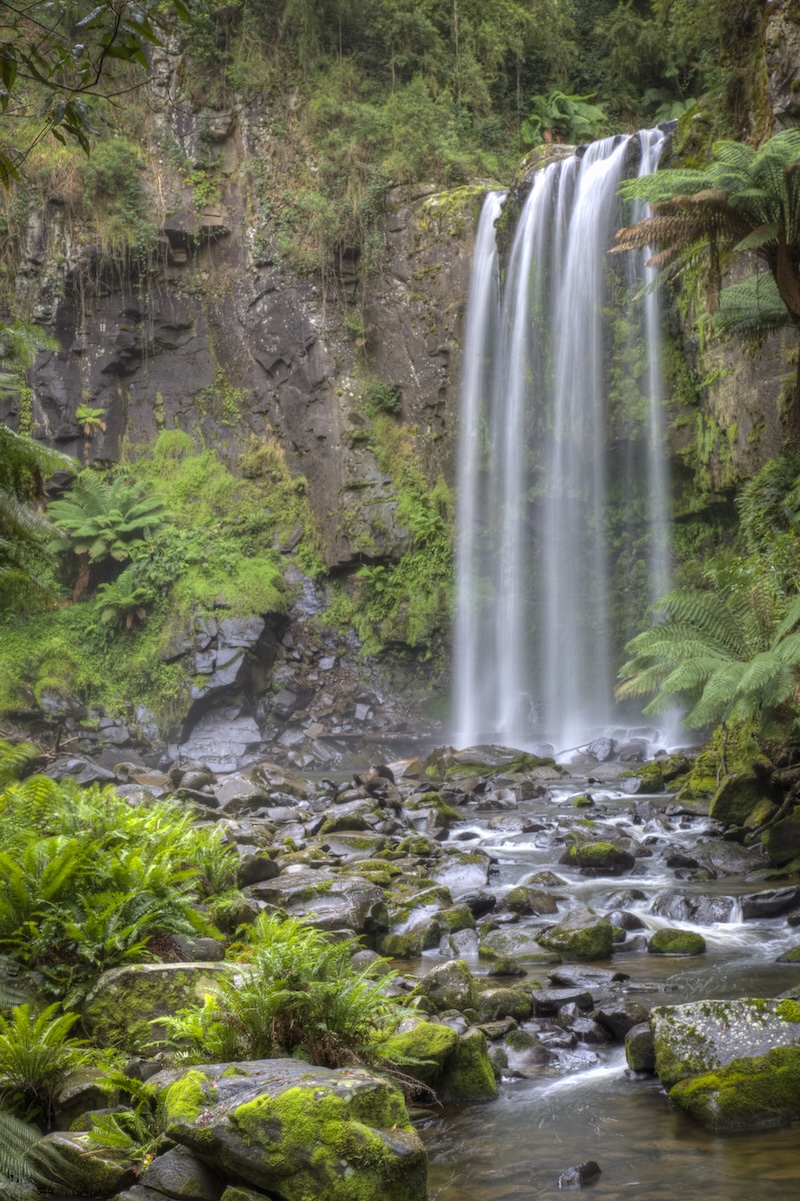
Located near Beech Forest, the waterfall drops approximately 30 metres into the Aire River through a lush temperate rainforest dominated by tree ferns, moss, wet rock and dense forest.
What makes Hopetoun Falls particularly attractive to photographers is the way the lower viewpoint combines several strong landscape elements:
- The complete waterfall.
- The Aire River flowing towards the camera.
- Dark rocks and boulders.
- Tree ferns.
- Moss-covered forest.
- A naturally enclosed rainforest setting.
It is therefore possible to make a photograph that is much more than a simple record of a waterfall.
The strongest compositions can lead the viewer from the foreground river, through rocks and ferns, directly towards the waterfall.
Current Access - September 2026
At the time of checking, there is no Hopetoun Falls-specific closure listed.
However, conditions in the Great Otway National Park can change quickly following heavy rain, storms or fallen trees.
Nearby Aire River camping areas are affected by seasonal closures during winter 2026, and Wye Road has also been affected by storm and flood damage.
Check current Parks Victoria conditions immediately before travelling.
Viewpoints


-
Lower Viewing Platform - Main Photographic Viewpoint
This is the principal photographic location at Hopetoun Falls.
The lower viewing area is reached by descending approximately 200 steps through dense tree-fern forest.
The descent is relatively short but steep, and the climb back to the car park requires considerably more effort.
From the lower platform the complete waterfall can be photographed with the Aire River and surrounding rainforest forming the foreground and frame.
Recommended lenses: 16-35mm and 24-70mm.
I would begin at approximately 24-35mm rather than automatically using the widest possible focal length.
Too wide a lens can make the waterfall appear smaller than it feels when standing in front of it.
-
Aire River Foreground
The flowing Aire River is one of the elements that separates Hopetoun Falls from many other waterfall locations.
Use:
- River rocks.
- Flowing water.
- Small cascades.
- Wet boulders.
- Ferns along the river bank.
as leading foreground elements pointing towards the main waterfall.
Vertical compositions can be particularly effective because they allow the photograph to progress naturally from foreground water to the waterfall and then into the rainforest canopy.
-
Lower Platform - Telephoto Waterfall Details
Once the main wide compositions are complete, use the 70-200mm.
Look for:
- The upper lip of the waterfall.
- Water separating into individual curtains.
- White water against dark rock.
- Tree ferns overlapping the waterfall.
- Water striking the plunge area.
These tighter photographs give useful variety to the final Auspano gallery.
-
Upper Viewing Platform
An upper viewing platform is located very close to the car park.
It provides an easy first view of the waterfall and is useful for showing Hopetoun Falls within its broader forest setting.
The waterfall occupies less of the frame from here than from the lower platform, so the 70-200mm can be especially useful.
This is also an important alternative for visitors who do not wish to undertake the steep stair descent.
-
Tree Fern Stairway
The descent itself is photographically worthwhile.
The stairs wind down through dense tree ferns and wet forest and can produce a strong image that explains the experience of reaching the waterfall.
Look for:
- Stairs disappearing through ferns.
- Repeating fern fronds.
- People descending for scale.
- Wet timber and dark forest.
- Strong leading lines.
Recommended lens: 24-70mm.
-
Rainforest Details
The forest surrounding Hopetoun Falls deserves as much attention as the waterfall itself.
Photograph:
- Tree fern fronds.
- Moss-covered logs.
- Wet tree trunks.
- Fungi.
- Water droplets.
- Small streams.
A 70-200mm lens can simplify the forest particularly effectively.
Water Flow & Conditions
Water flow varies with recent rainfall and season. Higher flow gives power and separated strands; moderate flow often preserves rock texture and is easier to expose. Never enter a creek or cross barriers to improve a composition.
Other Things to Look Out For
How I photographed Hopetoun Falls
What I took - what was in my kit
I took my LowePro Backpack loaded with Linhof Technorama with Velvia 50 film for the panorama, and Canon 5DSR body, Canon 24 mm TS, Canon 16-35mm and 50mm Sigma Art Lenses, Manfrotto 190 Tripod, and of course a range of lens wipes, spare batteries, sunscreen and bug repellant.
Techniques
As the falls are fairly high, the lower part of the falls is always poorly lit, while the upper part can be in bright sunshine. This leads to an exposure / composition issue: if you include the sky, then the dynamic range is probably too high and a HDR technique is probably needed. If you excluse the sky, then the composition is limited.
As with any falls, the water looks better (to me at least) with some movement in it, so a slow shutter speed helps to create this. The slow shutter speed in turn implies using a good tripod.
Location
Hopetoun Falls, Great Otway National Park, Victoria
Approximate coordinates: -38.66880, 143.56750
Markers identify photographic objectives rather than guaranteed parking spaces or open access.
Apple Map – Waterfall and Nearby Photographic Locations
This Apple Map shows the principal subject and nearby photographic locations. Verify signs, road status and track conditions before relying on a marker for access.
Photographic locations
How to Get There
From Beech Forest
Hopetoun Falls is approximately a 10-minute drive from Beech Forest.
Follow the local road network towards Aire Valley Road and the signed Hopetoun Falls turn-off.
From Apollo Bay
Allow approximately 55 minutes from Apollo Bay under normal driving conditions.
This makes Apollo Bay a practical coastal accommodation base for combining Hopetoun Falls with other Great Otway and Great Ocean Road locations.
From Colac
Allow approximately 45 minutes from Colac under normal conditions.
From the Car Park
The upper viewing platform is only about 20 metres from the car park.
To reach the principal lower photographic viewpoint, descend approximately 200 steps through tree-fern forest.
The overall walk is approximately 1 km return.
Allow more time for the climb back to the car park than for the descent.
Parking and Large Vehicles
I would not take a large caravan to the Hopetoun Falls car park simply for convenience.
With the Chevrolet Silverado and 23-foot caravan, the better strategy is to leave the caravan at your accommodation base and visit Hopetoun Falls in the Silverado alone.
This provides much greater flexibility on the narrow forest roads and avoids having to manoeuvre a large rig in a potentially busy visitor car park.
Apple Map – Driving from the State Capital
The route ends at the road-accessible destination configured above. Driving distance and time are Apple Maps estimates.
State capital to destination
Calculating the driving route with Apple Maps…
Current Access / Conditions
Conditions checked: 22 September 2026.
Check Parks Victoria changed conditions and local road information before departure. Storm damage, fire, flooding and maintenance may temporarily close roads, tracks or platforms.
Follow all barriers and remain on formed public access. Do not enter flooded roads, unstable cliff edges, sensitive wetlands or closed tracks.
Best Time to Visit
Winter
Winter is one of the best periods for Hopetoun Falls photography.
Higher rainfall usually produces stronger water flow while the forest remains dark, saturated and atmospheric.
The disadvantages are:
- Wet stairs.
- Mud.
- Slippery surfaces.
- Cold conditions.
Spring
Spring is probably the best all-round season.
Water flow can remain strong while temperatures become more comfortable and the rainforest remains lush.
Summer
Water flow may be reduced after dry periods.
Bright summer sunlight filtering through the forest canopy can also create difficult patches of high contrast.
Autumn
Autumn can provide quieter conditions and attractive soft light.
Water volume will depend largely on recent rainfall.
Overcast Conditions
Overcast weather is usually preferable to direct sunshine.
It provides:
- More even exposure.
- Less glare.
- Better colour saturation.
- Less risk of bright white water clipping against a dark forest.
After Rain
A day after good rainfall can be particularly productive.
Water flow strengthens, the rocks darken and moss and ferns become more saturated.
Always check track conditions and weather warnings first.
Accessibility
Hopetoun Falls offers two very different levels of physical access.
Upper Viewing Platform
The upper platform is only approximately 20 metres from the car park.
This makes it much easier to reach than the lower waterfall viewpoint.
However, I have not found sufficiently specific current information to describe the photographic viewpoint as formally wheelchair accessible.
Visitors with mobility limitations should therefore check current conditions and the exact surface and gradient before relying on it as an accessible destination.
Lower Viewing Platform
The lower viewpoint is not suitable for wheelchair access.
Reaching it requires approximately 200 steps and a steep climb back to the car park.
The route can also be:
- Wet.
- Slippery.
- Uneven.
Parks Victoria also identifies slippery surfaces, steep terrain and uneven ground as hazards in this area.
Photographers carrying heavy camera bags and tripods should allow extra time for the return climb.
Nearby Locations
Nearby photographic locations
Where to Stay
Apollo Bay
The Beech Forest pub is a nice place to eat and have a beer after visiting the falls, but I dont think they have accomodation. Colac has a range of reasonable nice hotels. Apollo Bay is another 40mins south of the falls and is my pick of where to stay. It has a range of hotels and a caravan park. It also has good resturants, golf course, etc. If you are going to camp or use a caravan, then Beauchamp Falls has a lovely camp site at the car park to the falls. This site is 'free camping' - meaning first in best dressed and no bookings. It would fit 10-15 camp sites and I have never seen more than 5 tents there. It has picnic table and toilets (Longdrop). This is also a great spot for a picnic after or before visiting the falls.
Apollo Bay is probably the most useful overall photographic base.
It provides access not only to Hopetoun Falls but also to:
- Triplet Falls.
- Beauchamp Falls.
- Otway Redwoods.
- Melba Gully.
- Cape Otway.
- Johanna Beach.
- Great Ocean Road coastal photography.
It also provides the widest choice of caravan parks, fuel, food and other services.
With the Silverado and 23-foot caravan, confirm site dimensions and turning space directly with the park when booking.
Beech Forest
Staying around Beech Forest provides quicker access to the waterfalls and rainforest, but there are fewer accommodation and service options.
It is a good choice if the trip is specifically concentrating on Otways forest photography.
Photography Recommendations
16-35mm
The 16-35mm is excellent when you want to combine:
- The Aire River foreground.
- River rocks.
- Tree ferns.
- The entire waterfall.
However, try several focal lengths rather than automatically working at 16mm.
The waterfall often looks stronger at approximately 20-28mm.
24-70mm
The 24-70mm would be my principal lens at Hopetoun Falls.
It is particularly useful for:
- Classic waterfall compositions.
- Vertical photographs.
- Moderate compression.
- Forest details.
70-200mm
Do not leave the 70-200mm in the vehicle.
It is excellent for:
- Individual sections of the cascade.
- Water against dark rock.
- Tree fern details.
- Compressed forest.
- Moss-covered boulders.
Tripod
A tripod is highly recommended.
The forest can be quite dark, allowing useful shutter speeds without very strong filters.
Keep the tripod entirely within the designated platform or track so other visitors can pass safely.
Polarising Filter
A circular polariser is extremely useful in the wet Otway forest.
It can reduce reflections from:
- Wet leaves.
- Rocks.
- Water surfaces.
It can also deepen the saturated greens of the tree ferns.
Avoid automatically applying maximum polarisation because some reflections help give the river depth.
Neutral Density Filters
Carry a 3-stop and 6-stop ND if available.
In heavily overcast conditions the forest may already be dark enough to achieve useful shutter speeds without one.
Shutter Speeds
Photograph several different water textures.
-
1/30 to 1/10 second
Retains considerable texture in the falling water. -
1/8 to 1/4 second
Excellent balance between structure and movement. -
1/2 to 2 seconds
Smooths both the waterfall and foreground river. -
Several seconds
Produces very soft water, but can make the scene appear less powerful.
My starting point would be approximately 1/4 to 1 second.
Protect the Highlights
The white waterfall is frequently the brightest object in an otherwise very dark scene.
Check the histogram carefully and avoid clipping important waterfall highlights.
Shadow detail in the forest is usually easier to recover than detail in completely blown white water.
Exposure Bracketing
A small bracket can be useful where the dark rainforest and bright waterfall exceed the useful dynamic range of a single exposure.
If exposures are blended later, keep the finished image natural.
The forest should still feel darker than the waterfall.
Vertical Compositions
Hopetoun Falls is particularly well suited to vertical images.
Try layering:
foreground river → rocks → waterfall → tree ferns → forest canopy.
Clean the Lens Often
Spray and rain can quickly place fine droplets on the front element or filter.
Carry several dry lens cloths and check the front of the lens before every important exposure.
Photographing Moving Water
Photographing moving water
Begin around 1/4 to 1 second and adjust to retain texture in the flow. Use the polariser to manage glare, not simply to maximise saturation, and check the lens frequently for spray.
Suggested Photographic Sequence
-
Arrive early.
Early arrival reduces the likelihood of having to work around large numbers of visitors on the relatively confined lower platform.
-
Upper viewpoint.
Make a quick establishing photograph and assess the amount of water flowing over the falls.
-
Photograph the stairway.
Use the tree ferns and descending stairs to document the journey into the gorge.
-
Lower platform - classic composition.
Begin with the complete waterfall and river foreground before the platform becomes busy.
-
Vertical composition.
Include foreground water and allow the eye to move upward through the waterfall.
-
Vary shutter speed.
Make at least:
- A 1/10-1/4 second exposure.
- A 1/2-1 second exposure.
- A faster water-detail image if flow is powerful.
-
Switch to the 70-200mm.
Photograph cascade details and tree fern framing.
-
Aire River details.
Concentrate on rocks, small cascades and water movement.
-
Forest details on the climb out.
Ferns, moss, stairs and wet trunks complete the story.
-
Otway Redwoods.
Continue to the nearby Redwood forest while the light remains soft.
-
Second waterfall.
Continue to either Beauchamp Falls or Triplet Falls.
-
Sunset.
If weather permits, finish at Johanna Beach or another safe Great Ocean Road coastal location.
How Long Should a Photographer Stay?
How long should a photographer stay?
A normal visitor might complete the walk in considerably less time, but a photographer should allow approximately 1½-2 hours.
This allows time for:
- The upper viewpoint.
- The stairway.
- Several lower-platform compositions.
- Different shutter speeds.
- Telephoto details.
- Forest photography.
- The climb back to the car park.
If conditions are exceptionally good - mist, recent rain or excellent waterfall flow - allowing closer to 2½ hours would not be unreasonable.
For the wider Beech Forest / Otways region, I recommend at least two nights.
Three nights would provide much better flexibility for rain, mist and changing waterfall conditions.
My Priority Photographs
- Classic lower-platform photograph with Aire River leading towards the waterfall.
- Vertical river-to-waterfall composition.
- Waterfall framed by tree ferns.
- Wide environmental image showing the waterfall within dense rainforest.
- 1/10-1/4 second version retaining strong water texture.
- 1/2-1 second version showing smoother water.
- Telephoto detail of the main drop.
- Water striking dark rock at the base.
- Small Aire River cascade in the foreground.
- Moss-covered river rocks.
- Tree fern stairway.
- Repeating fern fronds with the 70-200mm.
- Wet rainforest detail after rain.
- Fungi if present.
- Mist among the forest if conditions occur.
- Upper-platform environmental photograph.
- A carefully positioned person for scale if one can be included without disturbing other visitors.
Waterfall Information
| Waterfall | Hopetoun Falls |
|---|---|
| Approx. drop | 30 m (approximate) |
| Setting | Great Otway National Park, Victoria |
| Best flow | After sustained rain, subject to safe access |
Include only facts that can be verified. Remove rows that are not relevant or cannot be reliably documented.
Photo Subjects
Explore related Auspano photography guides by subject.
Photographer Comments & Updates
Have you photographed this location? Share your photographs, viewpoints, photography tips or recent access updates, or ask a question about visiting. When uploading your own photographs, please include your name and the date each photograph was taken. Date any access or track-condition observations; visitor reports may become outdated, so check official information before travelling.