Photographing Arkona Silo Art
About the Artwork
This is another Silo Art painting by Smug (aka Simon Bates). It is some 11km north of Dimboola on the Dimboola - Rainbow Rd. The painting depicts a local identity Roley Klinge, who had passed away some 11 years prior to painting.
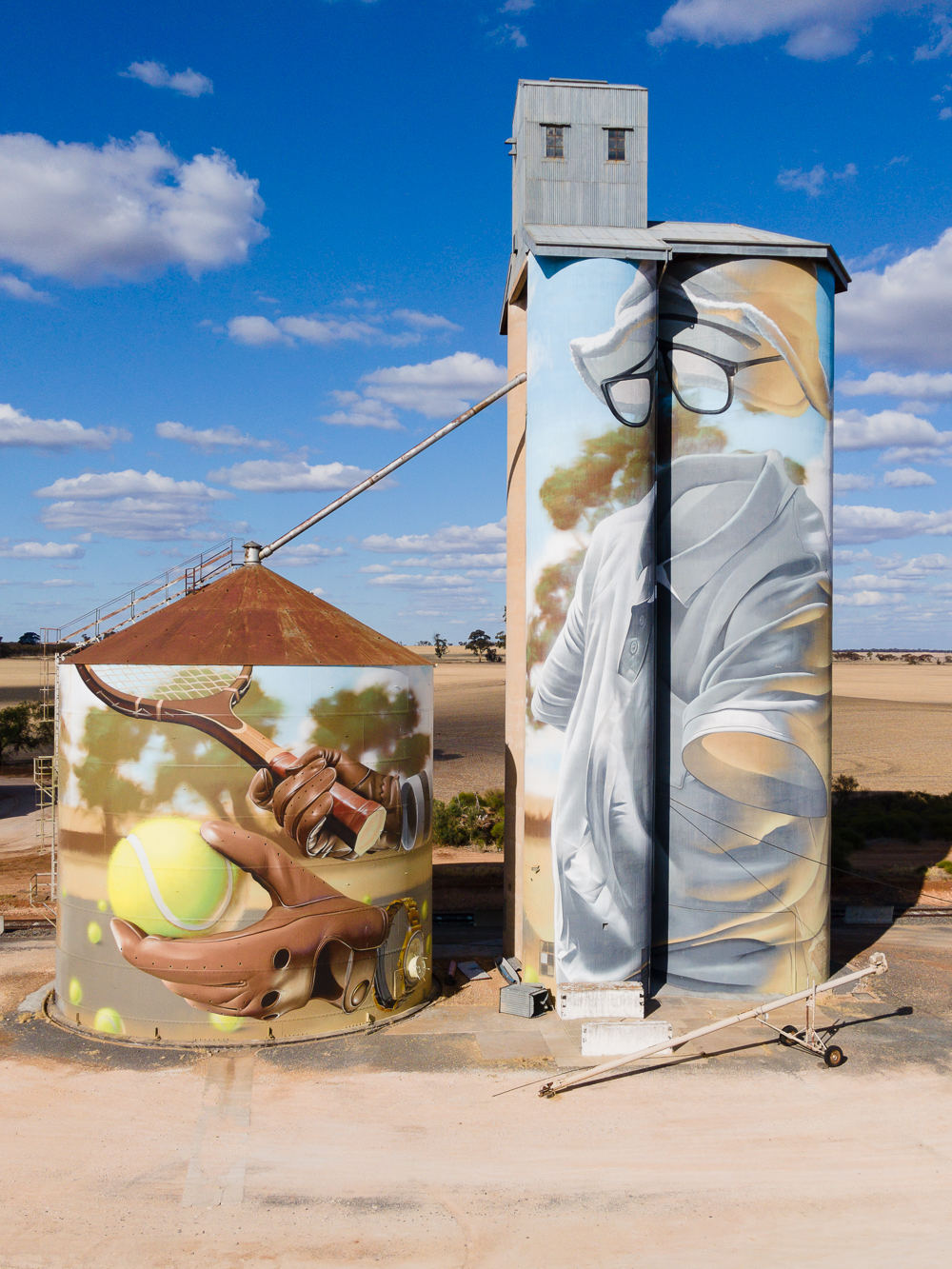
Arkona Silo Art is located approximately 10 km north of Dimboola on the Dimboola-Rainbow Road in western Victoria.
Visit Victoria - Arkona Silo Art
The mural was completed in 2022 by internationally renowned Australian mural artist Smug, also known as Sam Bates.
The artwork celebrates Roley Klinge, a well-known Arkona local who was closely associated with country tennis and was a tireless advocate and coach for young tennis players in the Arkona and Dimboola communities.
Roley died in 1991, creating an unusual challenge for the artist because Smug could not meet and photograph him in preparation for the mural.
Rather than attempting to recreate a conventional full-length portrait from old photographs, Smug developed a clever and playful solution: Roley's body is largely absent from the mural.
His distinctive terry-towelling hat and glasses remain, together with other carefully incorporated details, while the missing body allows visitors to position themselves within the artwork.
The mural consequently operates both as a portrait of a much-loved local identity and as an interactive celebration of the important role that country tennis plays in small rural communities.
Artwork / Subjects
Roley Klinge
The principal subject is Roley Klinge, a well-known Arkona identity remembered particularly for his involvement with country tennis.
Rather than presenting Roley as a conventional photorealistic portrait, Smug uses recognisable elements of his appearance to suggest his presence.
Look particularly for:
- Roley's distinctive terry-towelling hat.
- His glasses.
- The small portrait incorporated into the artwork.
- The gold watch incorporating the name "Roley".
Country Tennis
The second major subject is not an individual person but country tennis itself.
Tennis has traditionally been an important summer activity in many small Australian rural communities.
Country sporting clubs provide considerably more than competition. They are important places for social interaction, community identity and bringing together families living across widely dispersed farming areas.
The Arkona mural therefore records an aspect of rural Australian culture as well as commemorating an individual.
The Missing Figure
One of the most unusual features of Arkona Silo Art is the deliberate absence of Roley's painted body.
This creates negative space into which visitors can position themselves, effectively completing the artwork.
Photograph the mural both with and without a person occupying this space.
The two versions tell quite different stories.
Artist
Arkona Silo Art was painted by internationally renowned mural artist Smug, whose real name is Sam Bates.
Smug is particularly well known for enormous photorealistic murals, frequently depicting people with extraordinary facial and textural detail.
Arkona presented an unusual problem because Roley Klinge had died many years before the project and could therefore not be photographed by the artist specifically for the mural.
Smug's decision not to paint Roley's complete body transformed this limitation into one of the artwork's defining features.
While visiting Dimboola for the Arkona project, Smug also painted a mural in an alleyway behind the Dimboola Library.
Photographing the Artwork
Complete Silo Artwork
Begin with a clean documentary photograph showing the complete artwork.
Move sufficiently far away to avoid excessive perspective distortion and leave some space around the silo.
The silo art is on private property, but just alongside a small dirt road off the main C227 road. There are many views up and down the C227, and on or beside the dirt road.
The key options for photographing this are: to use a wide angle, and to get back over the C227 road as much as possible; stitch some normal photos and correct the distortion; use a tilt-shift lens; or use a drone to get up about 10m above the road. I opted to use the drone.
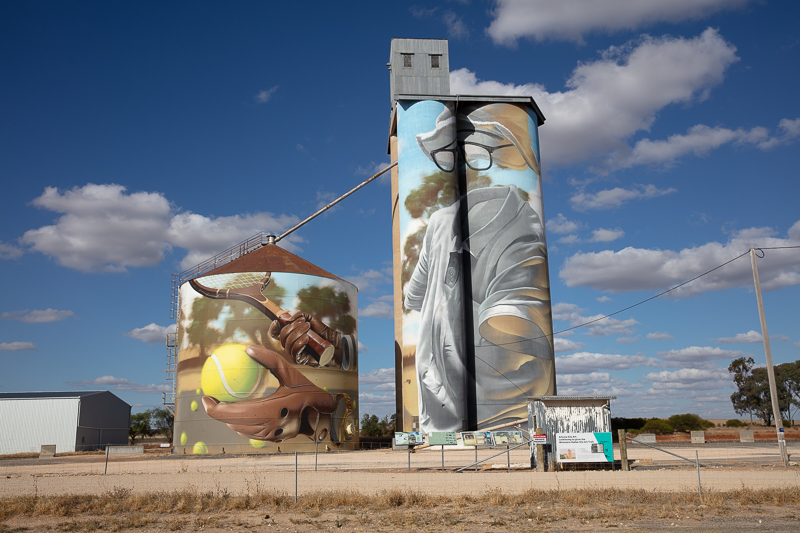
This should be the principal record photograph of the location.
Artwork and Rural Setting
Do not photograph only the painted surface.
Make several wider compositions incorporating the silo into the surrounding Wimmera agricultural landscape.
Possible supporting elements include:
- Open farmland.
- Rural roads.
- Large Wimmera skies.
- Grain infrastructure.
- Roadside vegetation.
Interactive Photograph
One of the priority photographs should take advantage of the deliberately missing figure.
Position a person carefully within the artwork so that their body visually completes Roley's hat, glasses and tennis composition.
Take time positioning the person accurately because even a small movement forwards, backwards or sideways can substantially change the illusion.
Artwork Details
After recording the complete mural, use a longer lens to isolate details.
Look particularly for:
- Roley's glasses.
- The terry-towelling hat.
- The tennis equipment.
- The gold watch.
- The small portrait of Roley.
- Paint texture.
- Sections demonstrating Smug's photorealistic technique.
Apple Map – Artwork and Nearby Photographic Locations
This Apple Map identifies Arkona Silo Art and the five nearest silo-art locations for which Auspano pages currently exist. Marker 1 is the principal artwork; the remaining markers link the wider photographic trail.
Mapped locations
Location
See the other sections of this page for location information.
Access & Parking
Arkona Silo Art is a roadside rural attraction and does not require a substantial walk.
The artwork is free to view and can be visited at any time.
When parking, remain aware that this is a rural agricultural environment rather than a conventional urban gallery.
Do not:
- Block gates or driveways.
- Interfere with agricultural vehicles.
- Enter operational areas.
- Cross fences or private-property boundaries for a photograph.
Visitors towing large caravans should select a safe parking position with adequate room to leave and re-enter the road.
Accessibility
Arkona Silo Art is considerably easier to view than many natural Auspano photographic locations.
There is no long walking track and the principal artwork can be seen from relatively close to the parking area.
However, this is a rural silo location and surrounding surfaces may include:
- Gravel.
- Grass.
- Loose stones.
- Uneven ground.
The principal mural is visible from relatively close to a vehicle, making it practical for many visitors with limited walking ability.
Best Light
Early Morning
Early morning provides lower-angle light and can produce attractive modelling across the silo surface.
It also provides softer light for wider photographs incorporating the surrounding agricultural landscape.
Late Afternoon
Late afternoon is another high-priority period.
Warm low-angle light can complement the rural setting and may produce a more atmospheric photograph than harsh midday illumination.
Bright Overcast
Bright overcast conditions can be excellent when the objective is to record the artwork itself.
Soft light:
- Reduces harsh shadows.
- Controls reflections.
- Provides even illumination.
- Allows the painted detail to dominate.
Interesting Skies
The open Wimmera landscape can produce enormous skies.
Storm clouds, broken cloud or dramatic late-afternoon light can transform a straightforward documentary silo photograph into a much stronger landscape image.
Nearby Locations
Dimboola
Dimboola, approximately 10 km south of Arkona, is the obvious base from which to explore the area.
It also provides several worthwhile photographic subjects in its own right.
Smug Mural - Dimboola
While working on the Arkona Silo Art project, Smug also painted a mural in an alleyway behind the Dimboola Library.
Photographing both works provides an interesting opportunity to compare the artist's work at two very different scales.
Wimmera River - Dimboola
The Wimmera River provides one of the strongest landscape subjects near Arkona.
Look for:
- River Red Gums.
- Reflections.
- Mist on cold mornings.
- Birdlife.
- Sunrise and sunset colour.
Nine Creeks and Dimboola Common
The Nine Creeks and Dimboola Common areas provide walking tracks through riverine and woodland environments near Dimboola.
They can provide:
- River Red Gum landscapes.
- Wetland subjects.
- Birdlife.
- Reflections.
- Woodland details.
Little Desert National Park
Little Desert National Park begins close to Dimboola and is one of the most important natural photographic locations in the region.
Depending on season and conditions, subjects can include:
- Mallee and heathland landscapes.
- Wildflowers.
- Birdlife.
- Native animals.
- Sand tracks.
- Sunrise and sunset.
- Night skies.
Rainbow Silo Art
Continue north along the Dimboola-Rainbow Road to Rainbow.
Rainbow's silo-art development provides a substantially different experience from Arkona, incorporating external artwork, internal artwork and elevated viewing positions.
This makes Rainbow particularly valuable when photographing several silo locations for Auspano because it demonstrates how far the silo-art concept has developed beyond a conventional exterior mural.
Albacutya Silo Art
Albacutya Silo Art lies approximately 10 km north of Rainbow.
The colourful artwork by Kitt Bennett is inspired by childhood, family and searching for yabbies.
Its bright, surreal character provides a strong contrast with Smug's photorealistic Arkona mural.
Lake Hindmarsh
Lake Hindmarsh, near Jeparit and Rainbow, can provide broad landscape, bird and sunset photography when conditions are suitable.
Its open horizons can be particularly effective during dramatic weather and late-afternoon light.
Nearby Auspano silo-art pages
- Brim Silo Art — approximately 48 km in a straight line; road distance will be longer.
- Rainbow Silo Art — approximately 51 km in a straight line; road distance will be longer.
- Kaniva Silo Art — approximately 70 km in a straight line; road distance will be longer.
- Albacutya Silo Art — approximately 73 km in a straight line; road distance will be longer.
- Woomelang Mini Silo Art Trail — approximately 95 km in a straight line; road distance will be longer.
Use the linked pages for verified viewpoints, access notes and additional nearby subjects. Check current road conditions before travelling between remote Mallee locations.
How to Get There
From Dimboola
From Dimboola, follow the Dimboola-Rainbow Road north towards Rainbow.
Arkona Silo Art is approximately 10 km from Dimboola.
Allow approximately 10 minutes driving time.
From Horsham
From Horsham, travel west along the Western Highway to Dimboola, then turn north onto the Dimboola-Rainbow Road.
Continue approximately 10 km to Arkona.
From Rainbow
From Rainbow, follow the Dimboola-Rainbow Road south towards Dimboola.
This route makes it particularly easy to combine Arkona with Rainbow and Albacutya Silo Art.
Travelling with a Caravan
The sealed-road location makes Arkona straightforward to incorporate into a caravan touring itinerary.
When towing a large caravan, select a safe parking position with adequate room for the complete combination and remain clear of agricultural and heavy-vehicle access.
Driving from the State Capital
The state capital is used as a consistent reference point. The actual route varies with the traveller's starting point, traffic, roadworks and closures.
State capital to artwork
Calculating the driving route with Apple Maps…
Distance and time are estimates and may change with conditions.
Where to Stay
Dimboola
Dimboola is my preferred nearby base for photographing Arkona.
It is only approximately 10 minutes from the silo and also provides easy access to:
- The Wimmera River.
- Nine Creeks.
- Dimboola Common.
- Little Desert National Park.
- The Smug mural behind Dimboola Library.
Staying in Dimboola therefore allows Arkona to become part of a much broader photographic visit rather than simply a roadside stop.
Horsham
Horsham is the better base if exploring a larger section of the Wimmera.
As the major regional centre, it provides a wider choice of:
- Caravan parks.
- Hotels and motels.
- Restaurants.
- Fuel.
- Supermarkets.
- Vehicle services.
The disadvantage is the additional drive to Arkona compared with staying at Dimboola.
Rainbow
Rainbow is another useful alternative if the main objective is to photograph several northern Wimmera-Mallee silo-art locations.
Staying at Rainbow makes it convenient to combine:
- Rainbow Silo Art.
- Albacutya Silo Art.
- Arkona Silo Art.
- Lake Hindmarsh.
- Wider Mallee landscapes.
Photography Recommendations
16-35mm
The 16-35mm can be useful for wide environmental photographs incorporating the silo and surrounding landscape.
Avoid standing unnecessarily close and photographing the mural at 16mm, because this can exaggerate perspective and distort the artwork.
24-70mm
This would be my principal lens at Arkona.
Use it for:
- The complete silo artwork.
- Interactive photographs with a person.
- Medium-detail compositions.
- Environmental photographs.
Where sufficient working distance is available, approximately 35-70mm should provide particularly natural-looking proportions.
70-200mm
The 70-200mm is very useful for details.
Look particularly for:
- Glasses.
- Hat texture.
- The watch.
- Small portrait.
- Tennis details.
- Sections demonstrating Smug's painting technique.
Tripod
A tripod is generally unnecessary during normal daylight.
Handheld photography makes it easier to experiment with viewpoints and position a person accurately within the interactive section of the mural.
A tripod becomes useful during blue hour or in very low light.
Circular Polariser
A circular polariser can help control reflections and increase colour saturation.
It can also deepen a blue sky, although care should be taken with very wide focal lengths to avoid uneven polarisation.
Photograph the Details
Arkona particularly rewards detail photography because several important elements of the story could easily be overlooked in a single wide photograph.
The watch, small portrait, hat and glasses should all be deliberately recorded.
Controlling Perspective
Perspective control is important when photographing tall silo artwork.
Wherever possible:
- Move farther away.
- Use a longer focal length.
- Keep the camera reasonably level.
- Avoid pointing sharply upwards.
- Keep the sensor plane as parallel as practical to the artwork.
- Leave additional space around the silo for later correction.
Using the 24-70mm from farther away will usually provide a more faithful representation of the artwork than standing close with an ultra-wide lens.
If perspective correction will be required later, compose slightly wider than the intended finished photograph because correction will crop the edges of the frame.
Suggested Photographic Sequence
-
Begin with an establishing photograph.
Show the silo within the surrounding rural Arkona landscape.
-
Make a clean photograph of the complete artwork.
Concentrate on accurate proportions and minimal perspective distortion.
-
Photograph the mural without a person.
Record Smug's unusual use of negative space.
-
Create the interactive photograph.
Carefully position a person within the missing section of Roley's figure.
-
Move closer to the important details.
Record the hat, glasses, watch, portrait and tennis elements.
-
Use the 70-200mm.
Isolate examples of Smug's photorealistic painting technique.
-
Step back again.
Photograph the silo against farmland, road and a large Wimmera sky.
-
Continue to Dimboola.
Photograph Smug's second local mural and the Wimmera River to extend the visual story beyond the silo itself.
How Long Should a Photographer Stay?
A casual visitor could view Arkona Silo Art in approximately 10-15 minutes.
For a comprehensive Auspano photographic record, I would allow approximately 30-45 minutes.
This allows time to photograph:
- The complete artwork.
- The silo within its rural setting.
- The interactive composition.
- The principal artwork details.
- Several focal lengths.
- The surrounding agricultural landscape.
Exceptional late-afternoon light or a dramatic sky could easily justify spending an hour at the location.
My Priority Photographs
- Complete Arkona Silo Art mural.
- Silo within the surrounding Wimmera agricultural landscape.
- Clean frontal photograph with controlled perspective.
- Mural showing the deliberately missing figure.
- Interactive photograph with a person completing the figure.
- Roley's terry-towelling hat.
- Roley's glasses.
- Gold watch incorporating "Roley".
- Small portrait of Roley incorporated into the mural.
- Tennis racquet and sporting details.
- Close photograph demonstrating Smug's photorealistic technique.
- Silo against a clean blue Wimmera sky.
- Silo beneath dramatic cloud if conditions permit.
- Warm late-afternoon version of the complete artwork.
- Rural road or agricultural element establishing the Arkona setting.
- Smug's Dimboola mural as a companion photograph.
Artwork Information
| Location | Arkona, near Dimboola, Victoria |
|---|---|
| Artwork | Arkona Silo Art |
| Artist | Smug (Sam Bates) |
| Completed | 2022 |
| Principal subject | Roley Klinge |
| Theme | Roley Klinge and the importance of country tennis |
| Artwork style | Photorealistic mural / interactive public art |
| Setting | Rural agricultural landscape |
| Entry | Free |
| Opening | Open at all times |
| Principal lens | 24-70mm |
| Useful additional lens | 70-200mm for artwork details |
| Suggested photography time | 30-45 minutes |
Photography Summary
Primary subjects: Arkona silo artwork and surrounding farmland
Best light: Soft light reduces glare; side light helps show the silo form.
Suggested kit: Wide and standard zoom; polariser
Photo Subjects
Explore related Auspano photography guides by subject.
Photographer Comments & Updates
Have you photographed this location? Share your photographs, viewpoints, photography tips or recent access updates, or ask a question about visiting. When uploading your own photographs, please include your name and the date each photograph was taken. Date any access or track-condition observations; visitor reports may become outdated, so check official information before travelling.