About Rutledge Lane
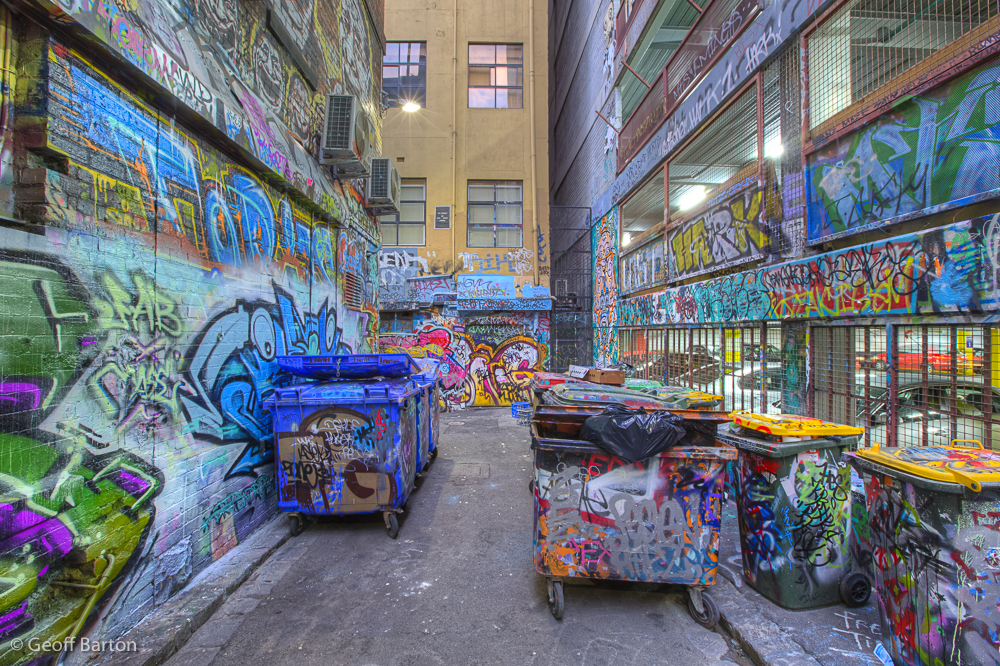
Rutledge Lane is the short, narrow branch on the eastern side of Hosier Lane. It shares Hosier’s continuously changing street-art culture but feels more enclosed, with short sightlines and very limited room to step back.
The lane also has an important place in Melbourne street-art history. In 2013 Adrian Doyle painted the lane a single colour for Empty Nursery Blue; later that year it formed part of the large All Your Walls repaint involving more than 100 artists across Hosier and Rutledge lanes. Those works were temporary, but the events demonstrate why historic and current photographs should always be dated.
Viewpoints
1. Hosier Lane junction
Photograph the entrance to Rutledge Lane as a visual branch from the busier main lane. The junction explains its geography and often layers art on several walls.
2. Long view into the lane
Use the converging walls and paving for depth. A person near the far end can show scale without dominating the artwork.
3. Opposing mural walls
The working distance is short. Keep the camera level, make overlapping frames and compare a complete-wall record with tighter artist details.
4. Doorways, corners and small works
Look for painted doors, pipes, paste-ups, stickers, tags and artwork wrapping around architectural edges.
5. Return view to Hosier Lane
Turn back towards the brighter, busier main lane for silhouettes, framed pedestrians and a clear relationship between the two locations.
Other Things to Look Out For
How I Photographed Rutledge Lane
What I took
The surviving August 2011 Auspano photograph records the lane as it appeared then. For a return visit I would use a 16–35 mm lens for confined views and a 24–70 mm lens for more natural details and people. A small tripod is useful only when the lane is quiet.
Techniques
Keep the camera level and use stitched frames rather than forcing every wall into one distorted ultra-wide exposure. Bright overcast conditions provide even colour. Where the Hosier Lane entrance is much brighter, bracket exposures or compose away from it.
Other things to look out for
Record dates, signatures where legible, painted doors, layers of older paint, paste-ups, stickers, pipes, bins, artists at work and the contrast between the enclosed branch and open Hosier Lane.
Nearby Locations
Hosier and Rutledge lanes
Melbourne’s best-known continuously changing street-art precinct, beside Federation Square.
AC/DC Lane and Rutledge Lane
Music-themed art, large murals, hospitality and small stencil details east of Russell Street.
Presgrave Place and Centre Place
Miniature framed works, paste-ups, cafés and classic laneway depth.
Drewery Lane and Mornane Place
Two smaller northern-CBD locations that reward close observation and can be combined in a walking circuit.
Flinders Street Station and Federation Square
Architecture, transport, people and blue-hour subjects complement a street-art visit.
Location
Rutledge Lane
Branching east from Hosier Lane between Flinders Street and Flinders Lane
Melbourne, Victoria 3000
Central coordinates: approximately -37.81643, 144.96868.
Rutledge Lane is reached on foot from Hosier Lane. It is a working public lane, not a formal gallery or guaranteed clear photographic set.
Apple Map – Location and Nearby Photographic Locations
The Apple Map separates five close photographic objectives in tiny Rutledge Lane from nearby Hosier Lane and city subjects. Artwork is ephemeral and marker placement does not guarantee an unobstructed wall.
Photographic locations
How to Get There
Enter Hosier Lane from Flinders Street opposite Federation Square or from Flinders Lane, then turn east into the short Rutledge Lane branch. Flinders Street Station is only a few minutes away and nearby trams operate through the central city.
Walking and public transport are strongly preferable. There is no visitor parking in either lane.
Driving from the State Capital
The state capital is used as a consistent reference point. Apple Maps calculates the automobile route to this location; your actual route may vary with your starting point, traffic, roadworks and temporary closures.
State capital to destination
Calculating the driving route with Apple Maps…
Distance and travel time are Apple Maps estimates and may change with the route and current conditions.
Current Access / Conditions
Information checked September 2026. Rutledge Lane remains physically connected to Hosier Lane and should be treated as the same rapidly changing street-art environment. Art can be repainted, tagged or removed without notice; older landmark works, including the 2013 blue intervention, are historical rather than current-view promises.
The lane can be crowded or temporarily affected by artists, deliveries, bins, cleaning, filming and events. Give artists room, do not touch wet work and keep doors and the lane centre clear.
Best Time to Visit
Early morning
Provides the best chance of a clear long view before Hosier Lane crowds build.
Bright overcast conditions
Even light gives reliable colour and reduces contrast between the narrow lane and its brighter entrance.
Late afternoon and blue hour
Pedestrians and nearby venue light add atmosphere, although tripod use becomes less practical.
During active painting
An artist at work can be a valuable documentary subject, but ask before making close portraits and never interrupt or touch materials.
Accessibility
The route from Flinders Street and Hosier Lane is paved and broadly step-free, but surfaces can be uneven and Rutledge Lane is very narrow. Crowds, bins, doors, wet paint and service activity may restrict turning and passing space.
A compact handheld setup is the most practical. Keep equipment close and avoid blocking the junction with Hosier Lane.
Where to Stay
Hotels around Federation Square, Flinders Lane and the eastern CBD provide the easiest access for an early uncrowded visit. Southbank is also convenient and adds river, bridge and skyline photography within walking distance.
Photography Recommendations
- Photograph Rutledge Lane separately rather than treating it as an unnamed corner of Hosier Lane.
- Begin with the junction so the spatial relationship is clear.
- Keep the camera level and stitch walls where working distance is short.
- Make both complete-wall records and close studies of temporary details.
- Include people carefully for scale and atmosphere.
- Date every gallery caption because the work changes rapidly.
- Respect artists, wet paint, doors and service access.
Field composition sequence
Begin with an establishing view showing the connection to Hosier Lane, then record individual works square-on and finish with layered paint and architectural details. The artwork changes, so treat the visit as a record of what is present on the day.
Suggested Photographic Sequence
- Start at the Hosier Lane junction with a contextual frame.
- Make the long view into Rutledge Lane before crowds enter.
- Work along each wall with level, overlapping photographs.
- Record doors, paste-ups, signatures and layered paint.
- Turn back for pedestrians framed by the Hosier Lane entrance.
- Continue through Hosier Lane, then Federation Square or AC/DC Lane.
How Long Should a Photographer Stay?
Allow 30 to 60 minutes for Rutledge Lane alone, or 90 minutes to two hours for a careful combined study with Hosier Lane. Return visits are justified because the art changes quickly.
My Priority Photographs
- A junction photograph showing Rutledge Lane branching from Hosier Lane.
- A complete long view through the narrow lane.
- Each principal wall recorded with controlled verticals.
- A strong current artwork with date and verified artist credit where possible.
- Paint layers, doors, pipes and paste-up details.
- An artist-at-work photograph made respectfully, if available.
- A return view with pedestrians silhouetted against Hosier Lane.
Photo Subjects
Explore related Auspano photography guides by subject.
Photographer Comments & Updates
Have you photographed this location? Share your photographs, viewpoints, photography tips or recent access updates, or ask a question about visiting. When uploading your own photographs, please include your name and the date each photograph was taken. Date any access or track-condition observations; visitor reports may become outdated, so check official information before travelling.