Photographing the Pinnacles, Nambung National Park
About The Pinnacles
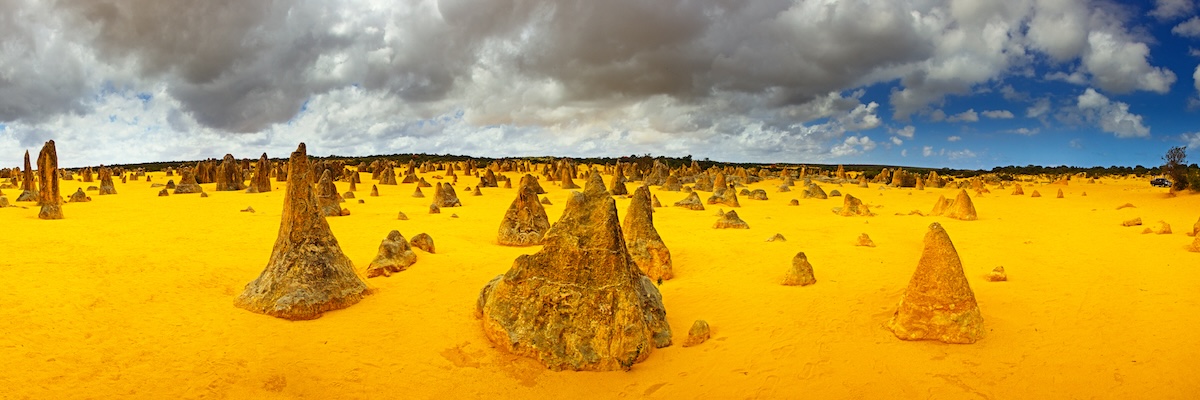
The Pinnacles are one of Western Australia's most distinctive landscapes and the principal attraction within Nambung National Park, approximately two hours north of Perth.
Thousands of limestone pillars rise from yellow sand to create an extraordinary desert landscape that can feel more like a film set than a natural geological formation.
Individual pinnacles vary enormously in shape. Some are narrow and sharply pointed, while others are broad, rounded or capped by harder material. The tallest reach approximately 3.5 metres.
The surrounding landscape includes low coastal heath, mobile white dunes, yellow sand plains and, only a short distance away, the turquoise waters of the Indian Ocean.
For photographers, The Pinnacles are particularly rewarding because the appearance of the landscape changes dramatically with the light.
During the middle of the day the scene can appear relatively flat, but early and late in the day the limestone pillars cast long shadows across the sand, revealing patterns that are largely invisible when the sun is high.
The location is also excellent for night photography. Its distance from major urban light sources and the strong silhouette shapes of the pinnacles make it particularly suitable for Milky Way and star photography.
Viewpoints
-
Classic Pinnacles Desert View
The classic composition places several prominent limestone pinnacles in the foreground while allowing hundreds of smaller formations to recede towards the horizon.
This creates an immediate impression of the scale and density of the landscape.
Best for: establishing photographs, landscape context, sunrise, sunset and dramatic skies.
Recommended lenses: 24-70mm and 16-35mm.
Avoid automatically using the widest focal length. Around 24-35mm often produces a more natural relationship between foreground pinnacles and the formations behind them.
-
Long Shadows
Shadows are one of the most important photographic elements at The Pinnacles.
When the sun is low, each limestone formation casts a long, strongly defined shadow across the pale sand.
These shadows create graphic patterns and can turn a relatively simple scene into a much stronger photograph.
Best time: the first hour or two after sunrise and the final two hours before sunset.
Look for arrangements where several shadows create parallel, converging or intersecting lines.
Recommended lenses: 24-70mm and 70-200mm.
-
Isolated Pinnacle
Some of the strongest photographs concentrate on a single distinctive formation rather than the entire desert.
Look for pinnacles with:
- Unusual shapes.
- Strong texture.
- Mushroom-like caps.
- Clean surrounding sand.
- Contrasting backgrounds.
Recommended lens: 70-200mm.
A longer lens allows unwanted surrounding pinnacles to be removed from the frame and can make the selected formation appear much more sculptural.
-
Telephoto Compression
A telephoto lens is one of the most useful tools at The Pinnacles.
From slightly elevated positions or the edges of the desert, use a longer focal length to compress dozens of pinnacles into dense layers.
The resulting photographs can make the formations appear almost endless.
Recommended lens: 70-200mm or 100-500mm.
Side lighting is particularly effective because alternating bright and shaded limestone surfaces create strong separation between layers.
-
Sand Patterns and Dunes
The yellow sand surrounding the pinnacles is an important photographic subject in its own right.
Wind creates subtle ripples and patterns which become especially visible in low-angle light.
Look for combinations of:
- Rippled sand.
- Limestone shadows.
- Small isolated pinnacles.
- Curving vehicle tracks.
- Contrasting vegetation at the edge of the desert.
Best for: abstract landscapes and minimalist compositions.
-
Low-Angle Pinnacle Portraits
Photographing from a lower viewpoint can make individual pinnacles appear substantially taller and more imposing.
Position a prominent formation against open sky and allow it to dominate the frame.
This technique works particularly well when clouds provide a strong background.
Recommended lens: 16-35mm or 24-70mm.
-
Limestone Textures
The surfaces of individual pinnacles contain excellent smaller compositions.
Look for weathering, grooves, holes, colour variation, cross-bedding and harder calcrete caps.
Cross-bedding visible in some pinnacles provides evidence of the wind-blown dune systems from which the limestone developed.
Best for: geological detail, abstract photography and monochrome.
Recommended lens: 70-200mm or macro-capable zoom.
-
Pinnacles Desert Lookout
The formal lookout provides a useful slightly elevated view over the Pinnacles Desert.
It is particularly useful for understanding the broader layout of the landscape before exploring individual formations at ground level.
Best for: panoramic photographs, telephoto compression and environmental views showing the relationship between the desert and surrounding vegetation.
This is also one of the most practical viewpoints for photographers with limited mobility.
-
Pinnacles Desert Drive
A one-way drive of approximately 4.5 kilometres winds through the Pinnacles Desert.
Parking bays are provided at numerous points, allowing visitors to stop and explore sections of the desert on foot.
From a photographic perspective, this is valuable because different sections contain quite different combinations of pinnacle height, spacing and background.
Do not assume that the first group of formations is the best. Drive the complete loop and note promising areas before committing most of your time.
-
Sunset
Sunset is arguably the most reliable period for dramatic photography at The Pinnacles.
The western light produces warm colour on the limestone while shadows stretch across the yellow sand.
As the sun approaches the horizon, look for pinnacles that can be positioned against the bright western sky.
Best for: silhouettes, backlight, starbursts, long shadows and warm colour.
A stopped-down aperture can create a sunstar when the sun is positioned partially behind the edge of a pinnacle.
-
Blue Hour
Do not leave immediately after sunset.
The warm colour of the sand and limestone contrasts beautifully with the deepening blue sky after the sun has disappeared.
Individual pinnacles gradually become silhouettes and the landscape takes on a much quieter appearance.
A tripod is useful as exposure times increase.
-
Milky Way and Astrophotography
The Pinnacles is one of the strongest astrophotography locations within relatively easy reach of Perth.
Low artificial light levels and the distinctive limestone formations provide unusually strong foreground subjects beneath the night sky.
Best for: Milky Way, star trails, silhouettes and environmental night landscapes.
Recommended lens: fast 14-24mm or similar wide-angle lens.
Scout the exact composition during daylight before returning in darkness.
Plan the position of the Galactic Centre, moon and major constellations before arriving.
The principal viewpoints, walking areas and designated drive pull-overs are numbered on the Apple Map below.
Other Things to Look Out For
How I photographed the Pinnacles
What I took - what was in my kit
I took my LowePro Backpack loaded with Canon 5DMkII body, Canon 24-105mm zoom, Manfrotto 190 Tripod, and of course a range of lens wipes, spare batteries, sunscreen and bug repellant. I tended to shoot 28-55mm
Techniques
TBD
Nearby Locations
-
Lake Thetis
Lake Thetis, near Cervantes, contains living stromatolites built by communities of microscopic organisms.
These rock-like structures provide an opportunity to photograph one of the most ancient forms of biological community still found on Earth.
Best for: stromatolites, reflections, minimalist landscapes and scientific/natural-history photography.
The first part of the trail includes an accessible boardwalk and passes many of the best stromatolite examples.
-
Hangover Bay
Hangover Bay provides a strong coastal contrast to the dry yellow landscape of The Pinnacles.
The broad beach, coastal vegetation and turquoise Indian Ocean can be photographed only a short drive from the desert.
Best for: seascapes, beaches, sunset and coastal vegetation.
-
Kangaroo Point
Kangaroo Point is another attractive coastal location within Nambung National Park.
It is useful for photographing the relationship between the national park's inland limestone landscape and the Indian Ocean.
Best for: beach landscapes, sunset and coastal details.
-
Cervantes
Cervantes is the nearest town and the logical base for a photography trip to The Pinnacles.
The town offers additional photographic subjects including beaches, fishing boats, coastal light and sunsets over the Indian Ocean.
-
White Sand Dunes
Nambung National Park contains striking white dune systems that provide an almost complete visual contrast to the yellow Pinnacles Desert.
Low-angle light reveals wind-created ridges and textures particularly well.
Best for: minimalist landscapes, dune patterns and abstract compositions.
-
Spring Wildflowers
From approximately August to October, the low heathland of Nambung National Park can produce extensive displays of native flowers.
This provides a completely different photographic subject from the limestone desert and can be combined with a Pinnacles visit on the same day.
Best for: wildflowers, environmental detail and colour.
A macro lens or telephoto zoom with good close-focus capability is particularly useful.
-
Lesueur National Park
Farther north, Lesueur National Park is one of Western Australia's important wildflower and biodiversity areas.
It makes an excellent extension to a spring photography trip based around Cervantes and The Pinnacles.
Best for: wildflowers, heathland, elevated views and botanical photography.
Selected nearby coastal and natural-history subjects are included after the principal desert locations on the Apple Map below.
Location
The Pinnacles Desert lies within Nambung National Park, inland from the coastal town of Cervantes on Western Australia's Coral Coast.
Main location:
Pinnacles Desert Discovery
Nambung National Park
Pinnacles Drive
Cervantes WA 6511
GPS reference: Pinnacles Desert Discovery, -30.58571, 115.16519.
Apple Map – Location and Nearby Photographic Locations
This interactive Apple Map separates the principal Pinnacles Desert viewpoints from worthwhile nearby coastal and natural-history locations. Pull-over markers identify useful photographic areas rather than a particular limestone pillar; always park only in designated bays and keep off fragile ground.
Photographic locations
How to Get There
From Perth
The Pinnacles are approximately 200 kilometres north of Perth.
The most straightforward route is generally:
Perth → Mitchell Freeway → Wanneroo Road → Indian Ocean Drive → Pinnacles Drive
Allow approximately two to two-and-a-half hours from central Perth, depending on traffic and stopping time.
From Cervantes
Cervantes is the nearest town and lies only a short drive from the park entrance.
This makes Cervantes the best base for photographers wanting to visit The Pinnacles at sunset, blue hour and again at sunrise.
Pinnacles Desert Drive
Once inside the visitor area, a 4.5 kilometre one-way drive winds through the limestone formations.
Numerous stopping bays allow visitors to leave the vehicle and explore selected parts of the desert on foot.
The drive is suitable for conventional vehicles under normal conditions.
Entry Fees and Visitor Information
Nambung National Park is a fee-paying national park.
At the time this page was prepared, the standard vehicle entry fee for a vehicle carrying up to 12 occupants was:
$17 per vehicle
Concession and motorcycle rates are also available, and valid Western Australian park passes cover entry.
Because fees can change, check the current rate immediately before travel.
Explore Parks WA - Current Park Entry Fees
Pinnacles Desert Discovery Centre
The Discovery Centre explains the geology, natural history and cultural significance of the Pinnacles and is worth visiting before or after photographing the desert.
Current opening hours are:
9:30am - 4:30pm daily
The centre is closed on Christmas Day.
Explore Parks WA - Pinnacles Desert Discovery
Driving from the State Capital
The state capital is used as a consistent reference point. Apple Maps calculates the automobile route to this location; your actual route may vary with your starting point, traffic, roadworks and temporary closures.
State capital to destination
Calculating the driving route with Apple Maps…
Distance and travel time are Apple Maps estimates and may change with the route and current conditions.
Current Access / Conditions
Nambung National Park is generally accessible by sealed roads and the Pinnacles Desert drive is normally suitable for conventional two-wheel-drive vehicles. Conditions can change because of fire, severe weather, maintenance or conservation work.
Explore Parks WA currently identifies a park alert for Nambung National Park. Check the linked park-alert page immediately before travelling, follow all closure signs, and do not enter closed tracks or areas.
Best Time to Visit
Autumn - March to May
Autumn generally provides pleasant temperatures and can produce clearer, calmer conditions.
The lower sun angles are useful for revealing the shapes of the limestone formations.
Good for: sunrise, sunset, landscapes and astrophotography.
Winter - June to August
Winter provides cooler temperatures, softer light and a greater chance of dramatic cloud.
It can also be an excellent period for night photography, particularly on clear moonless evenings.
Good for: dramatic skies, long shadows, night photography and comfortable daytime walking.
Spring - August to October
Spring is probably the best all-round season for a photographic visit.
The Pinnacles themselves remain the principal subject, but the surrounding heathland can also produce extensive displays of native wildflowers.
This allows a gallery to combine the yellow desert with completely different colours and textures from the surrounding vegetation.
Good for: Pinnacles, wildflowers, landscape photography and pleasant temperatures.
Summer - December to February
Summer can be very hot and the high midday sun is generally less interesting photographically.
Concentrate visits around sunrise and late afternoon.
Long daylight hours do, however, provide considerable time for combining The Pinnacles with the nearby coast.
Best time of day
The most important decision is often not the season but the time of day.
For landscape photography I would prioritise:
- Late afternoon.
- Sunset.
- Blue hour.
- Night.
- Early morning.
Midday is useful for geological detail and scouting, but generally produces flatter light and much shorter shadows.
Accessibility
The Pinnacles is one of the more accessible major natural attractions in Western Australia because substantial views can be obtained without undertaking a long bushwalk.
Pinnacles Desert Discovery
The main visitor centre has designated accessible parking spaces and wheelchair-accessible unisex toilets.
The accessible parking bays are on level bitumen near the visitor facilities.
Pinnacles View Lookout
A sealed concrete path provides access towards the principal lookout.
Official accessibility information notes gradients of up to approximately 1:10.
This provides one of the best options for photographers who cannot walk through deep sand.
Desert View Walk
The complete Desert View Walk is approximately 1.5 kilometres.
The first approximately 300 metres is a Class 1 accessible path to a viewing platform.
Beyond that point the route becomes a Class 3 sandy trail through the Pinnacles, which is significantly less practical for conventional wheelchairs and some mobility aids.
Pinnacles Desert Drive
The one-way vehicle route provides an especially useful alternative for visitors with limited mobility.
Numerous parking bays allow photographers to select viewpoints close to the vehicle, although the surrounding ground is naturally sandy and uneven.
Where to Stay
Cervantes
Cervantes is the best accommodation base for photographers visiting The Pinnacles.
Staying in town makes it practical to photograph sunset and stars before returning to accommodation, then revisit the area for early morning light.
Cervantes Pinnacles Motel
A conventional motel option in Cervantes, useful for photographers wanting a room rather than camping.
RAC Cervantes Holiday Park
A useful option for caravans, campers and cabins close to the coast.
For photographers travelling with a large caravan or motorhome, confirm site dimensions and suitability directly when booking.
Jurien Bay
Jurien Bay is farther north but provides a broader range of accommodation, restaurants and coastal photographic opportunities.
It can be a good alternative if The Pinnacles form part of a longer Coral Coast journey.
Photography Recommendations
-
16-35mm wide-angle lens
Useful for dramatic close foregrounds, low-angle views and night photography.
-
24-70mm standard zoom
Probably the most useful general-purpose lens for the Pinnacles.
It allows landscape context while avoiding the extreme perspective distortion that can occur when working very close with an ultra-wide lens.
-
70-200mm telephoto
I would regard this as an essential lens here.
It allows dozens of pinnacles to be compressed into layers and is ideal for abstract shadow patterns, isolated formations and distant desert views.
-
Tripod
Essential for serious blue-hour and astrophotography work and useful during low-light sunrise and sunset conditions.
-
Polarising filter
Can strengthen blue skies and reduce glare, but use it carefully with wide-angle lenses because the polarisation may become uneven across a large expanse of sky.
-
Graduated or exposure blending
Bright western skies at sunset can produce a substantial brightness difference between the horizon and foreground.
Bracketing exposures can be useful where necessary.
-
Use side light whenever possible
Side lighting reveals surface texture and makes individual formations appear three-dimensional.
Front lighting tends to flatten the scene.
-
Build compositions around groups
Instead of photographing random collections, look for groups of three or five pinnacles with clear visual separation.
Avoid having formations merge awkwardly into one another.
-
Watch the background
A strong foreground pinnacle can easily be weakened by another formation appearing directly behind it.
Moving sideways by only a few metres can completely change the relationship between formations.
-
Use people sparingly for scale
A person can demonstrate the size of the larger formations very effectively.
Position them deliberately rather than simply accepting unrelated visitors within the frame.
-
Look for abstract photographs
Some of the best images may contain only limestone, shadow and sand rather than a recognisable desert panorama.
-
Scout before sunset
The desert contains too many possible compositions to choose one efficiently after the light becomes good.
Arrive several hours early, drive the complete loop and mark two or three compositions worth returning to when the sun is lower.
Field composition sequence
Begin with an establishing view of the limestone field, then isolate groups of pinnacles and use their shadows as leading shapes. Keep the horizon deliberate and compare a low viewpoint with a more elevated composition from permitted access.
Suggested Photographic Sequence
For a photographer staying in Cervantes, I would organise a dedicated Pinnacles photography day approximately as follows.
-
Early morning - Pinnacles Desert
Arrive around sunrise and concentrate initially on long shadows and isolated formations.
-
Morning - Desert View Walk
Walk among the formations while light is still relatively low and use both standard and telephoto lenses.
-
Late morning - Pinnacles Desert Drive
Complete the driving loop and identify possible sunset foregrounds and silhouettes.
-
Midday - Discovery Centre
Use the least photogenic part of the day to learn more about the geology and formation of the Pinnacles.
-
Early afternoon - Lake Thetis
Photograph the stromatolites and broader lake landscape.
-
Mid-afternoon - Cervantes or Hangover Bay
Photograph the coast, beach and Indian Ocean before returning to the desert.
-
Late afternoon - return to The Pinnacles
Revisit the compositions identified earlier and watch the shadows lengthen across the sand.
-
Golden hour - side-lit pinnacles
Concentrate on three-dimensional form, limestone texture and repeating shadow patterns.
-
Sunset - western silhouettes
Use distinctive pinnacles against the bright western sky and experiment with both clean silhouettes and sunstars.
-
Blue hour
Remain after sunset while the yellow sand gradually cools in colour beneath the deep blue sky.
-
Night - astrophotography
If conditions are favourable, finish with the Milky Way or stars above a previously scouted limestone formation.
How Long Should a Photographer Stay?
A casual visitor can see The Pinnacles in a few hours, but I recommend at least one night in Cervantes for photography.
That allows the location to be photographed during both late-afternoon and early-morning light and provides the opportunity for night photography.
Two nights would be better if you also want to photograph Lake Thetis, Hangover Bay, Cervantes, wildflowers and other parts of Nambung National Park.
My Priority Photographs
- A wide establishing photograph showing hundreds of pinnacles receding into the distance.
- A single distinctive limestone pinnacle photographed in strong side light.
- Several pinnacles casting long parallel shadows across the sand.
- A compressed 70-200mm composition showing dense layers of pinnacles.
- A low-angle portrait of a tall pinnacle against dramatic sky.
- A close geological study showing limestone texture or cross-bedding.
- An abstract photograph containing only sand, limestone and shadow.
- A human figure included carefully to demonstrate scale.
- A sunset silhouette with the sun partially hidden behind a pinnacle.
- A blue-hour composition with warm limestone against deep blue sky.
- A Milky Way photograph using one or more pinnacles as foreground.
- A contrasting photograph of Lake Thetis stromatolites.
- A nearby Indian Ocean sunset or coastal image to complete the wider Nambung National Park story.
The Pinnacles is a location where light and spacing matter more than simply finding the largest rock formation.
The most successful photographs often come from studying the relationship between several pinnacles and waiting for low-angle light to give those forms depth.
I would therefore approach the area in two stages: first use daylight to scout the desert carefully, then return to selected formations when the sun is low.
Photo Subjects
Explore related Auspano photography guides by subject.
Photographer Comments & Updates
Have you photographed this location? Share your photographs, viewpoints, photography tips or recent access updates, or ask a question about visiting. When uploading your own photographs, please include your name and the date each photograph was taken. Date any access or track-condition observations; visitor reports may become outdated, so check official information before travelling.