Photographing Mount Ainslie
About Mount Ainslie
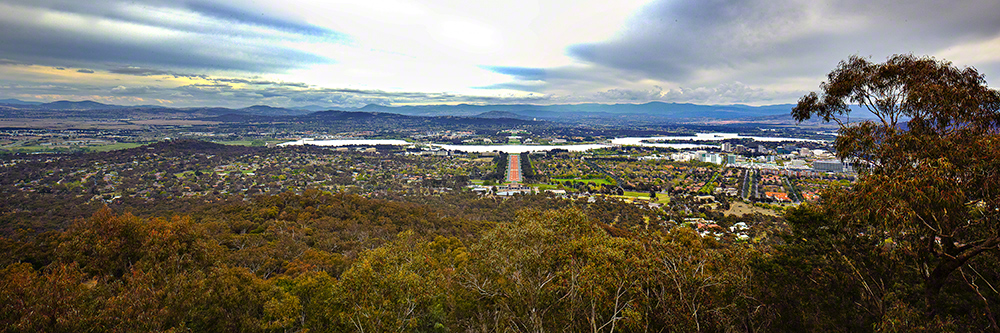
Mount Ainslie provides Canberra’s clearest elevated view along the national ceremonial axis, with the Australian War Memorial, Lake Burley Griffin and Parliament House aligned below.
This is Ngunnawal and Ngambri Country. The strongest coverage combines a defining view with medium studies and details that explain the geology, ecology, architecture or cultural setting.
Planning a photographic visit
A useful set of photographs should connect the ceremonial axis from the War Memorial towards Parliament House with the wider landscape. Begin with an establishing image, then work towards a tighter photograph of the most distinctive form and a detail that adds a sense of place.
Viewpoints
Mount Ainslie lookout
National-axis panorama. Start with the defining environmental view, then vary height and focal length.
Useful lenses: 16–35mm and 24–70mm.
Kokoda Track summit
Walking approach and woodland detail. Use this stop to add context or a contrasting visual rhythm.
Useful lenses: 24–70mm and 70–200mm.
Australian War Memorial
Axis foreground and architecture. Use this stop to add context or a contrasting visual rhythm.
Useful lenses: 16–35mm and 24–70mm.
Mount Pleasant lookout
Alternative city panorama. Use this stop to add context or a contrasting visual rhythm.
Useful lenses: 24–70mm and 70–200mm.
Red Hill lookout
Southern Canberra outlook. Use this stop to add context or a contrasting visual rhythm.
Useful lenses: 16–35mm and 24–70mm.
Working the viewpoints
Establish the full Canberra basin, then use a moderate telephoto to align the War Memorial, Anzac Parade, lake and Parliament House. Make separate frames of the city centre and distant hills rather than relying entirely on a panorama.
Other Things to Look Out For
- Directional light, cloud, mist and changing weather
- Characteristic textures and small details
- Wildlife observed quietly with a long lens
- Human scale where it strengthens the story without compromising privacy
Look for a supporting image that records the surrounding vegetation, characteristic surface textures or a changing weather condition. Use a longer lens for wildlife and keep a respectful distance. The summit can be busy at sunset. Set the tripod clear of pedestrian circulation and leave room for other visitors at the lookout.
Nearby Locations
Location
Mount Ainslie, Canberra Nature Park, Australian Capital Territory
Approximate photographic centre: -35.26900, 149.15800
Map markers identify photographic objectives, not guaranteed parking places or permission to leave formed public access.
Apple Map – Location and Nearby Photographic Locations
The Apple Map identifies the main photographic objectives and selected nearby viewpoints. Confirm signage, land status and current access on arrival.
Photographic locations
How to Get There
From Canberra, use the Apple Maps route for initial planning, then verify the final road, parking and walking approach with the responsible park, council or site operator. Allow extra time for unsealed roads, congestion and photographic stops.
Driving from the State Capital
The state capital is used as a consistent reference point. Apple Maps calculates the automobile route to this location; your actual route may vary with your starting point, traffic, roadworks and temporary closures.
State capital to destination
Calculating the driving route with Apple Maps…
Distance and travel time are Apple Maps estimates and may change with the route and current conditions.
Current Access / Conditions
Conditions checked: 22 September 2026.
Check current park, council, weather and emergency alerts immediately before travel. Closures and changed conditions take precedence over this guide.
Obey every closure, barrier and on-site instruction. Carry water, offline navigation and clothing suitable for changing conditions.
Best Time to Visit
Dawn and late afternoon usually provide the most dimensional light; overcast weather can be preferable for forest, waterfalls and architectural detail. Recheck sunrise direction, weather, tide or water flow for the exact date.
Accessibility
Expect conditions ranging from accessible paved areas to uneven natural tracks. Wear suitable footwear, keep clear of edges and moving water, and do not rely on mobile reception.
Where to Stay
Stay in the nearest service centre or approved on-site accommodation where available. A local base makes dawn and twilight sessions safer and leaves time to return in different conditions.
Photography Recommendations
Photography recommendations
- Use the summit lookout for the classic axial view along Anzac Parade to Lake Burley Griffin and Parliament House.
- A moderate telephoto is particularly useful for compressing the War Memorial, Anzac Parade and Parliament House into a strong graphic composition.
- Photograph both the broad Canberra basin and tighter architectural relationships; haze can add depth but may reduce distant contrast.
- Late afternoon, sunset and blue hour can be productive, but retain enough time to leave safely and observe any access restrictions.
Exposure and composition in the field
Late directional light gives the buildings and ridge lines more relief; at dusk, retain a little sky colour before city lights become dominant. For a stitched panorama, lock exposure and white balance. Check the histogram rather than judging the rear-screen preview alone; make a second composition after changing focal length or camera height.
Suggested Photographic Sequence
- Begin with the broad city panorama from the summit.
- Switch to a telephoto for the War Memorial–Anzac Parade–Parliament House alignment.
- Work side views toward the lake, city centre and surrounding ranges.
- Return to the axial composition for late light or blue hour.
Before leaving, compare the establishing frame with the tighter subject and one contextual detail. If the light has changed, remake the strongest composition rather than simply taking more versions of the same view.
How Long Should a Photographer Stay?
Allow 1–2 hours for daylight photography; allow 2–3 hours if you intend to cover sunset and blue hour.
My Priority Photographs
- A defining environmental portrait of Mount Ainslie
- A tighter image of the location’s characteristic structure or texture
- A composition that communicates scale
- A second image made in distinctly different light or weather
A coherent final set should include the ceremonial axis from the War Memorial towards Parliament House, a more selective study, and one frame that shows the character of the surrounding landscape.
Photo Subjects
Explore related Auspano photography guides by subject.
Photographer Comments & Updates
Have you photographed this location? Share your photographs, viewpoints, photography tips or recent access updates, or ask a question about visiting. When uploading your own photographs, please include your name and the date each photograph was taken. Date any access or track-condition observations; visitor reports may become outdated, so check official information before travelling.