Photographing Oodnadatta
About Oodnadatta

Oodnadatta is the tiny town that gives the Oodndatta Track its name. The town has perhaps 20 houses, a Roadhouse that provides fuel, an airport, a railway museum, and a caravan park. There is, or was, a Transcontinintal hotel here, but it was closed when we were there.
The township was the terminus of the Central Australian Railway until 1929, when they finally pushed the railway that extra 450km through to Alice Springs. From 1890 - 1929, Camel caravans took goods from here to more inland areas. It is this association with the "Afghan" (Ghan) camelers that provides the historical background to the town, and to the track which follows the old railway track.
The township is now at the crossroads of several outback tracks, so it is on the way to many outback locations.
The Pink Roadhouse is the main feature of the town. It provides fuel, food, and drinks. It is also where you book in your accomodation for the caravan park, and get the keys to the Railway Museum. When you are here, get one of their free Oondatta Track Maps. This hand annotated map has been updated several times and is one of the best guides to the track available.
Planning the photographic story
A varied set of photographs connects oodnadatta town and railway history with the wider setting. Begin with a broad view, then a tighter study and one distinctive detail.
Viewpoints
There are only two things to really see in town:
- The Pink Roadhouse. This provides some nice photos, from the front, the side, and inside. It is busy hub for both locals and those 'doing the track'. Have an Oodnaburger here, and have a look at their free map of the Oodnadatta Track.
- The Railway museum. You can borrow the key to this from the roadhouse. It has many nice pictures in the small station.
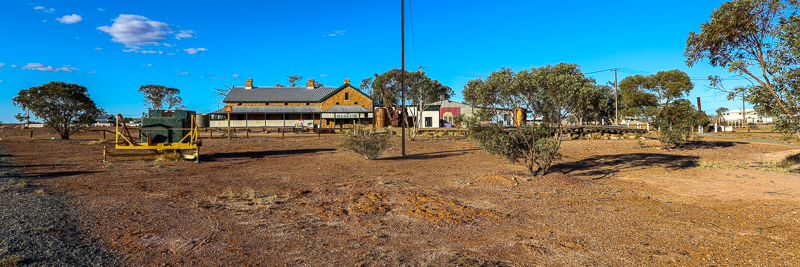
Working the viewpoints
Establish the town in its desert setting, then photograph public-facing historic buildings, signage and railway details as separate images.
Other Things to Look Out For
How I photographed Oodnadatta
What I took - what was in my kit
I took my LowePro Backpack loaded with Canon 5DSR body, Canon 24-70mm zoom, Manfrotto 190 Tripod, and of course a range of lens wipes, spare batteries, sunscreen and bug repellant. Given that the town is tiny, I left most of my kit in the car and just walked with the camera hand held.
Techniques
The desert light is very strong. It is either full sun or full shade. There are no clouds or awnings or buildings to break up the light. I therefore simply shot ISO 100 (for fidelity) and f10 (for diffration). Exposure was to-the-right and set by shutter speed.
Nearby Locations
Nearby photographic locations
Location
Oodnadatta, Far North, South Australia
Approximate coordinates: -27.54890, 135.44840
Markers identify photographic objectives rather than guaranteed parking spaces or open access.
Apple Map – Location and Nearby Photographic Locations
This Apple Map shows the principal subject and nearby photographic locations. Verify signs, road status and track conditions before relying on a marker for access.
Photographic locations
How to Get There
From Adelaide
Use the mapped Apple Maps route as a planning reference, then confirm road type, closures, fuel availability and final access with the relevant park or road authority. Allow extra time for photographic stops and changing conditions.
Driving from the State Capital
The state capital is used as a consistent reference point. Apple Maps calculates the automobile route to this location; your actual route may vary with your starting point, traffic, roadworks and temporary closures.
State capital to destination
Calculating the driving route with Apple Maps…
Distance and travel time are Apple Maps estimates and may change with the route and current conditions.
Current Access / Conditions
Conditions checked: 22 September 2026.
Outback road status can change within hours after rain. Check the South Australian Outback Roads map on the day of travel and obey every closure; fines and recovery costs can be substantial.
Carry water, fuel reserve, two sound spare tyres, communications and recovery equipment appropriate to the route. Do not rely on continuous mobile coverage or on every remote service being open.
Best Time to Visit
Best season and light
Choose a season that supports the defining subject, then favour the edges of the day for directional light. Overcast conditions are valuable for forest, moving water and detail; clear evenings suit silhouettes and night work.
Light in the field
Early or late side light gives texture to old structures and reduces harsh midday contrast.
Accessibility
See Oodnadatta Track. The town - like the rest of the track - is essentially flat. No problems with access for anyone with wheel chairs or limited mobility. The town is not large, and it is pet freindly.
Field access and safety
Check local opening hours, respect residents and private property, and confirm track conditions before continuing.
Where to Stay
We stayed in the Pink Roadhouse Campground. Apart from these campgrounds, there are some free-camps within the next few hours, but that is it. The campground is basically a large block at the rear of the Roadhouse. It does have nice toilets and showers though, and there is plenty of room to turn around the big rigs that are often found out here. We enjoyed our time.
Photography Recommendations
Photography recommendations
- Begin with a clear environmental composition before concentrating on details.
- Use a tripod only where it will not obstruct a path, platform, jetty or working area.
- Bracket high-contrast scenes and protect important highlights.
- Use a telephoto to simplify distant layers and avoid approaching wildlife or fragile features.
- Revisit the principal viewpoint as weather, tide or light changes.
Suggested photographic sequence
- Arrive early enough to inspect access and choose safe viewpoints.
- Make the broad establishing photographs while the location is quiet.
- Work through secondary markers and detail subjects.
- Return to the main composition for golden hour or softer late light.
- Finish with blue hour only where the route back is straightforward and safe.
How long should a photographer stay?
1 night is a practical minimum. Add time when weather, water flow, tides or remote-road conditions are central to the planned photographs.
My priority photographs
- A defining environmental view of Oodnadatta
- A tighter composition showing the location’s characteristic texture or structure
- A photograph using a person, vehicle, building or vegetation to communicate scale
- A low-light or weather-driven image that differs from the standard visitor view
Composition and exposure
Establish the town in its desert setting, then photograph public-facing historic buildings, signage and railway details as separate images. Early or late side light gives texture to old structures and reduces harsh midday contrast. Review highlights and make a second deliberate framing rather than repeating the same viewpoint.
Suggested Photographic Sequence
Work through the location in an order that makes the best use of changing light and conditions.
Suggested field sequence
Begin with oodnadatta town and railway history. Follow with a tighter detail and a context photograph; return to the strongest composition if the light changes.
How Long Should a Photographer Stay?
Allow enough time to photograph the location in more than one light or weather condition where practical.
My Priority Photographs
Use this section for the practical photographic shot list for the location.
Priority frames
Secure an establishing photograph of oodnadatta town and railway history, a selective detail and one image that explains the surrounding setting.
Oodnadatta gallery
Photographs of the principal views, details and changing conditions will be added here.
Photo Subjects
Explore related Auspano photography guides by subject.
Photographer Comments & Updates
Have you photographed this location? Share your photographs, viewpoints, photography tips or recent access updates, or ask a question about visiting. When uploading your own photographs, please include your name and the date each photograph was taken. Date any access or track-condition observations; visitor reports may become outdated, so check official information before travelling.