Photographing Erskine Falls
About Erskine Falls
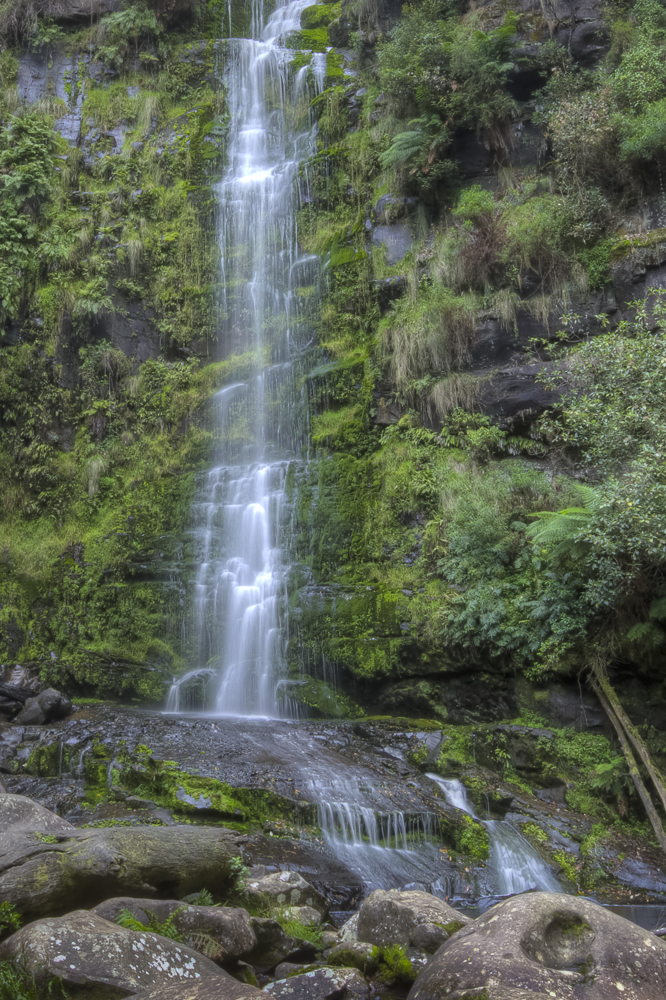
Erskine Falls is one of the best-known waterfalls in the Great Otway National Park and one of the most accessible major waterfalls near the Great Ocean Road.
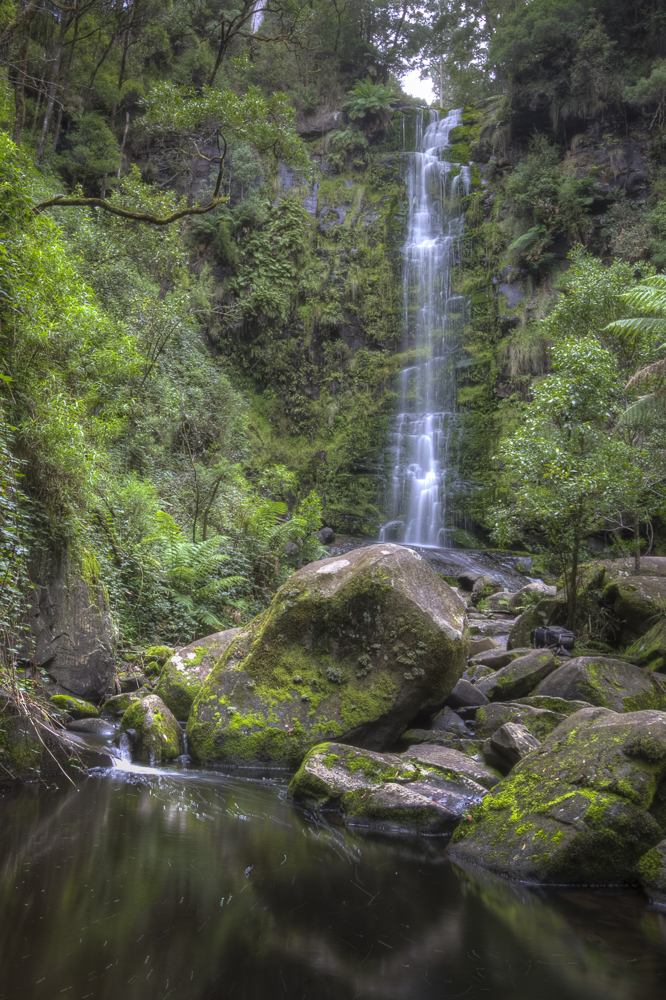
Located inland from Lorne, the Erskine River plunges approximately 30 metres over a dark rock face into a deeply shaded, fern-filled gorge.
The combination of:
- Falling water.
- Dark wet rock.
- Tree ferns.
- Moss.
- Dense temperate forest.
- Reflected green light.
makes Erskine Falls particularly attractive for photography.
Unlike many Great Ocean Road locations, it is generally not direct sunlight that produces the best photographs.
Cloud, mist, light rain and the soft light immediately after rain can be much more useful.
Under normal conditions there are two principal viewing areas:
- An upper lookout reached by a short walk from the car park.
- A lower viewing area close to the base of the waterfall, reached by a long stair descent.
The lower viewpoint normally provides the stronger photographic opportunities, but it is important to note that it is currently closed following flood damage in January 2026.
Current Access - September 2026
Important current access information:
Severe thunderstorms and flash flooding in January 2026 caused significant damage across the eastern section of Great Otway National Park.
At present, Erskine Falls is limited to the upper viewing platform.
Access to:
- The lower viewing platform.
- The base of Erskine Falls.
- Sections of the Erskine Falls Walking Track.
- The Erskine River Track.
remains closed while recovery work and safety assessments continue.
Check the current park conditions immediately before visiting because the situation may change as repairs are completed.
Viewpoints
-
Upper Viewing Platform
The upper lookout is currently the principal accessible viewpoint at Erskine Falls.
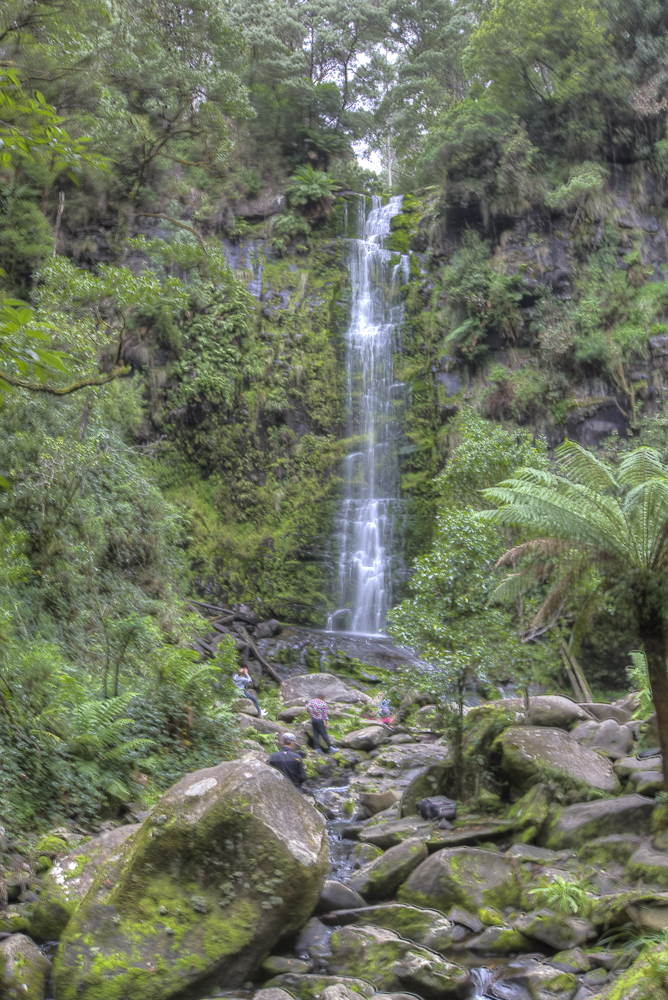
It looks across the fern-filled gorge towards the waterfall and provides a useful elevated view of the entire cascade.
This viewpoint is particularly useful for showing the relationship between the waterfall and the surrounding forest.
The waterfall itself occupies a relatively small part of the wider scene, so careful framing is important.
Recommended lenses: 24-70mm and 70-200mm.
Although a 16-35mm can include the broader rainforest, I would not automatically use the widest possible focal length.
A focal length between approximately 35mm and 100mm may give the waterfall substantially more visual presence.
-
Upper Lookout - Telephoto View
A 70-200mm lens is particularly valuable from the upper platform.
Rather than photographing the complete gorge, use the longer lens to isolate:
- The main waterfall.
- Individual tiers of falling water.
- Tree ferns framing the cascade.
- Moss-covered rock.
- Small sections of wet forest.
This is likely to produce stronger photographs than simply making multiple versions of the standard wide view.
-
Forest Approach
Do not regard the short walk to the lookout merely as access to the waterfall.
The surrounding forest is itself an important photographic subject.
Look for:
- Tree fern fronds.
- Wet bark.
- Moss-covered branches.
- Leading lines created by the path.
- Layers of vegetation.
- Small shafts of light through the canopy.
Recommended lenses: 24-70mm and 70-200mm.
-
Lower Viewing Platform - Currently Closed
The lower viewing platform and access to the base of the falls are currently closed following the January 2026 flood damage.
Under normal conditions, this is the principal photographic viewpoint at Erskine Falls.
The viewpoint is reached by descending a long staircase into the gorge and places the photographer close to the Erskine River at the base of the waterfall.
From here the waterfall becomes much more dominant within the frame.
Tree ferns, rocks and flowing water can all be used as foreground elements.
Recommended lenses: 16-35mm and 24-70mm.
When this viewpoint reopens, I would regard it as the primary Erskine Falls photography location.
-
Erskine River and Foreground Cascades - When Reopened
When lower access is restored, do not concentrate solely on the main waterfall.
The smaller flows of the Erskine River can provide excellent foreground material.
Look for:
- Water flowing around dark rocks.
- Small cascades.
- Moss-covered boulders.
- Reflections.
- Ferns arching over the river.
These foreground elements can lead the viewer naturally towards the main waterfall.
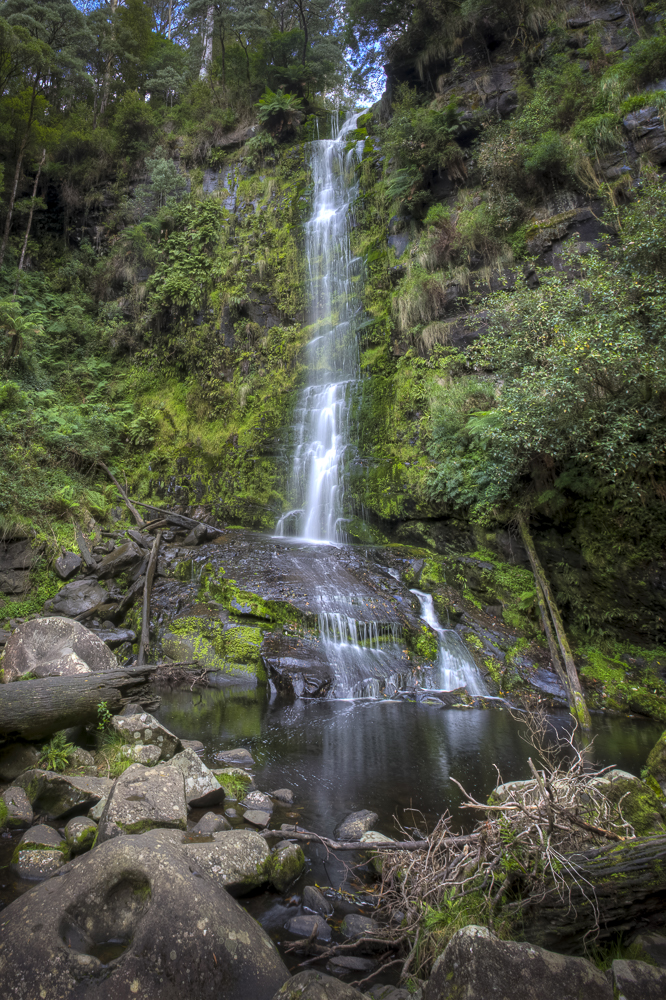
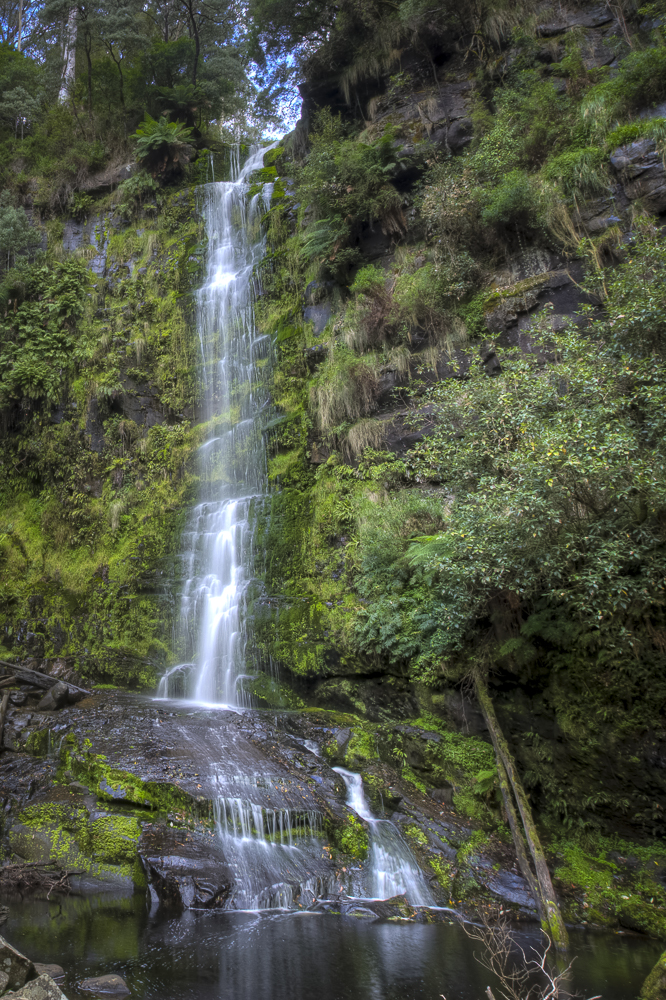
Water Flow & Conditions
Water flow varies with recent rainfall and season. Higher flow gives power and separated strands; moderate flow often preserves rock texture and is easier to expose. Never enter a creek or cross barriers to improve a composition.
Other Things to Look Out For
How I photographed Erskine Falls
What I took - what was in my kit
I took my LowePro Backpack loaded with Canon 5DMkII body, Canon 24-105mm zoom, Manfrotto 190 Tripod, and of course a range of lens wipes, spare batteries, sunscreen and bug repellant. I tended to shoot 28-55mm
Techniques
TBD
Location
Erskine Falls, Great Otway National Park near Lorne, Victoria
Approximate coordinates: -38.53050, 143.91400
Markers identify photographic objectives rather than guaranteed parking spaces or open access.
Apple Map – Waterfall and Nearby Photographic Locations
This Apple Map shows the principal subject and nearby photographic locations. Verify signs, road status and track conditions before relying on a marker for access.
Photographic locations
How to Get There
From Lorne
Erskine Falls is approximately a 10-minute drive inland from Lorne.
Follow Erskine Falls Road away from the coast and then continue along Erskine Falls Access Road to the waterfall car park.
From Melbourne
Lorne is approximately 150 km southwest of Melbourne.
The most scenic approach is via the Great Ocean Road through Torquay, Anglesea and Aireys Inlet.
From the Car Park
Under normal conditions:
- The upper lookout is approximately 300 metres return and normally requires around 15 minutes.
- The lower lookout is approximately 700 metres return and normally involves a long descent of more than 200 steps.
Current flood closures mean that only the upper viewing area should be considered accessible until official advice changes.
Parking and Large Vehicles
The Erskine Falls visitor car park is reached by a sealed access road.
For photographers travelling with a large caravan, I would leave the caravan at Lorne and drive to the falls without it.
This avoids the need to manoeuvre the Silverado and caravan together in a busy waterfall car park and makes it much easier to respond to changing weather or visit other nearby waterfalls.
Apple Map – Driving from the State Capital
The route ends at the road-accessible destination configured above. Driving distance and time are Apple Maps estimates.
State capital to destination
Calculating the driving route with Apple Maps…
Current Access / Conditions
Conditions checked: 22 September 2026.
Check Parks Victoria changed conditions and local road information before departure. Storm damage, fire, flooding and maintenance may temporarily close roads, tracks or platforms.
Follow all barriers and remain on formed public access. Do not enter flooded roads, unstable cliff edges, sensitive wetlands or closed tracks.
Best Time to Visit
Winter
Winter is one of the best periods for photographing Erskine Falls.
Higher water flow, wet vegetation and subdued light often produce the most atmospheric photographs.
The disadvantage is that paths and stairs may be particularly slippery.
Spring
Spring is probably the best all-round period.
Water flow is usually still worthwhile while the forest is lush and temperatures are more comfortable.
Summer
Summer can produce lower water flow and stronger patches of sunlight through the canopy.
This can create difficult contrast, particularly where bright sunlight strikes white water while the surrounding gorge remains dark.
Autumn
Autumn can provide quieter visitor conditions and attractive soft light, although waterfall flow depends substantially on recent rainfall.
Overcast Days
Overcast conditions are preferable to bright sunshine.
They provide:
- Lower contrast.
- Better colour saturation.
- Reduced glare from wet leaves.
- More even exposure across the waterfall and forest.
Immediately After Rain
A day after substantial rainfall can provide excellent conditions:
- Stronger water flow.
- Wet, dark rocks.
- Saturated moss.
- Fresh tree ferns.
- Atmospheric mist.
However, track closures, slippery surfaces and fallen-tree hazards should always be checked first.
Accessibility
Erskine Falls should not be described as fully wheelchair accessible.
The route to the upper lookout is relatively short and uses a formed, paved track, but steps are involved.
Consequently, visitors using wheelchairs or some mobility aids may not be able to reach the main upper viewing platform independently.
The normal route to the lower lookout is substantially more demanding.
It involves:
- A long stair descent.
- A correspondingly strenuous climb back to the car park.
- Wet and potentially slippery surfaces.
The lower route should therefore not be regarded as wheelchair accessible.
Photographers carrying tripods and heavy camera equipment should allow additional time for the return climb when the lower route eventually reopens.
Nearby Locations
Nearby photographic locations
Where to Stay
Lorne
Lorne is the obvious photographic base for Erskine Falls.
It allows photographers to combine the waterfall with:
- Sheoak Falls.
- Lower Kalimna Falls.
- Teddy's Lookout.
- Lorne Pier.
- Lorne foreshore.
- Great Ocean Road coastal viewpoints.
Lorne Foreshore Caravan Park
For caravan travellers, Lorne Foreshore Caravan Park offers powered caravan sites at several separate park areas around Lorne.
The Erskine River section includes:
- Powered sites.
- Water.
- Amenities.
- Accessible toilets.
- Camp kitchen.
Site sizes and access vary.
When booking with a large tow vehicle and caravan, provide the fully extended caravan length and advise the park that the tow vehicle is a Chevrolet Silverado 2500.
I would specifically ask for the easiest available site for a large rig rather than relying on automatic online allocation.
Photography Recommendations
16-35mm
The 16-35mm is most useful for environmental rainforest compositions and, when the lower platform eventually reopens, for including both foreground river rocks and the entire waterfall.
Avoid automatically photographing everything at 16mm.
Excessive width can make the waterfall appear surprisingly small.
24-70mm
This would be my principal lens at Erskine Falls.
It provides enough flexibility for:
- The full waterfall.
- Vertical compositions.
- Forest details.
- Moderately compressed views.
70-200mm
The 70-200mm is particularly important from the upper platform.
Use it for:
- Compressing the waterfall through the forest.
- Isolating individual cascades.
- Tree fern patterns.
- Rock and moss details.
- Abstract water movement.
Tripod
A tripod is highly desirable.
The forest is dark enough that relatively long exposures are often possible even without a strong ND filter.
Be considerate of other visitors and do not block narrow viewpoints.
Polarising Filter
A circular polariser is particularly useful here.
It can:
- Reduce glare from wet leaves.
- Reveal richer greens.
- Darken wet rock.
- Control reflections.
Rotate it carefully rather than assuming maximum polarisation is best.
Neutral Density Filters
A 3-stop or 6-stop ND filter can be useful if the available light is too bright to obtain the desired shutter speed.
However, the shaded forest often makes an ND filter unnecessary.
Shutter Speeds
I would deliberately photograph several shutter speeds.
-
1/30 to 1/10 second
Retains significant texture and structure in the falling water. -
1/8 to 1/4 second
Gives a good balance between movement and detail. -
1/2 to 2 seconds
Produces the familiar smooth waterfall effect. -
Several seconds
Creates very soft, ethereal water but can remove too much structure if overused.
I would make 1/4 to 1 second the starting point rather than automatically making extremely long exposures.
Protect the Highlights
White water can clip surprisingly quickly against the dark forest.
Expose carefully for the waterfall and recover darker forest areas later if necessary.
Bracketing can also be useful where the contrast is particularly high.
Vertical Compositions
Erskine Falls is naturally suited to vertical framing.
Try allowing the viewer's eye to move from:
- Foreground rocks or ferns.
- The lower cascade.
- The main fall.
- The surrounding canopy.
Use the Ferns as a Frame
Tree fern fronds make excellent natural framing elements.
Position them deliberately rather than simply allowing them to intrude randomly around the edge of the photograph.
Photograph the Forest as Well as the Waterfall
A successful Erskine Falls gallery should not contain ten near-identical long exposures.
Include:
- Forest.
- Ferns.
- Water details.
- Moss.
- Track and stairs.
- Wide environmental photographs.
- Tighter waterfall studies.
Photographing Moving Water
Photographing moving water
Begin around 1/4 to 1 second and adjust to retain texture in the flow. Use the polariser to manage glare, not simply to maximise saturation, and check the lens frequently for spray.
Suggested Photographic Sequence
I would use the following sequence:
-
Arrive early.
Photograph the wet forest around the car park before visitor numbers increase.
-
Walk slowly towards the upper platform.
Photograph ferns, moss, tree trunks and the path rather than heading directly for the waterfall.
-
Upper lookout - establishing image.
Begin with the complete waterfall and surrounding gorge.
-
Refine the composition.
Use 35-70mm to give the waterfall more visual weight.
-
Switch to the 70-200mm.
Make tighter waterfall photographs and isolate tree ferns around the cascade.
-
Experiment with shutter speed.
Make at least one photograph around 1/10-1/4 second and another around 1 second.
-
Forest details.
Photograph individual fern fronds, moss and wet tree trunks during the return walk.
-
Continue to another Lorne waterfall.
If current access permits, Sheoak Falls or Lower Kalimna Falls provide good complementary photographs.
-
Late afternoon - Teddy's Lookout.
Move from enclosed rainforest to an elevated Great Ocean Road landscape.
-
Sunset / blue hour - Lorne coast.
Finish around Lorne Pier, the foreshore or another safe coastal viewpoint.
When the Lower Lookout Reopens
Once official access to the base of Erskine Falls is restored, I would add:
- Classic wide waterfall photograph from the lower platform.
- Vertical waterfall composition.
- Foreground rocks and flowing Erskine River.
- 1/4-second water-texture photograph.
- 1-second smooth-water version.
- 70-200mm detail of individual cascades.
- Tree-fern-framed composition.
- A person included for scale where safe and appropriate.
How Long Should a Photographer Stay?
With only the upper viewpoint currently open, I would allow approximately 45-60 minutes for serious photography.
That provides time to photograph:
- The approach forest.
- The full waterfall.
- Telephoto details.
- Several shutter speeds.
- Forest details on the return walk.
When the lower platform reopens, increase this to approximately 1½-2 hours.
For a broader Lorne waterfall photography trip, I would stay at least two nights in Lorne.
Three nights would provide considerably more flexibility to respond to rainfall, cloud and changing coastal weather.
My Priority Photographs
- The complete waterfall surrounded by dense green forest.
- A tighter 70-200mm photograph giving the waterfall greater prominence.
- A vertical composition showing the full height of the cascade.
- Tree ferns forming a natural frame around the waterfall.
- A 1/10-1/4 second exposure retaining detail in the falling water.
- A smoother 1-second exposure for comparison.
- Telephoto detail of water flowing across dark rock.
- Wet moss and fern detail after rain.
- Repeating tree trunks compressed with the 70-200mm.
- A photograph of the forest approach to establish the environment.
- A track or stair composition leading into the rainforest.
- Mist or light rain through the tree ferns if conditions occur.
- Fungi or small forest details if present.
- After the lower platform reopens, the classic waterfall and foreground-river composition from below.
- After reopening, a person near the lower viewing area to demonstrate the scale of the gorge and waterfall.
Waterfall Information
| Waterfall | Erskine Falls |
|---|---|
| Approx. drop | 30 m (approximate) |
| Setting | Great Otway National Park near Lorne, Victoria |
| Best flow | After sustained rain, subject to safe access |
Include only facts that can be verified. Remove rows that are not relevant or cannot be reliably documented.
Photo Subjects
Explore related Auspano photography guides by subject.
Photographer Comments & Updates
Have you photographed this location? Share your photographs, viewpoints, photography tips or recent access updates, or ask a question about visiting. When uploading your own photographs, please include your name and the date each photograph was taken. Date any access or track-condition observations; visitor reports may become outdated, so check official information before travelling.