Photographing Sheoak Falls
About Sheoak Falls
Sheoak Falls is an attractive waterfall in the Great Otway National Park, approximately 5 km south-west of Lorne along the Great Ocean Road.
Sheoak Creek descends approximately 15 metres over a dark rock face into a sheltered pool surrounded by forest.
The standard walk begins at the Sheoak Falls Carpark beside the Great Ocean Road and follows a walking track for approximately 600 metres to the falls.
Although relatively short, the walk passes through several different photographic environments:
- Coastal woodland.
- Elevated views towards the Southern Ocean.
- Sheoak Creek.
- Wet forest.
- Rocky creek crossings.
- The waterfall and plunge pool.
This makes Sheoak Falls more photographically varied than its short walking distance might suggest.
The waterfall is particularly attractive after substantial rainfall, when the main cascade becomes much broader and more powerful.
Current Access - September 2026
At the time of writing, I have not found a current Parks Victoria closure specifically affecting the standard Sheoak Falls Walk.
Access conditions can nevertheless change after:
- Heavy rainfall.
- Flooding.
- Storm damage.
- Fallen trees.
- Fire or park-management operations.
The route includes a creek crossing using stepping stones. Following heavy rain, the stones can become slippery or the creek may become difficult to cross.
Check current Parks Victoria Great Otway National Park alerts and weather conditions immediately before visiting.
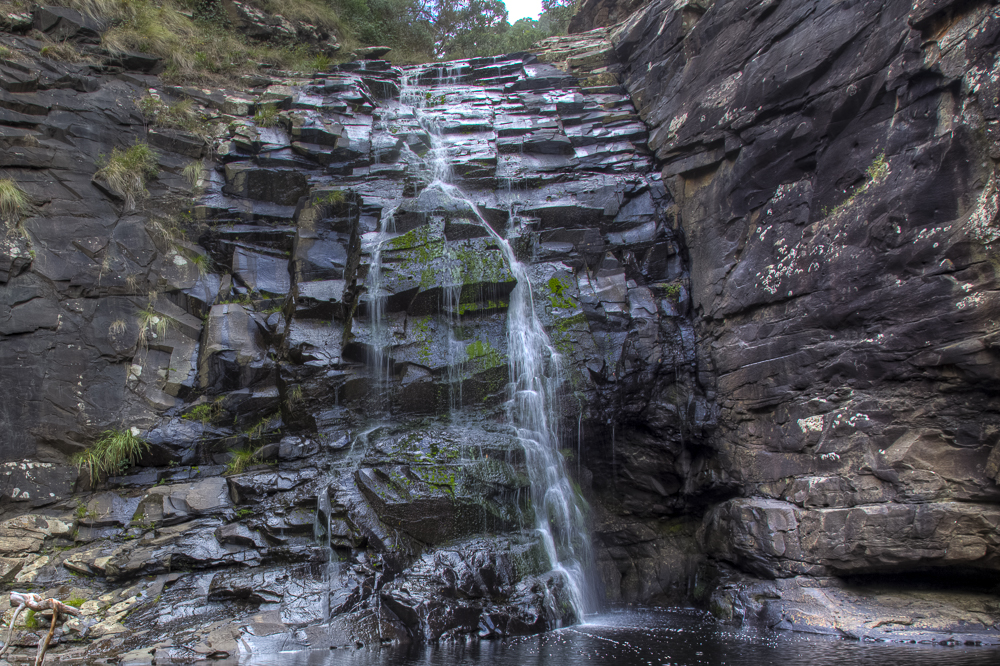
Sheoak Falls is about 6km from the town of the hoilday / beach town of Lorne. The falls are a a reasonable short drop into a pool. During summer, these falls reduce to a trickle (as in the above photo). After heavy rains though a torrent poors down and it brings branches which end up in the pool. I have cropped the bulk of the pool out of the above photo due the amount of branches that were visible and distracting. Vistors to this waterfall can also stop at the nearby swallow cave attraction. The falls are not far from the car park. They are also on a nice 7km walk that takes in Castle Rock. A picnic spot is nearby to make an outing oof a visit here. This all makes the falls a reasonably busy tourist attraction, so if you are going to photograph the falls, try to get there early and after good rains.
Viewpoints
-
Main Sheoak Falls View
The principal photographic position is at the base of the falls, where Sheoak Creek descends over the rock face into the pool.
The classic composition combines:
- The complete waterfall.
- The dark rock face.
- The plunge pool.
- Surrounding vegetation.
Recommended lens: 24-70mm.
I would begin at approximately 28-40mm rather than automatically using an ultra-wide lens.
This keeps the waterfall sufficiently large in the frame while retaining enough of the surrounding forest to establish the location.
-
Vertical Waterfall Composition
The shape of Sheoak Falls lends itself particularly well to portrait-orientation photographs.
Try arranging the frame as:
foreground pool → waterfall → upper rock face → surrounding vegetation.
A vertical composition can reduce distracting vegetation at the sides while emphasising the height of the waterfall.
-
Pool and Waterfall
Include more of the plunge pool when conditions are calm enough to create useful reflections or water patterns.
Look for:
- Reflections.
- Ripples.
- Floating leaves.
- Rocks breaking the water surface.
A circular polariser can be used either to remove surface reflections or, by rotating it differently, deliberately retain them.
-
Telephoto Waterfall Details
The 70-200mm provides useful alternatives to the standard full-waterfall photograph.
Look for:
- The lip of the waterfall.
- Individual ribbons of falling water.
- Water striking the pool.
- Wet rock textures.
- Small plants growing on the rock face.
These tighter photographs become particularly effective when the waterfall has a strong flow.
-
Sheoak Creek
Do not ignore Sheoak Creek while concentrating on the main waterfall.
Look for smaller photographic subjects including:
- Water flowing between rocks.
- Small cascades.
- Reflections.
- Wet vegetation.
- Stepping stones.
These quieter photographs can provide useful transitions within the final Auspano gallery.
-
Coastal Woodland
The walking track initially passes through coastal woodland rather than the deep rainforest associated with many other Otway waterfalls.
This gives Sheoak Falls a noticeably different photographic character.
Look for:
- Twisted coastal trees.
- Backlit foliage.
- Walking-track leading lines.
- Birdlife.
- Contrasts between woodland and ocean.
-
Southern Ocean Views
Parts of the approach provide elevated views towards the Southern Ocean and Great Ocean Road coastline.
These provide a useful photographic contrast to the enclosed waterfall.
A 70-200mm lens can be particularly useful for:
- Coastal headlands.
- Breaking waves.
- Ocean patterns.
- Distant wildlife.
During the whale migration season, keep an eye on the ocean for Southern Right Whales and other cetaceans.
-
Swallow Cave
Photographers with additional time should consider continuing beyond Sheoak Falls towards Swallow Cave.
This extends the photographic story beyond the main waterfall and provides additional creek, rock and forest subjects.
The longer route involves more demanding terrain than the standard Sheoak Falls return walk.
Check current track conditions before continuing.
Google Map - Sheoak Falls Photographic Viewpoints
Water Flow & Conditions
Water flow varies with recent rainfall and season. Higher flow gives power and separated strands; moderate flow often preserves rock texture and is easier to expose. Never enter a creek or cross barriers to improve a composition.
Other Things to Look Out For
I took my LowePro Backpack loaded with Canon 5DMkII body, Canon 24-105mm zoom, Manfrotto 190 Tripod, and of course a range of lens wipes, spare batteries, sunscreen and bug repellant. I tended to shoot 28-55mm
Techniques
As with any waterfall, I want to blur the water but not the surrounding vegitation. That means using a long exposure and a tripod. I could have used NR filters, but in this case I didnt. I simply changed the aperature to suit. I was already shooting at ISO 100.
Location
Sheoak Falls, Great Otway National Park near Lorne, Victoria
Approximate coordinates: -38.55100, 143.96900
Markers identify photographic objectives rather than guaranteed parking spaces or open access.
Apple Map – Waterfall and Nearby Photographic Locations
This Apple Map shows the principal subject and nearby photographic locations. Verify signs, road status and track conditions before relying on a marker for access.
Photographic locations
How to Get There
The best way to get to the falls is by car. It can be accessed by bike or walking from the town of Lorne. The falls are about 150km from Melbourne (2.5 hours drive) and about 9km from the town of Lorne by road and 7.5 via the walking track (past Splitter and Staw Falls).
If taking a car from Lorne, take the Great Ocean Road south (away from Melbourne). After some 5km the falls are on your right and clearly signposted.
From Lorne
Drive south-west from Lorne along the Great Ocean Road towards Wye River and Apollo Bay.
The Sheoak Falls Carpark is approximately:
- 5 km from Lorne.
- About 10 minutes by car.
Park at the signed Sheoak Falls Carpark and follow the walking track towards Sheoak Creek and the waterfall.
Alternative Access from Sheoak Picnic Area
A longer approach is available from Sheoak Picnic Area.
This route is approximately 3.6 km and is better suited to visitors wanting a longer forest walk rather than the shortest access to the falls.
The Sheoak Falls Walk
The standard return walk from the Great Ocean Road car park is approximately:
- 1.2 km return.
- Approximately 30 minutes.
- Moderate.
The waterfall is approximately 600 metres from the car park.
The track passes through coastal woodland before reaching Sheoak Creek.
Expect:
- Steps.
- Steeper sections.
- Natural walking surfaces.
- A creek crossing using stepping stones.
Conditions become considerably more slippery after rain.
The official 30-minute walking time is not realistic for serious photography.
Safety
Rocks and stepping stones can become extremely slippery after rain.
Creeks in the Lorne waterfall system can also rise rapidly following heavy rainfall.
Do not enter the plunge pool simply to obtain a photographic position.
Regional visitor advice specifically warns that swimming at waterfalls is unsafe because of slippery rocks and submerged branches.
Stay on the formed track and use established photographic positions.
Facilities
The Sheoak Falls Carpark is a relatively simple roadside visitor area.
Regional tourism information states that:
- The car park has a smooth surface.
- Vehicle circulation within the parking area is good.
- There are no toilets at the Sheoak Falls Carpark.
- There are no picnic facilities at the car park.
The nearest major facilities are in Lorne.
Alternatively, Sheoak Picnic Area has parking, picnic facilities and toilets.
Parking and Large Vehicles
Parking is provided beside the Great Ocean Road at the Sheoak Falls Carpark.
For a large tow vehicle there should generally be less difficulty than at many small forest trailheads, but parking availability depends on visitor numbers.
I would not tow a large caravan into the car park merely to photograph the falls.
Leave the caravan at the accommodation base and use the tow vehicle alone.
This is particularly sensible because the car park sits directly beside the Great Ocean Road, where entering, turning and rejoining traffic are considerably easier without a long combination.
Apple Map – Driving from the State Capital
The route ends at the road-accessible destination configured above. Driving distance and time are Apple Maps estimates.
State capital to destination
Calculating the driving route with Apple Maps…
Current Access / Conditions
Conditions checked: 22 September 2026.
Check Parks Victoria changed conditions and local road information before departure. Storm damage, fire, flooding and maintenance may temporarily close roads, tracks or platforms.
Follow all barriers and remain on formed public access. Do not enter flooded roads, unstable cliff edges, sensitive wetlands or closed tracks.
Best Time to Visit
These are falls that need water running over them, so post reasonable rains is best. This is likely to mean late winter / early spring. During this time the local vegitation is also greener and richer. During the summer months this can become a reasonably busy tourist spot - meaning that you might have to wait 15min to get the shot you want without people in the shot.
Winter
Winter is one of the best periods for Sheoak Falls.
Advantages include:
- Higher probability of good water flow.
- Wet dark rock.
- Saturated vegetation.
- Soft light.
- Lower visitor numbers.
The disadvantages are wet steps, slippery rocks and potentially difficult creek crossings.
Spring
Spring is probably the best all-round period.
Water flow can remain good while conditions become more comfortable for walking and photography.
Autumn
Autumn can also be excellent following useful rainfall.
Softer light and lower visitor numbers can be advantageous.
Summer
Summer flow can be considerably reduced after extended dry periods.
If visiting during summer, check recent rainfall rather than assuming the waterfall will resemble photographs taken during winter.
Overcast Conditions
Bright overcast conditions are ideal for the waterfall itself.
They provide:
- Lower contrast.
- Better colour saturation.
- Longer natural shutter speeds.
- Better control of bright waterfall highlights.
After Rain
Parks Victoria notes that Sheoak Falls is at its finest after several days of heavy rainfall.
Photographing shortly after the rain has passed is preferable to visiting during severe weather.
Always check the creek crossing before proceeding.
Accessibility
There are two viewing platforms: the upper viewing platform and lower. The upper is a short 5 minute walk from the car park, while the lower platform is down some 240 steps to the bottom of the falls.
The photograph above was taken from the Lower Platform. In this case the weather was overcast and the sky just a uniform grey. While I love a bright blue sky contrasting with the lush green to found around waterfalls - I dont like grey at all, so I composed the shot to crop it out.
The Sheoak Falls Carpark itself has a relatively smooth surface and good vehicle circulation.
However, the walking track to the waterfall is not wheelchair accessible.
The route contains:
- Steep sections.
- Numerous steps.
- Natural surfaces.
- A stepping-stone creek crossing.
Visitors with limited mobility should therefore not assume that the short 600-metre distance makes this an easy-access waterfall.
Photographers carrying a tripod and heavy camera bag should also allow additional time on the steps and creek crossing.
Nearby Locations
Nearby photographic locations
Where to Stay
Lorne
Lorne is an obvious choice here. It ia lovely town with many attractions, good hotels, a nice caravan park, and lots of nice and inexpensive resturants. If travelling in the summer / holiday period though, you will need to book.
It is only about 10 minutes from the waterfall and provides convenient access to:
- Sheoak Falls.
- Erskine Falls.
- Phantom Falls.
- Henderson Falls.
- Upper and Lower Kalimna Falls.
- Teddy's Lookout.
- Lorne Pier.
- The Great Ocean Road coastline.
For a photographer, Lorne is therefore much more useful as a multi-night base than simply somewhere to stop for lunch while travelling the Great Ocean Road.
Visitors towing a large caravan should confirm site dimensions and turning space directly with their chosen caravan park.
Slight west of Lorne is Apollo Bay. I also recommend this for accomodation. The same can be said of Apollo Bay. It is further from these falls though.
Photography Recommendations
Wide Angle
Useful for:
- Wide environmental waterfall photographs.
- Plunge-pool foregrounds.
- Coastal woodland.
- Dramatic foreground rocks.
I would not automatically photograph the waterfall at 16mm.
Try approximately 20-28mm for wider compositions while retaining sufficient prominence in the waterfall.
Zoom Lens
This would be my principal lens at Sheoak Falls.
It is ideal for:
- The classic waterfall composition.
- Vertical images.
- Pool and waterfall combinations.
- Creek details.
- Woodland photography.
I would initially try approximately 28-40mm at the main falls.
Telephoto Zoom
A 70-200mm Telephoto Zoom is worth carrying.
It is useful for:
- Waterfall details.
- Wet-rock patterns.
- Water striking the pool.
- Coastal landscapes.
- Birdlife.
- Whales if present offshore.
Tripod
A tripod is highly recommended for the waterfall.
Keep the tripod compact while walking and avoid obstructing other visitors at narrow sections of the track.
Circular Polariser
A circular polariser is extremely useful.
It can control reflections from:
- Wet rock.
- Leaves.
- The plunge pool.
- Sheoak Creek.
Rotate it while watching the effect rather than automatically applying maximum polarisation.
Neutral Density Filter
A 3-stop ND filter may be useful during brighter conditions.
In subdued forest light, the combination of low ISO, small aperture and polariser may already provide sufficiently slow shutter speeds.
Shutter Speeds
Photograph several shutter-speed variations.
-
1/30 to 1/10 second
Retains texture and energy in the falling water. -
1/8 to 1/4 second
Provides a good balance between texture and movement. -
1/2 to 2 seconds
Produces a smoother traditional waterfall appearance. -
Several seconds
Produces a very soft waterfall and smoother plunge pool.
My starting point would be approximately 1/4 to 1 second.
Protect the Highlights
The white water can be substantially brighter than the surrounding rock and vegetation.
Check the histogram and preserve detail in the brightest water.
Suggested photographic sequence
-
Photograph the coastal section first.
Look for ocean views, coastal woodland and birdlife before descending towards the creek.
-
Walking-track photographs.
Make one or two images explaining the approach to the falls.
-
Sheoak Creek.
Photograph stepping stones, flowing water and small details.
-
First view of Sheoak Falls.
Make an environmental photograph before moving to tighter compositions.
-
Classic waterfall composition.
Begin with the 24-70mm at approximately 28-40mm.
-
Vertical composition.
Include the pool, waterfall and vegetation above.
-
Vary shutter speed.
Try approximately 1/8, 1/4, 1/2 and 1 second where light permits.
-
Use the circular polariser.
Compare versions retaining and removing reflections from the pool.
-
Switch to the 70-200mm.
Photograph water, rock and vegetation details.
-
Continue towards Swallow Cave if conditions permit.
This adds variety and turns a short waterfall visit into a more complete photographic walk.
-
Finish with a coastal location.
Teddy's Lookout or Lorne Pier can provide an excellent contrast to the enclosed waterfall environment.
Photographing Moving Water
Photographing moving water
Begin around 1/4 to 1 second and adjust to retain texture in the flow. Use the polariser to manage glare, not simply to maximise saturation, and check the lens frequently for spray.
Suggested Photographic Sequence
- Record the trail and forest context on the approach.
- Make the principal fall composition before the area becomes busy.
- Work tighter studies of water, rock and ferns.
- Return to the main frame if cloud softens the contrast.
How Long Should a Photographer Stay?
The standard walk is officially approximately 30 minutes return.
For serious photography I would allow approximately 1½-2 hours.
This provides time for:
- Coastal photographs.
- The woodland walk.
- Sheoak Creek.
- The complete waterfall.
- Several shutter speeds.
- Telephoto details.
If continuing to Swallow Cave or exploring the longer trail system, allow substantially more time.
My Priority Photographs
- Classic full view of Sheoak Falls.
- Vertical composition including the plunge pool.
- Wide environmental waterfall photograph.
- Approximately 1/8-second waterfall retaining texture.
- Approximately 1/2-second version.
- Approximately 1-second smooth-water version.
- Reflection in the plunge pool.
- Water striking the pool photographed with the 70-200mm.
- Detail of falling water against dark wet rock.
- Sheoak Creek and stepping stones.
- Small creek cascade.
- Wet rock and vegetation detail.
- Walking track through coastal woodland.
- Coastal view from the approach.
- Breaking Southern Ocean waves with the 70-200mm.
- Birdlife if encountered.
- Whale offshore if fortunate enough to encounter one.
- Swallow Cave if the walk is extended.
Waterfall Information
| Waterfall | Sheoak Falls |
|---|---|
| Approx. drop | 15 m (approximate) |
| Setting | Great Otway National Park near Lorne, Victoria |
| Best flow | After sustained rain, subject to safe access |
Include only facts that can be verified. Remove rows that are not relevant or cannot be reliably documented.
Photo Subjects
Explore related Auspano photography guides by subject.
Photographer Comments & Updates
Have you photographed this location? Share your photographs, viewpoints, photography tips or recent access updates, or ask a question about visiting. When uploading your own photographs, please include your name and the date each photograph was taken. Date any access or track-condition observations; visitor reports may become outdated, so check official information before travelling.