Photographing Port Fairy
About Port Fairy
Port Fairy is a picturesque historic fishing village on Victoria's south-west coast, approximately 25 kilometres west of Warrnambool. It lies near the western end of the Great Ocean Road and is one of the most photogenic small towns along Victoria's coastline.
Originally known as Belfast, Port Fairy developed as an important nineteenth-century fishing, whaling and trading port. Today much of that history remains visible in its bluestone buildings, nineteenth-century cottages, old churches, wharves and maritime structures. Visit Victoria describes it as the last destination on the Shipwreck Coast and highlights its nineteenth-century cottages, stone churches and maritime character.
For photographers, Port Fairy's great advantage is its variety. Within a few kilometres you can photograph the Griffiths Island Lighthouse, fishing boats on the Moyne River, historic streetscapes, beaches, rock pools, waves, seabirds and wildlife.
The town is also small enough that many of its best photographic locations can be reached on foot.
Viewpoints
Unfortunately for us, when we visited the road to Griffiths Island was closed for roadworks. This meant some of the best photographic locations were not available to us.
1. Griffiths Island Lighthouse
This is the must-photograph location in Port Fairy.
Griffiths Island lies at the mouth of the Moyne River and is reached by a pedestrian causeway. A walking track leads through coastal vegetation to the lighthouse at the eastern end of the island.
The lighthouse was built in 1859 from local bluestone and remains operational.
Best for: lighthouse landscapes, sunrise, seascapes, wildlife and bird photography.
Best light: sunrise.
The official Great Ocean Road tourism site specifically recommends an early-morning visit for sunrise. The lighthouse is approximately a 20-minute walk from the Martin's Point car park.
Photography tip: Don't arrive at sunrise. Allow at least 30–40 minutes before sunrise so you have time to walk to the lighthouse and select a composition while there is still colour in the sky.
A 16–35 mm or 24–70 mm lens works particularly well. A longer lens can produce attractive compressed compositions of the lighthouse from East Beach.
Approximate lighthouse GPS: -38.3909, 142.2543.
2. Moyne River and Fisherman's Wharf
The Moyne River is one of Port Fairy's strongest photographic subjects.

Fishing boats, yachts, jetties, reflections and historic buildings provide numerous compositions along the river. The Fisherman's Wharf area is particularly attractive, and the pedestrian bridge provides elevated views along the river.
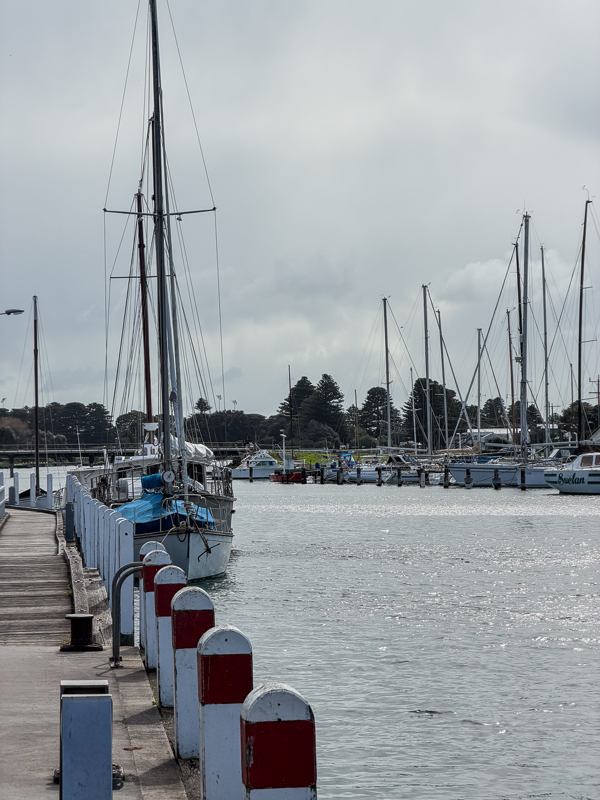
Best for: fishing boats, reflections, maritime details, sunrise and blue-hour photography.
Best light: early morning.
On a still morning, the boats reflected in the Moyne can produce some of the best photographs in Port Fairy.
A 24–70 mm is probably the most useful lens, although a telephoto is excellent for isolating individual boats and details.
3. Griffiths Island Causeway and Moyne River Mouth
The area around Martin's Point where the Moyne River enters the sea provides several good compositions.
From here you can photograph:
- boats entering and leaving the river
- Griffiths Island
- the river mouth
- coastal vegetation
- East Beach
- sunrise over Port Fairy Bay.
This is also the starting point for the Griffiths Island walk.
4. East Beach
East Beach forms a long sweeping arc on the eastern side of Port Fairy. From its southern end there are excellent views towards Griffiths Island and its lighthouse.
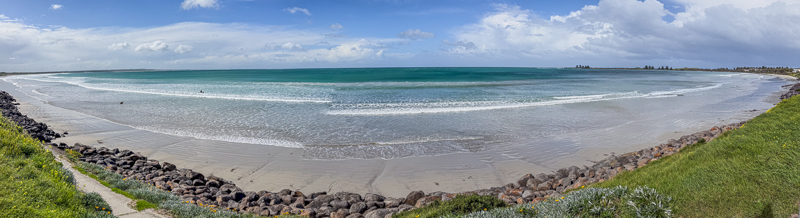
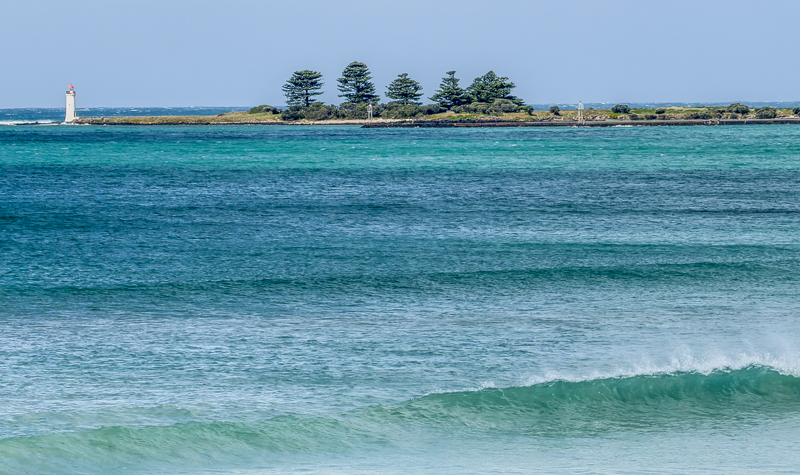
Best for: sunrise, reflections, minimalist seascapes, waves and distant lighthouse compositions.
Best light: sunrise and early morning.
A particularly effective composition is to use a 70–200 mm or longer lens to compress the lighthouse against the sea and sky.
After rain or around low tide, look for reflections in the wet sand.
5. Pea Soup Beach / South Beach
Pea Soup is very different from East Beach.
Basalt reefs offshore shelter a series of small coves, producing lagoons, rock pools and rocky foregrounds. At low tide the reefs provide numerous opportunities for foreground interest.
Best for: sunsets, rock pools, long exposures, reflections and intimate coastal landscapes.
Best light: late afternoon and sunset.
This is one of my preferred Port Fairy locations for wide-angle landscape photography.
Try a 16–35 mm lens with the tripod positioned relatively low, using rocks and pools as foreground elements leading towards the sunset.
6. Battery Hill
Battery Hill sits above the southern side of the Moyne River and contains remnants of Port Fairy's nineteenth-century coastal defences.
It provides views across the river and towards the ocean.
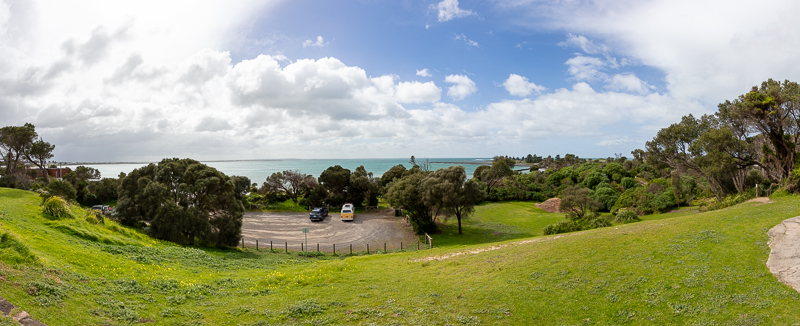
Best for: maritime history, cannons, river views and broader Port Fairy landscapes.
It is particularly useful if you want photographs that explain Port Fairy's historical character rather than purely scenic landscapes.
7. Port Fairy Historic Precinct
Don't overlook the town itself.
Port Fairy has an unusually large collection of historic buildings, cottages, churches and commercial buildings.
Good streets for wandering with a camera include:
Sackville Street, Bank Street, Cox Street, Gipps Street and William Street.
Look for:
- bluestone buildings
- old cottages
- churches
- verandahs
- heritage shopfronts
- old stone walls
- mature Norfolk Island pines.
Best light: early morning or late afternoon.
An overcast day can actually be preferable for architectural photography because it eliminates harsh shadows.
8. Port Fairy Wharf at Blue Hour
Return to the Moyne River 20–30 minutes after sunset.
Artificial lights begin appearing around the wharf while sufficient blue remains in the sky to balance them.
With calm conditions this can produce beautiful reflections.
A tripod and exposures of several seconds can transform an otherwise ordinary harbour scene.
9. Griffiths Island Wildlife
Griffiths Island isn't just a lighthouse location.
The 37-hectare island contains coastal scrub and grassland and supports wildlife including swamp wallabies. It is also an important breeding site for short-tailed shearwaters, traditionally called mutton-birds.
The birds are particularly interesting between September and April.
Carry a 100–500 mm or similar telephoto if wildlife photography is important to you.
Stay on the designated tracks and avoid approaching nesting birds.
How I photographed Port Fairy
What I took - what was in my kit
I took my LowePro Backpack loaded with Canon 5DMkII body, Canon 24-105mm zoom, Manfrotto 190 Tripod, and of course a range of lens wipes, spare batteries, sunscreen and bug repellant. I tended to shoot 28-55mm
Techniques
TBD
Other things to look out for
Port Fairy makes an excellent base for exploring the surrounding coast. All of the following are approximately within an hour's drive.
The Crags — approximately 15 minutes
Highly recommended for photographers.
About 12 kilometres west of Port Fairy, The Crags is a rugged coastal reserve containing cliffs, rocky islands and dramatic Southern Ocean views.
From the lookout there are views towards Deen Maar (Lady Julia Percy Island) offshore. The official tourism information specifically recommends The Crags for sunrise.
Address: 241 Crags Road, Yambuk.
Best for: sunrise, stormy seas, telephoto landscapes and dramatic coastal photography.
Killarney Beach — approximately 10–15 minutes
Killarney is a quieter coastal location between Port Fairy and Warrnambool.
Offshore reefs create interesting shapes and can provide excellent foreground elements.
Best for: minimalist seascapes, long exposures, sunrise/sunset and reflections.
Because it receives far fewer visitors than Port Fairy's main beaches, it can be particularly good for uncluttered landscape photography.
Tower Hill Wildlife Reserve — approximately 15–20 minutes
Tower Hill should be near the top of the list for anyone interested in wildlife photography.
The reserve occupies an extinct volcanic crater and provides opportunities to photograph:
koalas, emus, kangaroos, wallabies and numerous bird species.
Tower Hill is accessed directly from the Princes Highway.
Best time: early morning and late afternoon.
Recommended lens: 100–500 mm or similar.
Take a wide-angle lens as well—the volcanic landscape itself is worth photographing.
Warrnambool — approximately 25–30 minutes
Warrnambool provides numerous additional photographic opportunities, particularly:
Thunder Point, Stingray Bay, Middle Island, Warrnambool Breakwater, Hopkins River Mouth and Logans Beach.
During winter, Logans Beach is particularly important for Southern Right Whale photography.
Yambuk — approximately 20 minutes
The Yambuk district provides wetlands, dunes, farmland and coastal landscapes.
The famous Yambuk Slide descends a large sand dune near Yambuk Lake and can make an unusual photographic subject.
The lake itself is worth investigating around sunrise when conditions are calm.
Deen Maar / Lady Julia Percy Island
You won't drive onto this one—it lies offshore—but it frequently appears in photographs from The Crags and the coast west of Port Fairy.
The island provides an excellent distant focal point when photographing sunsets and coastal landscapes with a telephoto lens.
Budj Bim Cultural Landscape — approximately 45–60 minutes
For a completely different photographic and cultural experience, head north-west into the Budj Bim landscape.
This volcanic country is of enormous cultural importance to the Gunditjmara people and is very different from Port Fairy's coastline.
If visiting culturally significant areas, use designated visitor areas and follow any photography restrictions or guidance provided by Traditional Owners.
Location
Port Fairy & Region Visitor Information Centre
Address:
4 Bank Street / Railway Place
Port Fairy VIC 3284
Australia
Port Fairy town centre GPS: approximately
-38.3855, 142.2367
Griffiths Island Lighthouse:
-38.3909, 142.2543
Techniques used
- Techniques
- Normal Style
- Long Exposures
- Nuetral Density Filters
- High Dynamic Range
- Focus Stacking
- Remove People
- Photo Stitching
- Movements
- Tombstoning
- ISO
- Shutter Speed
- Depth of Field
- Diffraction
- Moving the eye around the picture
- Golden and Blue Hour
- Infra-Red Photography
- Raw vs JPG (JPEG)
- Camera Modes
- Expose to the Right
- Sharpness
- Fore, Middle, Far
- Rule of Thirds
Kit used
How to get there
Driving from Melbourne
Port Fairy is roughly 290 km west of central Melbourne.
The most direct route is:
Melbourne → Geelong → Colac → Camperdown → Terang → Warrnambool → Port Fairy
using the M1 and Princes Highway.
Allow approximately 3½–4 hours driving time, depending on traffic and stops.
For photographers, however, there is a much better alternative.
Via the Great Ocean Road
Allow at least a full day—and preferably two or three days—and travel:
Melbourne → Geelong → Torquay → Lorne → Apollo Bay → Twelve Apostles → Port Campbell → Warrnambool → Port Fairy.
This transforms the journey into a photographic trip in its own right.
Major photographic stops include:
Bells Beach → Split Point Lighthouse → Lorne → Cape Patton → Apollo Bay → Gibson Steps → Twelve Apostles → Loch Ard Gorge → London Bridge → Bay of Islands → Warrnambool → Port Fairy.
I would strongly recommend this route for an overseas photographer visiting Port Fairy for the first time.
Train and coach
There is no passenger railway station at Port Fairy.
The practical public-transport option from Melbourne is to take a V/Line train from Southern Cross Station to Warrnambool, then connect with a bus/coach service to Port Fairy. Transport Victoria confirms Warrnambool rail services connect with bus and coach services to Port Fairy.
V/Line journey planner
For a photographer carrying a tripod and several lenses, I would still strongly favour a car because many of the best surrounding locations aren't conveniently accessible by public transport.
Walking
Port Fairy itself is extremely walkable.
A particularly good photographic walking route is:
Town centre → Moyne River → Fisherman's Wharf → Martin's Point → Griffiths Island → Lighthouse → return via the island → East Beach.
The lighthouse is about a 20-minute walk from Martin's Point, although you should allow considerably longer if stopping to photograph wildlife and coastal scenery.
Best time to visit
Port Fairy can be photographed throughout the year, but the character changes considerably with the seasons.
Autumn — March to May
Possibly the best all-round period for landscape photography.
Autumn often provides relatively mild conditions, fewer summer visitors and attractive early and late light.
March and early April also overlap with the short-tailed shearwater season on Griffiths Island.
Good for: lighthouse, harbour, architecture, beaches and sunsets.
Winter — June to August
Winter is excellent for photographers prepared to tolerate cold, wet and windy conditions.
The Southern Ocean becomes much more dramatic, producing large seas and excellent conditions for photographing waves and storm fronts.
It is also Southern Right Whale season. Local tourism information describes whales migrating along this coast during roughly June–October, with occasional sightings from East Beach.
Good for: whales, dramatic skies, storm photography and moody seascapes.
Another advantage is the much later sunrise—considerably more civilised for photographers than a 5:30 am summer start.
Spring — September to November
Spring is probably the best combination of landscape and wildlife photography.
The surrounding countryside is green, wildflowers and coastal plants are active, and the short-tailed shearwaters begin returning to Griffiths Island.
The official tourism information identifies September through April as the particularly interesting period for birdwatching on Griffiths Island.
September may also overlap with the Southern Right Whale season.
Summer — December to February
Summer provides warmer weather, very long evenings and better conditions for beach photography.
The disadvantages for serious photographers are very early sunrises, more visitors and harsher middle-of-the-day light.
It is nevertheless an excellent period for photographing Griffiths Island's shearwaters and for evening photography around Pea Soup and the Moyne River.
Best overall photographic period
For a dedicated photography trip I would choose September–October or March–April.
September–October provides green landscapes, active birdlife, dramatic weather and a chance of whales.
March–April is particularly attractive if you prefer somewhat more settled weather, fewer visitors and good sunrise/sunset conditions.
For Griffiths Island Lighthouse, I'd make sunrise the priority. For Pea Soup and South Beach, concentrate on sunset. For Moyne River, try both sunrise and blue hour. For The Crags, sunrise and dramatic weather are particularly worthwhile.
Port Fairy deserves at least two nights for photography. That gives you two opportunities at the Griffiths Island lighthouse at sunrise and two sunsets to divide between Pea Soup/South Beach and The Crags. It also leaves a morning or afternoon for Tower Hill wildlife photography.
Accessability
The town of Port Fairy is on a major road that is tarmac. Any 2wd car or motorbike etc. can get there. Almost all locations were also fine to drive to (if they were not closed for road works :-( ). There are many locations around Port Fairy that are wheelchair accessable, and many / most of the areas are suitable for bikes and trikes.
Where to stay
For photographers I would favour accommodation either near the Moyne River or on the southern side of town, giving quick access to Griffiths Island before sunrise.
Boutique / luxury
Drift House, Small Luxury Hotel — 96 Gipps Street. An attractive boutique option close to the Moyne River and within easy reach of Griffiths Island.
The Oak & Anchor Hotel — 9 Bank Street. A boutique hotel in the centre of historic Port Fairy, particularly convenient for photographing the town and river.
Old Market Inn Port Fairy | Luxury Accommodation — 51 William Street. A small luxury accommodation option within walking distance of the centre.
Historic / moderately priced
Seacombe House Accommodation — 22 Sackville Street. Very centrally located and useful for exploring the historic town on foot.
Clonmara Country House and Cottages — 106 Princes Highway. Cottage-style accommodation slightly away from the immediate centre.
Waterfront / B&B style
The Boatshed Waterfront B&B Port Fairy — 39 Gipps Street. Its location on the Moyne River makes this particularly appealing for photographers wanting to be near the wharf before sunrise.
Edge 17 - Port Fairy Wharf Accommodation — 17 Gipps Street. Another particularly useful location for river and harbour photography.
Caravan parks
Gardens Caravan Park — 111 Griffiths Street. This would be one of my first choices for a photographer with a caravan, because it is beside the Moyne River, close to East Beach and within easy reach of Griffiths Island. The local caravan-park authority confirms it is beside the Botanic Gardens on the river and close to East Beach.
Southcombe Caravan Park — James Street. Another excellent photographic location, close to South Beach/Pea Soup and within walking distance of town.
BIG4 Port Fairy Holiday Park — 115 Princes Highway. A good family-oriented option with cabins and caravan facilities.
Port Fairy Holiday Park — 139 Princes Highway. Offers cabins, powered/unpowered sites and, importantly for larger touring rigs, drive-through sites.
My photographic-location recommendation would be Gardens Caravan Park for caravans, or accommodation around Gipps Street/Moyne River for hotels and apartments.
Photographic Recommendations
recommendations XX