Photographing Westmoreland Falls
About Westmorland Falls
Westmorland Falls is a secluded rainforest waterfall located within Mole Creek Karst National Park in northern Tasmania.
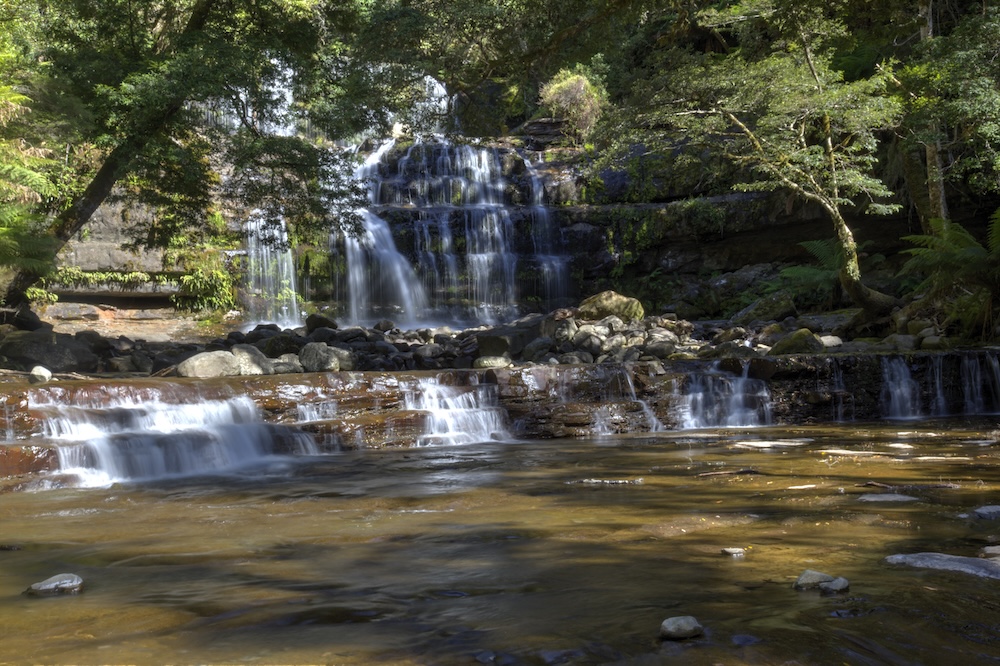
Reached by a walking track from Wet Caves Road, the falls sit within a particularly attractive mixture of:
- Tall eucalypt forest.
- Tree ferns.
- Moss-covered logs and rocks.
- Dense rainforest understorey.
- Rocky creek beds.
- Tiered cascades.
Westmorland Falls differs from many larger Tasmanian waterfalls because the setting feels relatively intimate.
Rather than viewing a single large vertical drop from a distant lookout, the photographer can work with the relationship between the waterfall, surrounding ferns, rock shelves, creek and forest.
This makes the location particularly well suited to both conventional waterfall photography and more detailed rainforest photography.
The walk itself should also be regarded as part of the photographic experience rather than merely as the route to the falls.
Current Access - September 2026
Westmorland Falls is accessed from Wet Caves Road near Caveside within the Mole Creek Karst National Park area.
At the time of writing, I have not found a current Parks and Wildlife Service alert specifically closing the Westmorland Falls walk.
However, Tasmanian walking tracks can be affected by:
- Heavy rain.
- Flooding.
- Fallen trees.
- Track damage.
- Fire or planned management works.
Check current Tasmania Parks and Wildlife Service alerts shortly before travelling.
Westmoreland Falls are at the northern end of the Walls of Jerusalem. At this end, there are nice roads to get to a series of falls, and a series of scenic walks.


Viewpoints
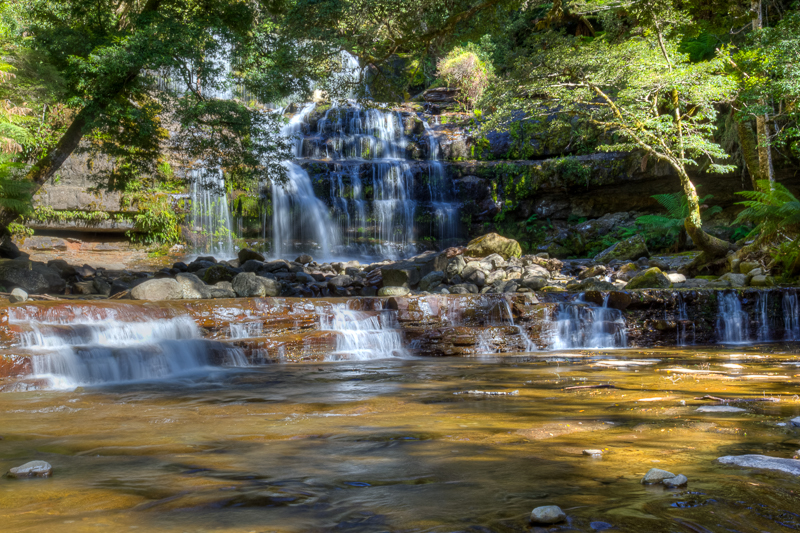
The path runs down the side of the valley that contains the river, and then joins / crosses the river near the bottom. Jenny got 'stuck' at the top of the path photographing the huge variety of macro shots - fungis and ferns, bark, and insects. I started taking photos about half way down and did not stop until Jenny called on the radio.
-
Main Waterfall View
The principal waterfall viewpoint provides the classic photograph of Westmorland Falls descending over a sequence of rock shelves within dense vegetation.
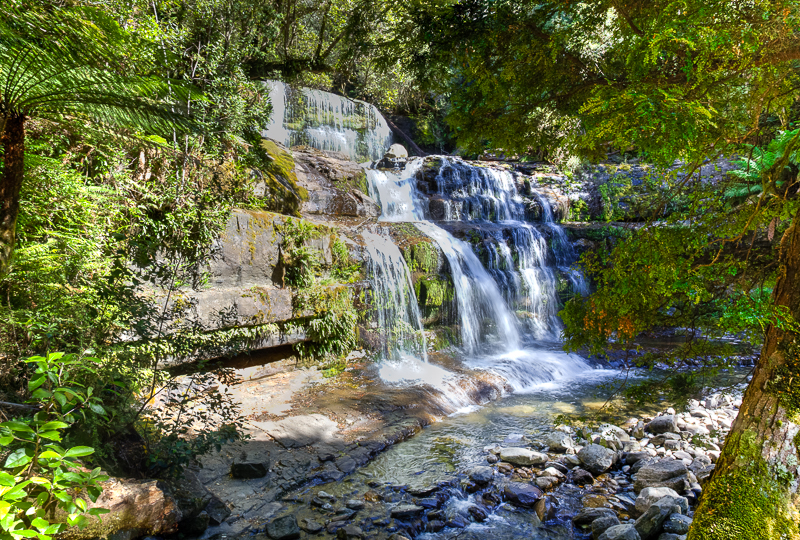
Westmoreland Falls The waterfall is particularly attractive because the cascade is broken into a series of smaller drops rather than one uninterrupted plunge.
This creates many opportunities to combine:
- White water.
- Dark rock.
- Tree ferns.
- Moss.
- Foreground boulders.
Recommended lenses: 24-70mm and 16-35mm.
I would begin around 24-35mm rather than immediately using the widest focal length.
This keeps the waterfall visually important within the frame while still retaining enough surrounding rainforest to establish the setting.
-
Vertical Waterfall Composition
Westmorland Falls is particularly well suited to vertical compositions.

Westmoreland Falls A portrait-orientation frame can combine:
- Foreground creek or rock.
- The lower cascade.
- The principal waterfall.
- Tree ferns.
- The forest canopy.
This creates a strong sense of depth and better reflects the vertical character of the rainforest.
Try several focal lengths between approximately 24mm and 50mm.
-
Fern-Framed Waterfall
The surrounding tree ferns are one of the defining photographic features of Westmorland Falls.
Rather than trying to keep vegetation completely out of the frame, use fern fronds deliberately to:
- Frame the waterfall.
- Create foreground depth.
- Provide colour contrast.
- Reinforce the Tasmanian rainforest setting.
Be careful that a bright fern does not dominate the waterfall.
A slightly longer focal length can help control the relationship between foreground vegetation and falling water.
-
Lower Cascades and Creek
Do not concentrate exclusively on the complete waterfall.
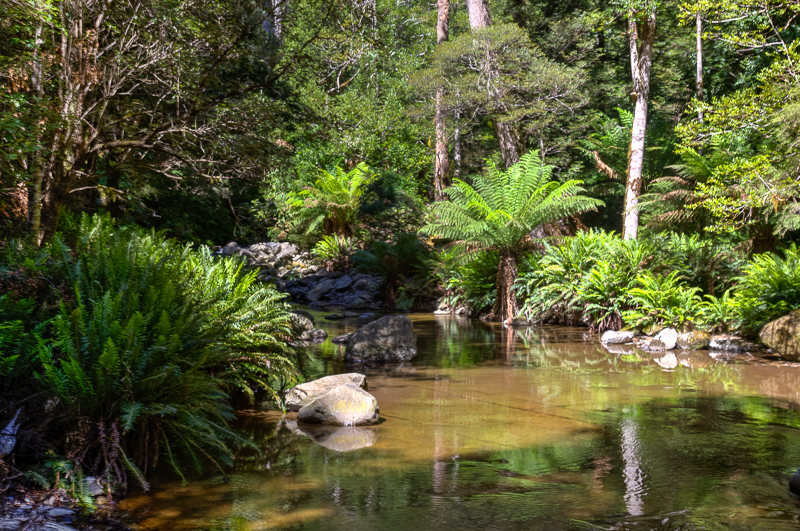
The creek below the main falls provides excellent opportunities for more intimate compositions incorporating:
- Flowing water.
- Boulders.
- Small cascades.
- Fallen timber.
- Ferns.
- Moss-covered surfaces.

The Creek at Westmoreland Falls These can produce some of the strongest photographs from the visit because they are less obvious than the standard full-waterfall composition.
Recommended lenses: 24-70mm and 70-200mm.
-
Telephoto Water Details
A 70-200mm lens is worth carrying despite the additional weight.
It can isolate:
- Individual tiers of the waterfall.
- Water spilling over rock edges.
- Small fern-framed cascades.
- Patterns of white water against dark stone.
- Moss and lichen details.

-
Rainforest along the Walking Track
The forest should be regarded as a major photographic subject in its own right.
Look for:
- Large tree ferns.
- Repeating fern fronds.
- Moss-covered logs.
- Wet tree trunks.
- Fungi.
- Fallen timber.
- Small streams.
- Filtered light through the canopy.
A 70-200mm lens can be particularly effective in the forest because it simplifies visually complicated scenes.
-
Forest Path
The walking track itself can provide useful storytelling images.
Look for sections where:
- The trail disappears into dense vegetation.
- Tree ferns lean over the track.
- Roots and wet earth create foreground texture.
- A walker provides scale.
These images are particularly valuable near the beginning of an Auspano gallery because they give the viewer a sense of discovering the falls rather than immediately revealing the destination.
Water Flow & Conditions
Water flow varies with recent rainfall and season. Higher flow gives power and separated strands; moderate flow often preserves rock texture and is easier to expose. Never enter a creek or cross barriers to improve a composition.
Other Things to Look Out For
How I photographed the falls
What I took - what was in my kit
I took my LowePro Backpack loaded with Canon 5DMkII body, Canon 24-105mm zoom, Manfrotto 190 Tripod, and of course a range of lens wipes, spare batteries, sunscreen and bug repellant. I tended to shoot wide open at 24mm, and in hindsight, I should have used the 16-24mm.
Techniques
As with any waterfall, I want to blur the water but not the surrounding vegitation. That means using a long exposure and a tripod. I could have used NR filters, but in this case I didnt. I simply changed the aperature to suit. I was already shooting at ISO 100.
Location
Westmorland Falls, Caveside, Tasmania
Approximate coordinates: -41.62024, 146.39014
Markers identify photographic objectives rather than guaranteed parking spaces or open access.
Apple Map – Waterfall and Nearby Photographic Locations
This Apple Map shows the principal subject and nearby photographic locations. Verify signs, road status and track conditions before relying on a marker for access.
Photographic locations
How to Get There
This is definitely a car only spot to visit. That said, the road there is good and any 2WD car or motorhome etc. could do it. Most people would come to the site from Mole Creek. The C138 / B12 road crosses east-west at the end of the alpine region.
From Mole Creek
Travel south from Mole Creek along Caveside Road.
After approximately 6 km, turn onto Wet Caves Road.
Continue past the Honeycomb Cave area and follow the gravel road towards the signed Westmorland Falls / Mole Creek Karst Conservation Area trailhead.
The final approach is on an unsealed road.
Drive according to current road conditions, particularly after prolonged rain.
From Deloraine
Travel west towards Mole Creek and then follow Caveside Road towards Caveside before turning onto Wet Caves Road.
Mole Creek Karst National Park is approximately 30-40 minutes west of Deloraine depending on the particular destination within the park.
The Walk to Westmorland Falls
Published descriptions vary slightly in both distance and grading.
Current official regional tourism information describes the walk as approximately:
- 3-4 km return.
- About 2 hours return.
- Grade 2.
Photographers should allow substantially longer.
The track passes through tall eucalypt forest with a dense understory that includes tree ferns.
Conditions can include:
- Mud.
- Tree roots.
- Uneven natural surfaces.
- Slippery sections.
- Short steeper sections.
After rain, the track may be considerably wetter and slower than its nominal walking grade suggests.
National Park Entry
Westmorland Falls lies within Mole Creek Karst National Park.
A valid Tasmania National Parks Pass is required when exploring national park areas outside the cave-tour arrangements.
Check current Tasmania Parks and Wildlife Service pass requirements before travelling.
Facilities
The Westmorland Falls trailhead is a relatively simple bushwalking access point rather than a developed visitor centre.
Current regional information states that there are no amenities at the walk location.
Do not expect:
- Toilets.
- A cafe.
- Drinking water.
- Extensive visitor facilities.
Toilets, food, fuel and accommodation are available in the surrounding Mole Creek district.
Parking and Large Vehicles
The Westmorland Falls trailhead has a relatively small parking area reached by an unsealed road.
For a large vehicle and caravan combination, I would leave the caravan at your accommodation and take the tow vehicle alone.
This provides several advantages:
- Easier manoeuvring on Wet Caves Road.
- Easier use of the small trailhead parking area.
- Less risk if road conditions deteriorate after rain.
A capable tow vehicle by itself is far more appropriate for this photographic excursion than towing a large caravan to the trailhead.
Apple Map – Driving from the State Capital
The route ends at the road-accessible destination configured above. Driving distance and time are Apple Maps estimates.
State capital to destination
Calculating the driving route with Apple Maps…
Current Access / Conditions
Conditions checked: 22 September 2026.
Check Tasmania Parks alerts and Tasmania Police road information before travel. Alpine weather, ice, snow, fire and maintenance can alter access rapidly.
A valid parks pass is required where the site is within a national park. At Cradle Mountain, private vehicle access beyond the visitor centre is restricted during shuttle operating hours and parking is limited.
Best Time to Visit
I am not aware of any time that is better than any other here. In winter, there may be more water and the chance of snow. In summer, you get nice skies. At dawn / dusk you might be better light, but you also have to deal with walking in the dark and driving in the dark. (Note, it is easy to drive in the dark, BUT in country places like this, you will get a lot of wildlife moving around near dawn and dusk. This is when you hit a kangaroo, deer, or wombat. None of which are good for you, your car, or the animal.
Winter
Winter can provide excellent waterfall photography.
Advantages include:
- Higher likelihood of good water flow.
- Saturated rainforest colour.
- Soft light.
- Excellent moss and fern conditions.
Disadvantages include mud, cold conditions and potentially slippery track surfaces.
Spring
Spring is probably the best all-round period.
Water flow can remain strong while temperatures and walking conditions are generally more comfortable.
New forest growth and wet-season moisture can also provide excellent colour.
Autumn
Autumn can provide attractive soft light and quieter conditions.
Water flow depends more heavily on recent rainfall.
Summer
Summer can still provide good rainforest photography, but waterfall flow may be substantially reduced during prolonged dry periods.
Overcast Days
Bright overcast conditions are ideal.
They provide:
- Low contrast.
- Longer natural shutter speeds.
- More saturated green foliage.
- Reduced highlight problems in white water.
After Rain
Rain can substantially improve the waterfall and rainforest.
However, the track and rocks may also become significantly more slippery and muddy.
I would prefer to visit shortly after a period of rain rather than during intense rain.
Accessibility
The road into the car park is good. After this there is 1km or so walk down the valley side on a dirt path. This path is the sort of path common in National Parks - well constructed, but still having tree roots, rocks etc. that need to be navigated. I would not recommend this for anyone with mobility issues.
Westmorland Falls is not an accessible photographic location for visitors who require wheelchair access.
Discover Tasmania currently states that the attraction does not cater for people with access needs.
The route involves a natural forest track with:
- Uneven surfaces.
- Potential mud.
- Roots.
- Occasional steps.
- Steeper sections.
The walk is therefore substantially more demanding than a roadside waterfall lookout.
Photographers carrying a tripod, multiple lenses and a full camera bag should also allow additional time.
Nearby Locations
Nearby photographic locations
Where to Stay
Doloraine is the closet good sized town. It has hotels, caravan parks etc. Mole Creek has a small caravan park, and Cradle Mountain is about 40 mins away.
Mole Creek
Mole Creek is the most convenient base for photographing Westmorland Falls.
It also provides easy access to:
- Marakoopa Cave.
- King Solomons Cave.
- Alum Cliffs.
- Other Great Western Tiers locations.
Mole Creek Caravan Park
Mole Creek Caravan Park provides powered and unpowered sites beside Sassafras Creek.
Facilities currently include:
- Powered and unpowered caravan sites.
- Amenities.
- Laundry.
- Camp kitchen.
- Wi-Fi.
Some sites overlook Sassafras Creek, where wildlife including platypus may occasionally be seen.
For a large tow vehicle and 23-foot caravan, contact the park before arrival and provide the complete rig dimensions rather than assuming every site will accommodate the combination.
The park has also operated seasonal winter closures, so check current opening arrangements before travelling.
Photography Recommendations
16-35mm
Useful for:
- Wide environmental waterfall images.
- Large foreground rocks.
- Forest interiors.
- Tree ferns close to the camera.
Do not automatically use 16mm.
The waterfall can become too small within a very wide frame.
Try approximately 20-28mm for environmental photographs.
24-70mm
This would be my principal lens at Westmorland Falls.
It provides enough flexibility for:
- The complete waterfall.
- Vertical compositions.
- Fern framing.
- Creek details.
- Forest scenes.
70-200mm
The 70-200mm is well worth carrying.
It can isolate:
- Individual waterfall tiers.
- Water patterns.
- Fern details.
- Moss-covered logs.
- Fungi.
It is also excellent for simplifying visually complicated rainforest scenes.
Tripod
A tripod is highly recommended.
It allows:
- Low ISO.
- Longer shutter speeds.
- Careful composition.
- Exposure bracketing.
Choose a tripod that you are comfortable carrying along a potentially wet and uneven bush track.
Circular Polariser
A circular polariser is one of the most useful accessories here.
It can reduce reflections from:
- Wet leaves.
- Ferns.
- Rocks.
- The surface of the creek.
This often produces much richer greens and reveals more rock colour.
Do not automatically apply maximum polarisation; rotate the filter while watching the effect.
Neutral Density Filter
A 3-stop or 6-stop ND filter may be useful when ambient light is too bright to achieve the desired shutter speed.
In dark rainforest conditions it may often be unnecessary.
Shutter Speeds
Photograph the waterfall at several shutter speeds rather than assuming one long exposure will automatically be best.
-
1/30 to 1/10 second
Retains considerable texture and energy in the water. -
1/8 to 1/4 second
Provides an excellent balance between texture and movement. -
1/2 to 2 seconds
Produces smoother traditional waterfall movement. -
Several seconds
Produces a much softer and more ethereal result.
My starting range would be approximately 1/4 second to 1 second.
I would then deliberately photograph several faster and slower versions.
Protect the Highlights
White waterfall highlights can clip surprisingly easily against dark rainforest.
Check the histogram and preserve detail in the brightest water.
If necessary, make a small exposure bracket for later natural blending.
Keep the Lens Dry
Carry several clean microfibre cloths.
Fine spray, rain and dripping vegetation can leave droplets on the front element without being immediately obvious through the viewfinder.
Check the lens regularly.
Photographing Moving Water
Photographing moving water
Begin around 1/4 to 1 second and adjust to retain texture in the flow. Use the polariser to manage glare, not simply to maximise saturation, and check the lens frequently for spray.
Suggested Photographic Sequence
-
Begin photographing immediately after leaving the trailhead.
Do not regard the forest as merely the approach to the waterfall.
-
Tree ferns and rainforest.
Use the 24-70mm for environmental photographs and the 70-200mm for cleaner details.
-
Forest path.
Photograph a section where the track disappears into the vegetation.
-
Fungi, moss and wet details.
These provide important supporting photographs for the final gallery.
-
First view of the waterfall.
Make an environmental photograph before approaching closer.
-
Main waterfall composition.
Begin around 24-35mm and refine the relationship between waterfall and surrounding vegetation.
-
Vertical composition.
Combine foreground water or rock with the falls and forest above.
-
Vary shutter speed.
Photograph approximately 1/8, 1/4, 1/2 and 1 second if water flow and light permit.
-
Switch to the 70-200mm.
Isolate individual cascades and fern-framed water details.
-
Lower creek details.
Look for rocks, small cascades and moving water rather than another complete-waterfall photograph.
-
Photograph the return walk.
Different light direction often reveals forest compositions that were not obvious on the way in.
How Long Should a Photographer Stay?
The published walking time is approximately 2 hours return.
A serious photographer should allow considerably longer.
I would allow approximately 3-4 hours for:
- The walk in.
- Forest photography.
- The main waterfall.
- Several shutter-speed variations.
- Telephoto details.
- Creek photography.
- The return walk.
In exceptional conditions involving mist, fungi or particularly strong water flow, I could easily spend four hours or more on the complete excursion.
My Priority Photographs
- Classic complete view of Westmorland Falls.
- Vertical composition incorporating foreground water and the full cascade.
- Waterfall framed by tree ferns.
- Wide environmental waterfall photograph showing the surrounding rainforest.
- Approximately 1/8-second waterfall photograph retaining water texture.
- Approximately 1/2-second version of the same scene.
- Approximately 1-second smooth-water version.
- 70-200mm photograph isolating one waterfall tier.
- White water against dark wet rock.
- Small cascade below the main waterfall.
- Water flowing between foreground rocks.
- Tree fern canopy.
- Repeating fern-frond detail.
- Moss-covered fallen log.
- Fungi if present.
- Water droplets on fern fronds.
- Walking track disappearing through dense forest.
- Person on the track for scale if appropriate.
- Mist through the rainforest if conditions occur.
Waterfall Information
| Waterfall | Westmorland Falls |
|---|---|
| Approx. drop | 10 m (approximate) |
| Setting | Caveside, Tasmania |
| Best flow | After sustained rain, subject to safe access |
Include only facts that can be verified. Remove rows that are not relevant or cannot be reliably documented.
Photo Subjects
Explore related Auspano photography guides by subject.
Photographer Comments & Updates
Have you photographed this location? Share your photographs, viewpoints, photography tips or recent access updates, or ask a question about visiting. When uploading your own photographs, please include your name and the date each photograph was taken. Date any access or track-condition observations; visitor reports may become outdated, so check official information before travelling.