Photographing Werrimull Mobile Silos
About the Artwork
The Werrimull Mobile Silos are an unusual example of silo art located in the small Mallee community of Werrimull in north-western Victoria.
Rather than using the enormous permanent grain silos normally associated with Australia's silo-art trails, the Werrimull artwork has been painted on two smaller mobile silos positioned beside the town's larger grain-storage complex.
The silos were painted in August 2023 by Australian artists Jimmy Dvate and Justin Fennelseed, working in collaboration with the local community.
The theme of the project is Local Flora & Fauna, with the artwork celebrating wildlife associated with the surrounding Mallee and Millewa environment.
Their relatively small size creates a very different photographic experience from conventional silo art.
Visitors can approach the structures closely and walk around them, allowing the artwork to be examined and photographed from several directions.
The result is a more intimate public-art installation where individual wildlife portraits, painting details and the curved metal surfaces are as important photographically as the complete silos.
Artwork / Subjects
The two mobile silos contain six principal wildlife subjects.
Budgerigar
The Budgerigar is one of Australia's most recognisable inland parrots and is strongly associated with the dry interior.
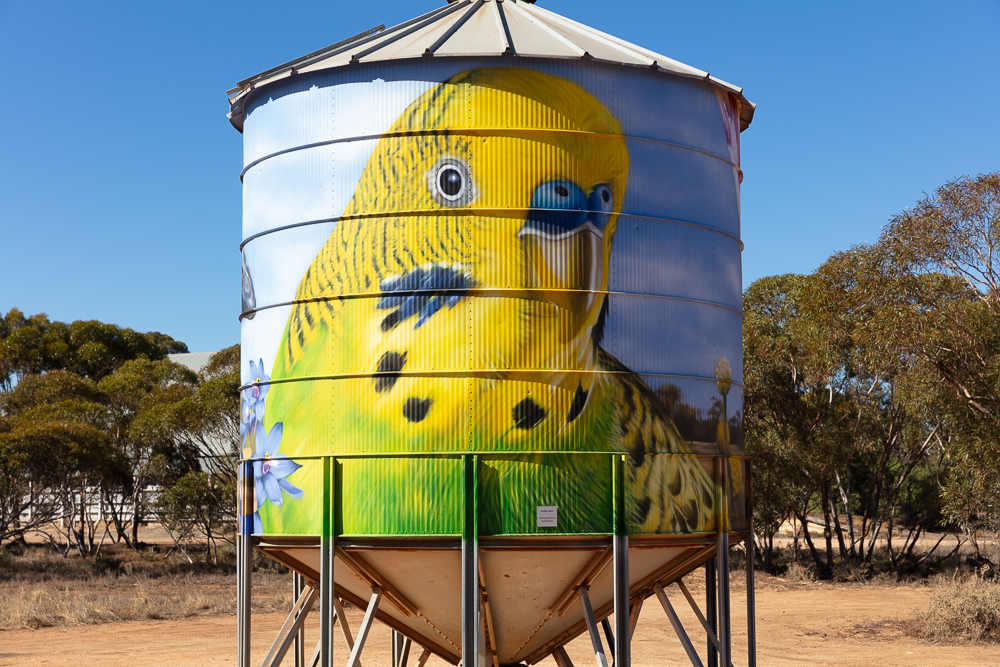
The yellow budgerigar is iconic in Australia and large flocks can be seen at watering holes. The first Werrimull Mini Silo contains a great protrait of one.
Photograph the complete bird first, then move closer for details of the eye, feathers and colour patterns.
Major Mitchell Cockatoo
The Major Mitchell Cockatoo, also known as the Pink Cockatoo, is one of the most visually striking subjects on the silos.
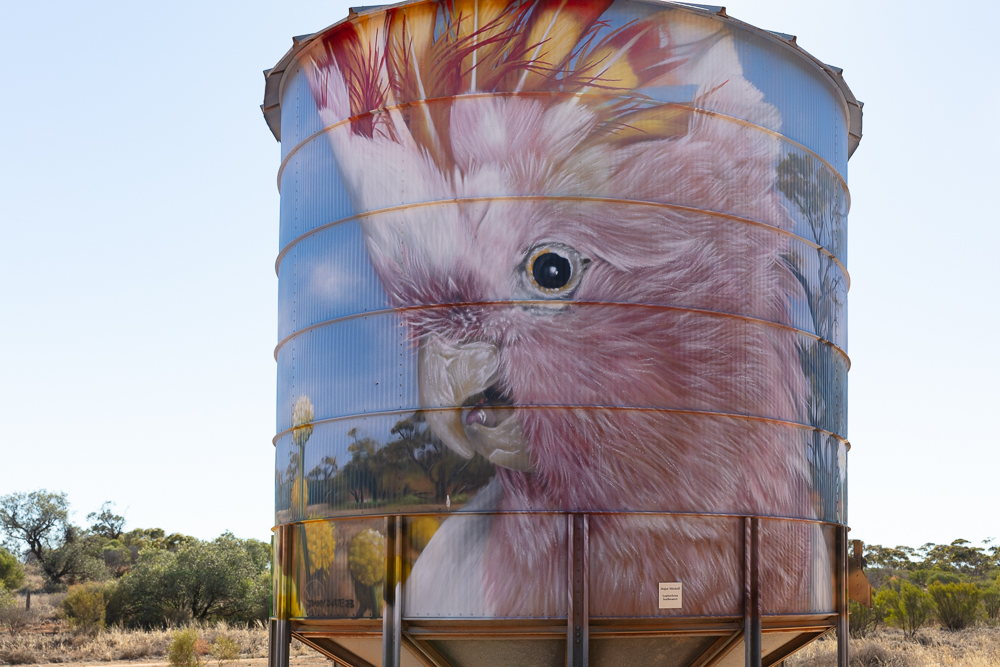
In this region, it is also common to see large flocks of Major Mitchell Cockatoos. While easily startled, they are typically seen walking around open areas feeding on seeds. The second side - rear of the first Werrimull Mini Silo contains an image of an Major Mitchell Cockatoo.
Its pink plumage provides strong colour against both the painted silo surface and the generally subdued colours of the surrounding Mallee landscape.
Mallee Ringneck
The Mallee Ringneck is particularly appropriate to Werrimull because of its close association with the surrounding Mallee country.
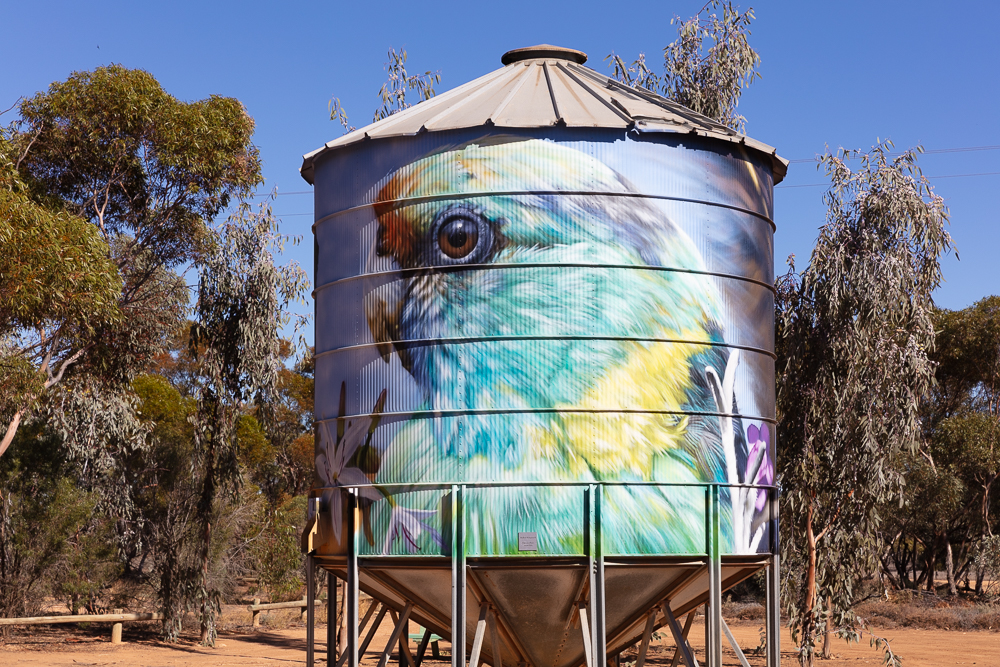
The first image on the second Werrimull Mini Silo is of a Mallee Ring Neck Parrot. This is one of the paintings that most directly connects the artwork with its location.
Little Eagle
The Little Eagle introduces a different character from the colourful parrots.
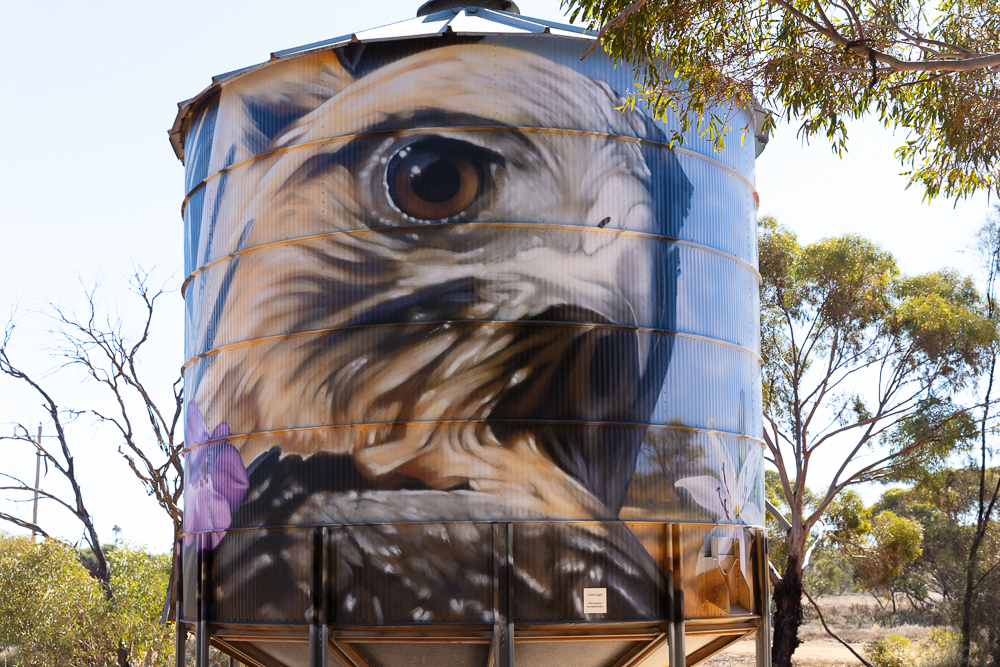
The third image on the second Werrimull Mini Silo is of a Little Eagle. Look particularly for tighter compositions concentrating on the eye, beak and feather structure.
Echidna
The Echidna provides an important change from the predominantly avian subjects.
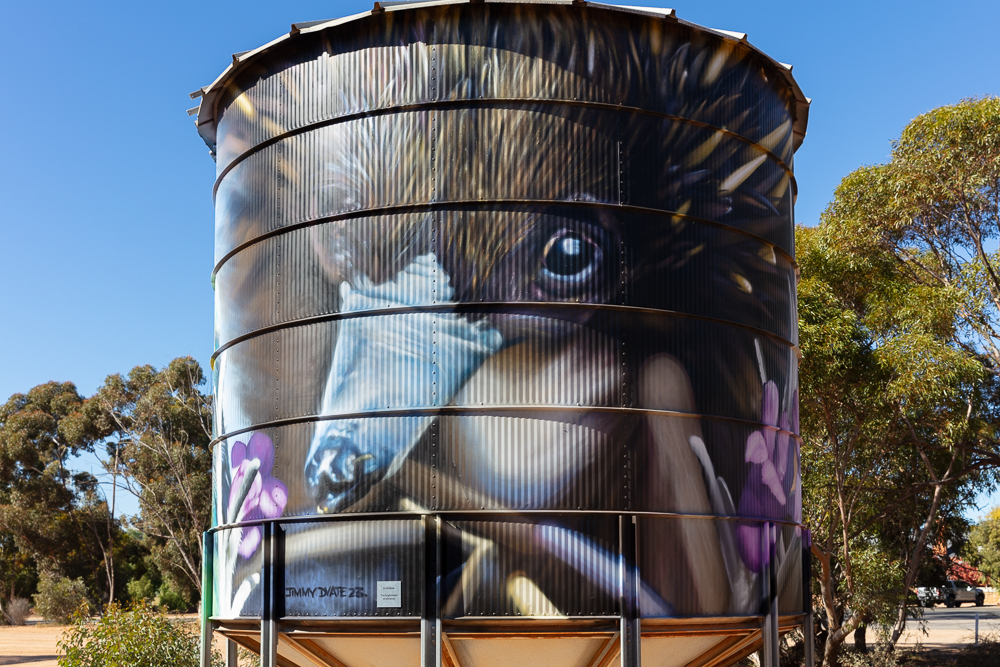
The second image on the second Werrimull Mini Silo is of a Echidna. The individual spines and facial details provide particularly good opportunities for close photographic studies.
Emu
The Emu is another characteristic animal of Australia's dry inland landscapes.
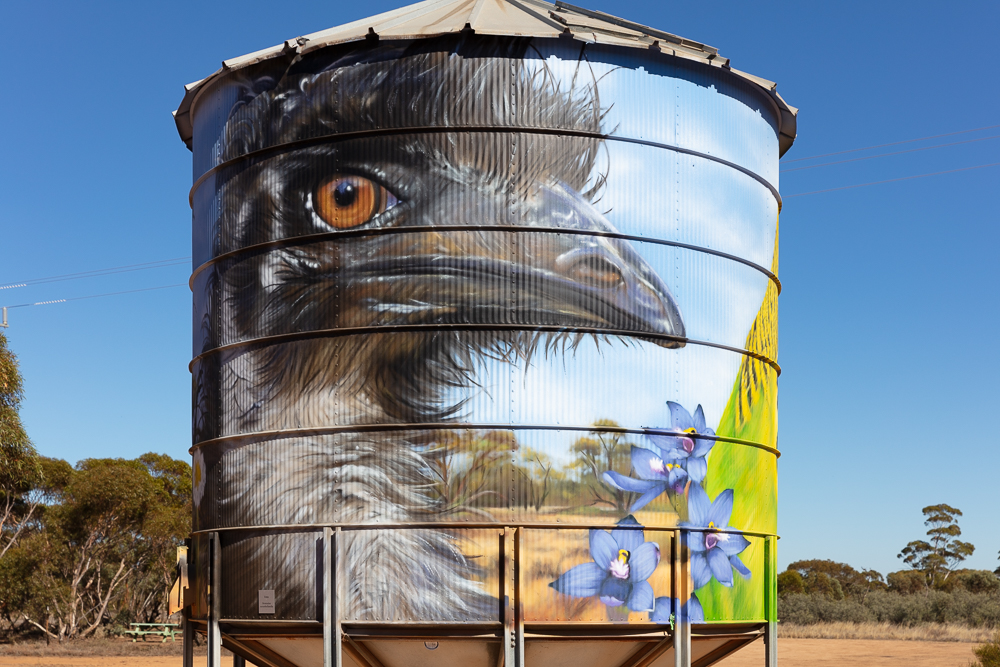
Foreigners expect to see large numbers of kangaroos everywhere when they travel around Australia. In reality, kangaroos are generally seen around dawn and dusk. In the daytime, small family groups of emu are a common site though. The side - rear of the first Werrimull Mini Silo contains an image of an emu.
Photograph both the complete portrait and tighter details concentrating on the head, eye and feather texture.
Artist
Jimmy Dvate
Jimmy Dvate is an Australian artist particularly well known for large-scale murals depicting native flora and fauna.
His detailed wildlife paintings appear on silos and other public-art installations throughout Australia.
The Werrimull project is particularly well suited to his established interest in Australian biodiversity.
Justin Fennelseed
Justin Fennelseed collaborated with Jimmy Dvate and the local Werrimull community to create the mobile-silo artwork.
The completed installation combines public art with an interpretation of the wildlife of the surrounding Millewa and Mallee landscape.
Photographing the Artwork
Werrimull presents a different photographic problem from most large silo-art installations.
The artwork wraps around two relatively small cylindrical structures, so there is no single viewpoint that adequately records the complete installation.
I would therefore photograph Werrimull as a sequence rather than attempting to create one definitive photograph.
Both Silos Together
Begin with an establishing photograph showing both mobile silos together.
Include enough of the surrounding environment to explain that these are small painted structures standing beside a much larger rural grain-storage complex.
This is probably the most important documentary photograph of the location because it immediately establishes the unusual scale of the artwork.
Each Complete Silo
Photograph each mobile silo separately.
Move sufficiently far away to minimise perspective distortion and keep the cylindrical structure looking natural.
Where possible, keep the camera reasonably level rather than pointing it sharply upwards.
Each Wildlife Subject
Walk around both structures and photograph each of the six principal wildlife subjects individually.
This is important because photographs from only one direction cannot record all of the artwork.
Artwork Details
After recording each complete animal or bird, move closer or use a longer lens to isolate details.
Look particularly for:
- Eyes.
- Feathers.
- Beaks.
- Echidna spines.
- Colour transitions.
- Brush and spray-paint details.
- The relationship between the painting and curved metal surface.
Artwork and Environment
Do not restrict the photography to the painted surfaces.
The surrounding grain-handling infrastructure and Mallee landscape explain why the artwork exists here.
Look for compositions incorporating:
- The larger grain silos.
- Open Mallee sky.
- Rural roads.
- Grain-handling infrastructure.
- Dry vegetation.
- Werrimull township details.
Apple Map – Artwork and Nearby Photographic Locations
This Apple Map identifies Werrimull Mobile Silo Art and the five nearest silo-art locations for which Auspano pages currently exist. Marker 1 is the principal artwork; the remaining markers link the wider photographic trail.
Mapped locations
Location
See the other sections of this page for location information.
Access & Parking
The Werrimull Mobile Silos are essentially a roadside public-art attraction and do not require a substantial walk.
The principal consideration is safely parking and approaching the artwork without interfering with local traffic or grain-handling operations.
Remain within public areas and respect:
- Fences.
- Private-property boundaries.
- Operational signs.
- Heavy-vehicle access.
Rural silo complexes can become considerably busier during grain harvest and out-loading periods.
Visitors towing caravans should choose a safe parking position rather than entering an operational silo yard simply because there appears to be sufficient turning space.
Accessibility
The Werrimull Mobile Silos are substantially easier to view than many natural Auspano photographic locations.
There is no long walking track and much of the artwork can be viewed from relatively close to a vehicle.
However, the surrounding surfaces may include:
- Gravel.
- Loose stones.
- Uneven ground.
- Unsealed surfaces.
I have not found authoritative information confirming a formally designed wheelchair-accessible viewing area specifically for the mobile silos.
Visitors with limited mobility should nevertheless be able to see and photograph substantial portions of the artwork without undertaking a long walk.
Best Light
Early Morning
Early morning can provide:
- Low-angle light.
- Longer shadows.
- More modelling across the curved silos.
- Lower summer temperatures.
- Potentially quieter conditions.
Side lighting is particularly useful because it reveals the cylindrical form of the structures.
Late Afternoon
Late afternoon is another high-priority period.
Warm light can complement the earthy colours of the Mallee landscape and produce attractive modelling across the curved surfaces.
Because the artwork extends around the silos, walk around them as the light changes rather than assuming one side will provide every photograph.
Middle of the Day
Midday should not automatically be dismissed for silo-art photography.
Strong daylight can reproduce the painted colours clearly and may provide useful documentary photographs of each individual artwork.
The disadvantages can include:
- Harsh shadows.
- Glare from painted metal.
- Less attractive surrounding landscape light.
Bright Overcast
Bright overcast conditions can be excellent for recording the artwork itself.
Soft light reduces harsh reflections and produces relatively even illumination around the curved surfaces.
This can be particularly useful when the objective is to document all six wildlife paintings accurately.
Blue Sky
A clear blue Mallee sky provides a simple background that can allow the colourful wildlife paintings to dominate the frame.
A circular polariser may deepen the sky, but use it carefully with wide-angle lenses because uneven polarisation can become obvious.
Nearby Locations
Werrimull is in the Millewa, a sparsely populated Mallee district west of Mildura.
There are relatively few conventional tourist attractions nearby, but the area contains several subjects that can complement the silo artwork and help create a broader photographic story of north-western Victoria.
Millewa Pioneer Park - Meringur
Meringur lies west of Werrimull and is home to the Millewa Pioneer Park.
The park preserves buildings, machinery and objects associated with early European settlement and farming in the Millewa.
Photographic subjects can include:
- Historic agricultural machinery.
- Old buildings.
- Weathered timber and metal.
- Rural heritage details.
It provides a particularly appropriate companion to the Werrimull artwork because both locations help explain the character of the Millewa district.
Lake Cullulleraine
Lake Cullulleraine lies approximately 13 km north of Werrimull, close to the Sturt Highway.
The lake provides a completely different range of photographic subjects, including:
- Water landscapes.
- Reflections.
- Sunrise and sunset.
- Birdlife.
- Reeds and shoreline details.
It is particularly useful for early-morning or late-afternoon photography before or after photographing the Werrimull artwork.
Mallee Agricultural Landscape
The surrounding Millewa landscape is itself worth photographing.
Look for:
- Long straight roads.
- Large skies.
- Grain fields.
- Old farm buildings.
- Windmills.
- Grain infrastructure.
- Isolated trees.
- Dust and harvest activity.
These images provide useful context for a gallery centred on rural silo art.
Murray-Sunset Country
The vast Murray-Sunset landscape lies to the south and west of the Millewa district.
Depending on the route, road conditions and available time, the wider region can provide:
- Mallee woodland.
- Salt-lake landscapes.
- Wildflowers in suitable seasons.
- Remote tracks.
- Excellent night skies.
Treat remote park excursions as separate photographic trips and check current road and park conditions before travelling.
Mildura and the Murray River
Mildura provides a much broader range of photographic subjects and is the major regional centre east of Werrimull.
Subjects include:
- The Murray River.
- River Red Gums.
- Paddle vessels.
- Historic irrigation infrastructure.
- Rural and agricultural landscapes.
Werrimull can therefore be incorporated into a larger photographic visit to the Mildura and Millewa region.
Patchewollock Silo Art
Patchewollock Silo Art is not immediately adjacent to Werrimull, but it is an important consideration for photographers building a wider north-west Victorian silo-art itinerary.
The enormous Patchewollock silo provides a useful visual contrast with the much smaller mobile silos at Werrimull.
Photographing both demonstrates the extraordinary variation in scale that exists within Victoria's silo-art movement.
Nearby Auspano silo-art pages
- Walpeup Silo Art — approximately 92 km in a straight line; road distance will be longer.
- Patchewollock Silo Art — approximately 123 km in a straight line; road distance will be longer.
- Albacutya Silo Art — approximately 152 km in a straight line; road distance will be longer.
- Sea Lake Silo Art — approximately 169 km in a straight line; road distance will be longer.
- Rainbow Silo Art — approximately 172 km in a straight line; road distance will be longer.
Use the linked pages for verified viewpoints, access notes and additional nearby subjects. Check current road conditions before travelling between remote Mallee locations.
How to Get There
The Werrimull Mobile Silos are located at Werrimull in the Millewa district of north-western Victoria.
Werrimull is a small rural community west of Mildura and south of Lake Cullulleraine.
From Mildura
From Mildura, travel west along the Sturt Highway towards Lake Cullulleraine.
At Lake Cullulleraine, leave the Sturt Highway and travel south along Millewa Road towards Werrimull.
The mobile silo artwork is located beside the much larger grain-storage silos in Werrimull and is readily identifiable on arrival.
Allow approximately 45-60 minutes from Mildura, depending on traffic and road conditions.
From Lake Cullulleraine
Werrimull is approximately 13 km south of Lake Cullulleraine.
Follow Millewa Road south directly to Werrimull.
This makes Lake Cullulleraine particularly useful as either an accommodation base or an additional photographic location when visiting the mobile silos.
From Meringur
Visitors approaching from the western Millewa can incorporate Meringur and the Millewa Pioneer Park into the same journey.
Follow the local sealed road network east towards Werrimull.
This approach provides numerous opportunities to photograph the agricultural landscapes of the Millewa along the way.
Travelling with a Caravan
Werrimull can readily be incorporated into a touring itinerary through north-western Victoria.
When towing a large caravan, remember that the artwork stands within a rural grain-handling environment.
Use an appropriate public parking area and avoid entering operational grain-handling areas simply to turn a caravan or obtain a closer photographic position.
Extra care may be required during harvest periods when considerably more grain-truck traffic can be expected throughout the district.
Driving from the State Capital
The state capital is used as a consistent reference point. The actual route varies with the traveller's starting point, traffic, roadworks and closures.
State capital to artwork
Calculating the driving route with Apple Maps…
Distance and time are estimates and may change with conditions.
Where to Stay
Werrimull itself has very limited accommodation, so most photographers will find it more practical to stay at either Lake Cullulleraine or Mildura.
Lake Cullulleraine
Lake Cullulleraine is my preferred nearby base if the objective is to photograph Werrimull and explore the surrounding Millewa district. It is where we stayed (at the Bushman's Rest Caravan Park there).
It is only approximately 13 km north of Werrimull and provides the additional photographic advantage of the lake itself.
Staying near the lake makes it possible to combine:
- Sunrise photography at Lake Cullulleraine.
- Morning photography at Werrimull.
- Exploration of the surrounding Millewa agricultural landscape.
- Meringur and Millewa Pioneer Park.
- Late-afternoon or sunset photography back at the lake.
This would make a particularly efficient photographic day.
Caravan and camping accommodation is available in the Lake Cullulleraine area.
The Bushman's Rest Caravan Park is a wide open park on the edge of the Lake. It was easily able to accomodate our 23 ft van. It also had nice facilities and was nicely taken care of when we were there.
Mildura
Mildura is the best base for a longer photographic visit to north-western Victoria.
It provides a much greater choice of:
- Caravan parks.
- Hotels and motels.
- Restaurants.
- Fuel.
- Supermarkets.
- Vehicle services.
Mildura also provides access to a much wider range of photographic subjects including the Murray River, River Red Gums, historic irrigation infrastructure and surrounding agricultural landscapes.
The disadvantage is the additional driving required to reach Werrimull, particularly if the intention is to photograph the artwork in early or late light.
Which Base Would I Choose?
For a photographer concentrating on Werrimull and the Millewa, I would choose Lake Cullulleraine.
For a photographer spending several days exploring the broader Mildura and Murray River region, I would choose Mildura.
When travelling with a large caravan, the final choice should also take account of site dimensions, ease of access and whether the accommodation can comfortably handle the complete tow vehicle and caravan combination.
Photography Recommendations
Expose to the right
Exposing to the right means slightly over-exposing an image on purpose. The reason for this is simply that the sensor in your camera is not 'balanced' in the sense of recording as much data in the darker areas as in the lighter areas. It records more data in the brighter areas. By over exposing in camera, and the darkening in post processsing, more data can be recorded in the darker areas of the image.
Using low ISO
'ISO' used to refer to the light sensitivity of various films. ISO 50 film is very light insensitive, and requires comparitively long exposures. It does however (Fuji Velvia 50) have very little grain. Most film was 100-200 ISO. ISO 400 - 1000 films were 'fast' films used for low light or when high speed was necessary. They were generally more grainy (noisy) that ISO 100 films. In digital cameras, we can vary the ISO of the sensor by varying the gain used when reading the sensor. However, like film, the more gain we use, the more noise we introduce. My cameras go from ISO 100 - ISO 51,200. At the high end, they can almost photograph in the dark, but the image quality is low (noisy). At around ISO 100 - 300, there is very little noise, but more light is required.
16-35mm
The 16-35mm lens is useful when working close to the silos or when trying to incorporate both structures and their surroundings.
However, avoid using an unnecessarily extreme focal length.
Photographing a cylindrical structure at 16mm from very close range can distort both the silo and the artist's original proportions.
24-70mm
This would be my principal lens at Werrimull.
It should handle:
- Both mobile silos together.
- Each complete silo.
- Individual wildlife subjects.
- Environmental photographs.
Where space permits, move farther away and use approximately 35-70mm rather than photographing from very close with an ultra-wide lens.
70-200mm
The 70-200mm is particularly useful for artwork details.
Use it to isolate:
- Eyes.
- Feather patterns.
- The Echidna's spines.
- Small sections of paintwork.
- Artwork against the curved metal surface.
It can also be useful for compressing the painted mobile silos against the larger grain-storage structures behind them.
Tripod
A tripod is generally unnecessary during normal daylight.
Handheld photography makes it easier to move around the structures and respond quickly to changing angles and light.
A tripod becomes more useful if photographing during blue hour or in very low light.
Circular Polariser
A circular polariser can be useful for:
- Reducing reflections from painted metal.
- Increasing colour saturation.
- Deepening a blue sky.
Check the effect carefully because reflections can vary significantly around a curved cylindrical surface.
Aperture
For straightforward documentary photographs of the artwork, an aperture around f/8 is a useful starting point.
For close details, a wider aperture can isolate individual features while allowing the remaining artwork to soften into the background.
Controlling Perspective
Perspective control is particularly important when photographing silo and water-tank artwork.
The objective is usually to record the artwork while preserving the proportions intended by the artist.
Wherever possible:
- Move farther away from the structure.
- Use a slightly longer focal length.
- Keep the camera level.
- Avoid pointing the camera sharply upwards.
- Keep the sensor plane as parallel as practical to the artwork.
- Leave additional space around the structure for later correction.
With cylindrical structures such as the Werrimull Mobile Silos, some curvature is obviously natural and should not be removed.
The objective is to control camera-induced perspective distortion, not to make a cylindrical silo appear flat.
Photographing from farther away with the 24-70mm or 70-200mm will usually produce a more natural representation than standing very close with the 16-35mm.
Suggested Photographic Sequence
-
Begin with Werrimull itself.
Make one or two photographs establishing the small rural Mallee community before concentrating on the artwork.
-
Photograph both mobile silos together.
This is the essential establishing photograph of the artwork.
-
Include the large grain silos.
Use the difference in scale to explain why the mobile silos are unusual.
-
Photograph the first mobile silo completely.
Work around the structure methodically rather than randomly.
-
Record each wildlife subject.
Make a clean documentary photograph of each complete painting.
-
Repeat the process with the second silo.
Make sure all six principal wildlife subjects have been recorded.
-
Switch to the 70-200mm.
Photograph eyes, feathers, spines and other artwork details.
-
Look for relationships between adjoining artworks.
Photograph sections where the cylindrical surface allows two subjects or different colours to interact within the same frame.
-
Return to environmental compositions.
Combine the artwork with grain silos, road, sky and other elements of Werrimull.
-
Finish with wider Millewa photographs.
Roads, grain fields, machinery and large skies can provide the closing photographs for the location.
How Long Should a Photographer Stay?
A casual visitor could inspect the Werrimull Mobile Silos in approximately 10-15 minutes.
For a comprehensive photographic record, I would allow approximately 30-45 minutes.
This provides enough time to photograph:
- Both silos together.
- Each complete silo.
- All six wildlife subjects.
- Close artwork details.
- The relationship with the larger grain silos.
- The surrounding rural environment.
In exceptional sunset light or beneath an interesting sky, I would allow up to one hour.
My Priority Photographs
- Both Werrimull Mobile Silos together.
- Mobile silos with the much larger grain silos behind them.
- Each mobile silo photographed separately.
- Budgerigar artwork.
- Major Mitchell / Pink Cockatoo artwork.
- Mallee Ringneck artwork.
- Little Eagle artwork.
- Echidna artwork.
- Emu artwork.
- Close photograph of a bird's eye.
- Feather detail.
- Echidna-spine detail.
- Two adjoining artworks showing how the painting wraps around the cylindrical surface.
- Artwork beneath a clean blue Mallee sky.
- Warm late-afternoon light across a curved silo.
- Wider photograph showing the artwork within Werrimull.
- Rural road, sign or grain-handling detail establishing the location.
Artwork Information
| Location | Werrimull, Victoria |
|---|---|
| Artwork | Werrimull Mobile Silos |
| Artists | Jimmy Dvate and Justin Fennelseed |
| Completed | August 2023 |
| Structures | Two mobile silos |
| Theme | Local Flora & Fauna |
| Subjects | Budgerigar, Major Mitchell Cockatoo (Pink Cockatoo), Mallee Ringneck, Little Eagle, Echidna and Emu |
| Setting | Rural grain-storage precinct |
| Access | Roadside / short walking distances |
| Best light | Early morning, late afternoon or bright overcast |
| Principal lens | 24-70mm |
| Useful additional lens | 70-200mm for artwork details |
| Suggested photography time | 30-45 minutes |
Photography Summary
Primary subjects: Werrimull mini silo artwork
Best light: Soft light controls reflections and retains paint detail.
Suggested kit: Wide and standard zoom; polariser
Photo Subjects
Explore related Auspano photography guides by subject.
Photographer Comments & Updates
Have you photographed this location? Share your photographs, viewpoints, photography tips or recent access updates, or ask a question about visiting. When uploading your own photographs, please include your name and the date each photograph was taken. Date any access or track-condition observations; visitor reports may become outdated, so check official information before travelling.