Photographing Sea Lake Silo and Town Murals
About the Artwork
Sea Lake Silo Art is one of the most colourful and atmospheric works on Victoria's Wimmera Mallee Silo Art Trail.
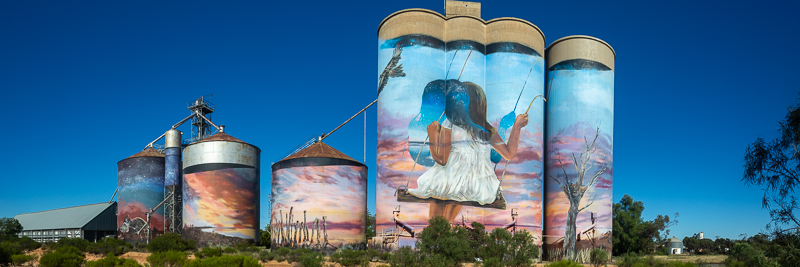
The GrainCorp silos were painted in October 2019 by Australian street artists Joel Fergie, known as The Zookeeper, and Travis Vinson, known as Drapl.
The enormous mural celebrates the stillness, space and isolation of Victoria's Mallee and is closely connected with nearby Lake Tyrrell.
A young girl swings from the branch of a Mallee eucalyptus while looking across the vast salt lake. Above her a Wedge-tailed Eagle soars through the sky, while emus move through the landscape below.
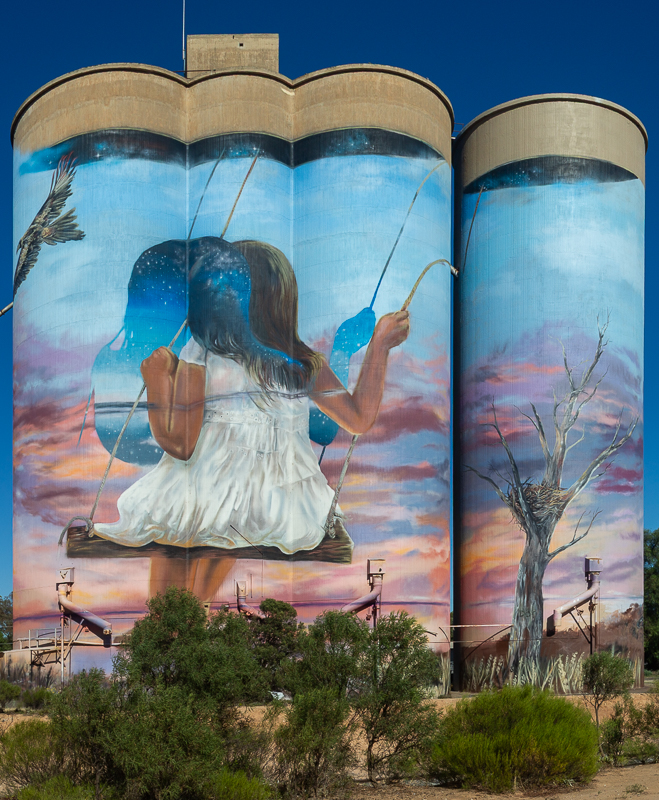
Behind these subjects, the colours of the Mallee landscape gradually move from the warm tones of sunset into the deep blue of the night sky.
The mural also reflects the Indigenous history of Lake Tyrrell and the importance of astronomy and the night sky to the Boorong people.
Sea Lake is particularly interesting because the art does not end at the silos.
Drapl and The Zookeeper also created murals within the town itself, depicting local flora and scenes of Mallee life.
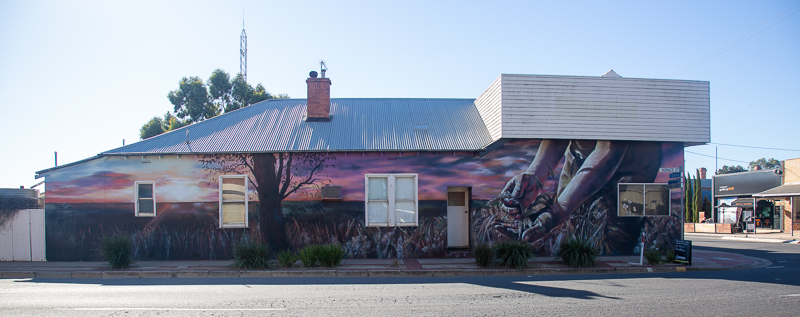
These smaller murals should be considered part of the complete Sea Lake art experience and photographed as a companion series to the enormous silo artwork.
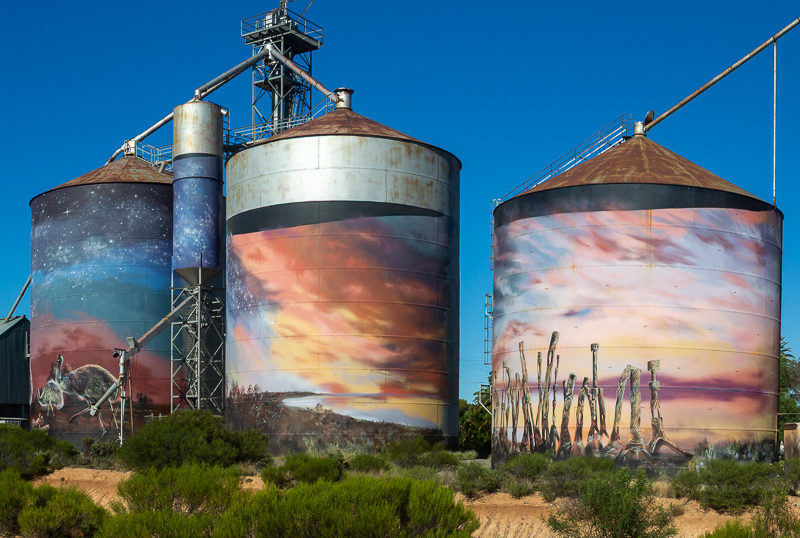
The silos now have another identity after dark. A permanent night-time cinematic projection uses the silo structures to present stories of Mallee farming, nature and astronomy.
Sea Lake can therefore be photographed in three distinctly different ways:
- The painted silos during daylight.
- The town's street murals.
- The illuminated silo experience after dark.
Artwork / Subjects
The Girl on the Swing
The principal human subject is a young girl swinging from a Mallee eucalyptus while looking across Lake Tyrrell.
Rather than facing the viewer, she looks into the landscape.
This is important to the composition because it encourages the viewer to follow her gaze towards the lake, horizon and enormous Mallee sky.
Photograph:
- The complete girl-and-tree composition.
- The girl on the swing.
- The swing and branches.
- The girl's relationship with Lake Tyrrell.
- The transition from figure to surrounding landscape.
Lake Tyrrell
Lake Tyrrell provides the environmental foundation of the mural.
The shallow salt lake is represented beneath an enormous sky, reflecting the sense of space and isolation for which this part of the Mallee is known.
This creates an obvious photographic opportunity.
After photographing the painted interpretation, visit Lake Tyrrell and make your own photographs of the actual landscape.
Try to create visual pairings such as:
- Painted lake and real lake.
- Painted sunset and real sunset.
- Painted night sky and real Mallee stars.
- Painted Mallee vegetation and the surrounding landscape.
Wedge-tailed Eagle
A powerful Wedge-tailed Eagle soars above the principal scene.
Although relatively small compared with the complete mural, the eagle is an important detail and deserves a separate photograph.
Use the 70-200mm to isolate the bird and show the detail that can easily disappear in a conventional complete-silo photograph.
Emus
Emus running through the painted Mallee landscape provide another distinctly Australian element.
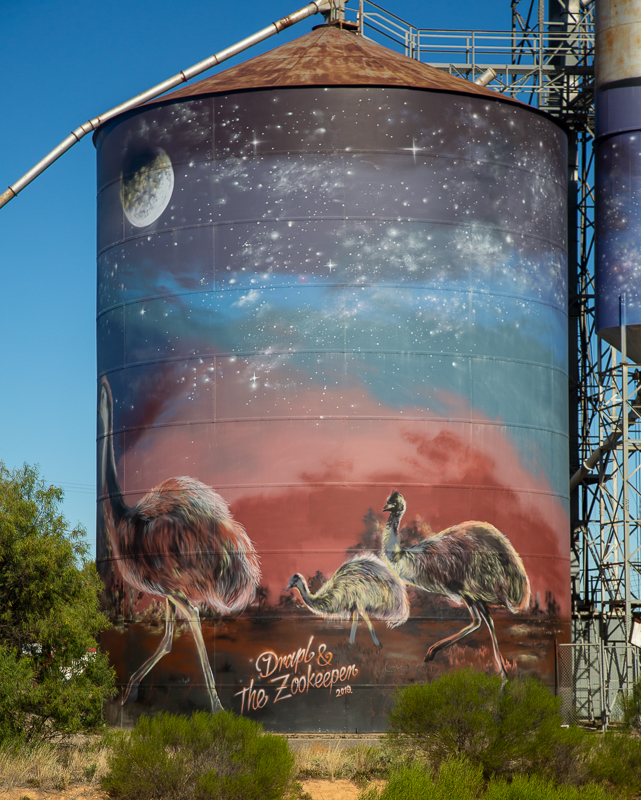
Photograph the group first and then look for individual shapes, movement and relationships between the birds and surrounding landscape.
Mallee Eucalyptus
The Mallee eucalyptus is more than a convenient support for the swing.
It connects the human figure with the vegetation characteristic of the surrounding country.
Look closely at:
- Branches.
- Leaves.
- Trunk texture.
- The attachment of the swing.
- The transition between painted tree and silo surface.
Dusk, Stars and the Mallee Sky
One of the strongest visual characteristics of Sea Lake Silo Art is its transition from the warm colours of dusk into a dark, star-filled sky.
This connects the artwork directly with Lake Tyrrell's reputation for enormous skies, reflections and astronomical observation.
Photograph the colour transitions as smaller abstract compositions as well as recording the complete mural.
The Hidden "Dot" Detail
When photographing the mural, look carefully around the lower-right portion of the artwork for a tree bearing the name "Dot".
This small element commemorates a local woman remembered for caring for injured Wedge-tailed Eagles.
It is the type of easily overlooked detail that deserves a photograph with the 70-200mm.
Sea Lake Town Murals
Do not leave Sea Lake after photographing only the silos.
Drapl and The Zookeeper also created a series of colourful murals within the town.
These works depict local flora and scenes of Mallee life and extend the visual language of the silo artwork into the streets of Sea Lake.
The main-street murals are particularly useful photographically because their smaller scale allows much closer examination of the artists' technique.
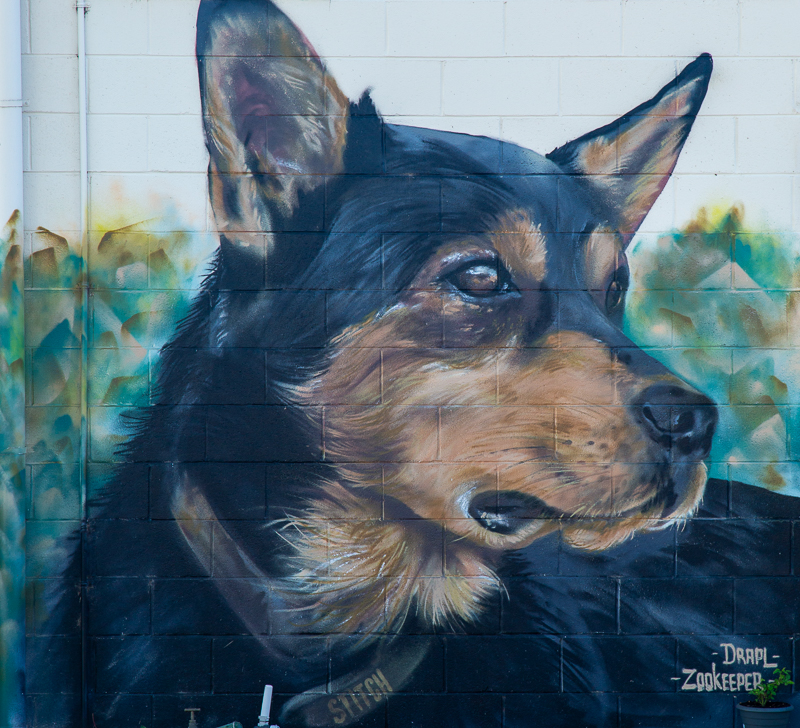
Where the silo demands large compositions and careful perspective control, the town murals allow you to concentrate on:
- Individual plants.
- Native flora.
- Mallee scenes.
- Colour.
- Paint texture.
- Small details.
- The relationship between art and town architecture.
Photograph the Murals as Part of the Town
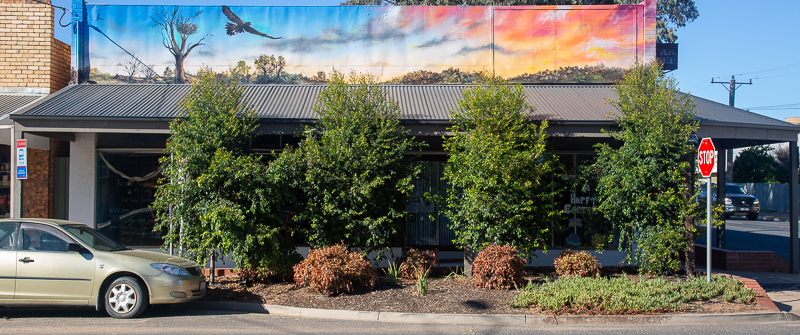
Do not photograph every mural as a perfectly rectangular reproduction.
Make a documentary record first, but then step back and include the environment around it.
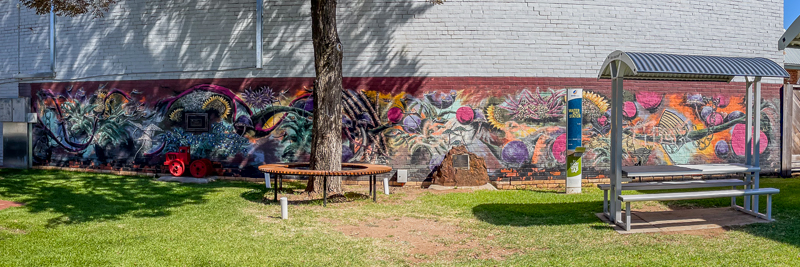
Useful compositions may include:
- A mural and the complete building.
- Artwork beside a shopfront.
- Murals with street furniture.
- Artwork and passing local activity.
- Signs identifying Sea Lake.
- Painted vegetation beside real Mallee vegetation.
These photographs will help explain how public art has become integrated into Sea Lake rather than existing only at the grain silos.
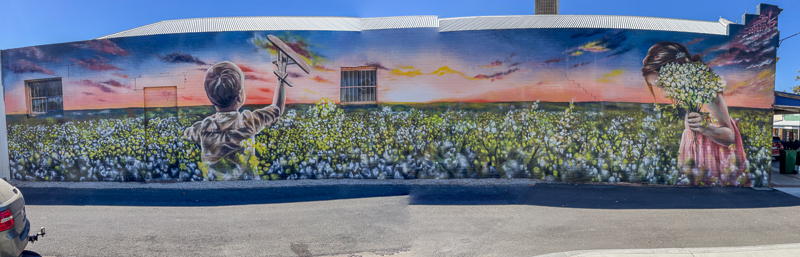
Details and Abstracts
The smaller murals provide an excellent opportunity for tighter, semi-abstract compositions.
Look for:
- Leaves and flowers.
- Eyes and faces where present.
- Strong colour combinations.
- Paint against brick or corrugated metal.
- Edges where artwork meets the original building.
- Weathering and surface texture.
Artist
Sea Lake Silo Art was created collaboratively by Joel Fergie - The Zookeeper and Travis Vinson - Drapl.
The two artists have worked together on numerous large-scale mural projects and are particularly experienced in translating detailed figurative and environmental imagery onto enormous structures.
At Sea Lake they worked across multiple GrainCorp silo cylinders, integrating the individual structures into one continuous landscape.
This is an important characteristic of the work.
Instead of treating every silo as a separate canvas, the artists use the complete structure to create a single expansive Mallee environment.
The same artists subsequently extended their contribution to Sea Lake through murals within the town.
Photographing the Artwork
Begin with the Complete Panorama
The first priority should be a photograph showing the complete silo installation.
The artwork is fundamentally a landscape, despite being painted on vertical industrial structures.
Give it enough breathing room for the viewer to understand the enormous sky, lake and Mallee environment.
Then Break the Story Apart
After making the establishing photograph, work through the individual narrative elements:
- Girl and swing.
- Mallee eucalyptus.
- Lake Tyrrell.
- Wedge-tailed Eagle.
- Emus.
- Sunset colours.
- Stars.
- The "Dot" detail.
Look for Transitions Across the Silos
Pay particular attention to places where an image crosses from one cylindrical silo onto another.
These areas reveal how Drapl and The Zookeeper dealt with an unusually complicated three-dimensional canvas.
Slight lateral changes in camera position can dramatically alter the apparent continuity of the artwork.
Photograph the Town Murals
After completing the silo photographs, walk through the central part of Sea Lake and locate the town murals.
Photograph each artwork first as a record, then make wider compositions showing how it relates to the surrounding street.
Return After Dark
Sea Lake now offers an unusual second opportunity after sunset.
The GrainCorp silos are used for a nightly cinematic projection featuring Mallee farming, nature and astronomy.
This should be treated as a separate photographic session rather than simply an afterthought to the daylight visit.
Bring a tripod and allow enough time to establish a stable position before the projection begins.
Map
Location
Sea Lake Silo Art is located on Railway Avenue in Sea Lake, in Victoria's Wimmera Mallee region.
Address:
33 Railway Avenue,
Sea Lake VIC 3533
Google Maps: Sea Lake Silo Art
The town murals are located within central Sea Lake and are best explored on foot after parking safely in town.
Access & Parking
Sea Lake Silo Art is a well-established attraction on the Wimmera Mallee Silo Art Trail.
Current visitor information lists both car parking and coach parking.
Use the designated public viewing and parking areas rather than entering GrainCorp or railway property to obtain a closer photographic position.
Remember that the silos remain part of an agricultural and railway environment.
Stay clear of:
- Operational grain-handling areas.
- Railway infrastructure.
- Heavy vehicles.
- Fenced areas.
- Private property.
Night Projection
The night-time silo experience is free, with seating available at the viewing area.
Current visitor information recommends bringing a torch for leaving the site after dark.
Check the current nightly session time before planning the photographic visit because projection times may vary through the year.
Large Vehicles and Caravans
Coach parking is listed at the silo attraction, making Sea Lake more practical for larger touring vehicles than many informal roadside silo-art sites.
With a large tow vehicle and caravan, still assess the available turning space and current parking arrangement before committing the complete rig.
If staying in Sea Lake, leaving the caravan at your accommodation and returning with the tow vehicle alone will make it much easier to move between the silo, town murals and Lake Tyrrell.
Accessibility
The principal silo artwork can be viewed without a substantial walk.
Current visitor information specifically states that the night-time silo viewing experience caters for wheelchair users and for visitors who use walking frames or other mobility aids.
The principal artwork is large enough to be appreciated from close to the public parking and viewing area.
This makes Sea Lake a comparatively practical silo-art location for photographers with limited mobility.
The town murals are also concentrated around the central township, although individual photographic positions may involve footpaths, kerbs or other typical streetscape surfaces.
Best Light
Early Morning
Early morning provides quieter conditions and can be particularly useful if Sea Lake is being combined with sunrise photography at Lake Tyrrell.
The low sun may emphasise the cylindrical silo forms and reveal surface texture.
Late Afternoon
Late afternoon is a high-priority period at Sea Lake.
Warm natural light complements the orange, pink and purple tones within the painted sunset.
This creates an interesting transition between the real changing light and the permanently painted dusk within the mural.
Bright Overcast
Bright overcast is excellent when the priority is an accurate record of the artwork.
Soft light provides:
- Even colour.
- Reduced glare.
- Controlled contrast.
- Good detail in the girl, eagle and emus.
- Consistent results across the town murals.
Blue Hour
Blue hour should be particularly interesting because the upper portion of the mural already incorporates a night sky.
As the real sky darkens, the boundary between painted dusk and actual twilight may become less obvious.
A tripod will be useful for exploiting this transition.
After Dark
Do not finish the Sea Lake photographic visit at sunset.
The nightly cinematic projection transforms the silos into a very different artwork after dark.
Use a tripod and experiment with shutter speeds, but remember that the projected images change continuously.
A shutter speed that is too long may combine several frames of the projection and produce unwanted blur or colour mixing.
Begin with moderately high ISO and shorter exposures, then adjust once you understand the brightness and movement of the projection.
Nearby
Lake Tyrrell
Lake Tyrrell is the essential companion photographic location to Sea Lake Silo Art.
The salt lake provides the landscape represented in the mural and is located only a short drive from Sea Lake.
The principal photographic opportunities include:
- Sunrise.
- Sunset.
- Reflections when water conditions permit.
- Salt textures.
- Minimalist horizons.
- Boardwalk compositions.
- Enormous Mallee skies.
- Stars and astronomical photography.
The strongest Auspano coverage should connect the silo mural directly with photographs of the real Lake Tyrrell landscape.
Sea Lake Town Murals
The murals through central Sea Lake should be considered part of the principal art experience rather than merely another nearby attraction.
Allow enough time to walk around the central streets and photograph both the artwork and its architectural context.
Sea Lake Streetscape
Beyond the murals, look for photographic details that establish the character of a small Mallee town:
- Historic shopfronts.
- Signs.
- Old buildings.
- Railway-related structures.
- Agricultural details.
- Quiet streets.
Green Lake
Green Lake provides another landscape and recreational subject in the Sea Lake district.
Depending on current water and weather conditions, look for open-water landscapes, reflections, birdlife and sunset opportunities.
Woomelang Mini Silo Art Trail
Woomelang is an excellent companion art location.
Instead of another enormous grain-silo mural, the town contains a trail of smaller painted field bins featuring native species.
The difference in scale makes Woomelang particularly useful after photographing Sea Lake's enormous silos.
Lascelles Silo Art
Lascelles provides another major Wimmera Mallee Silo Art Trail location.
Rone's restrained portraits of local farming couple Geoff and Merrilyn Horman provide a dramatic stylistic contrast with Sea Lake's intensely coloured landscape imagery.
Nullawil Silo Art
To the south-east, Nullawil provides another very different interpretation of silo art.
SMUG's photorealistic farmer and Kelpie make an excellent photographic contrast with Drapl and The Zookeeper's expansive Mallee landscape.
How to Get There
From Swan Hill
Sea Lake is reached from Swan Hill through Victoria's northern Mallee road network.
Allow approximately an hour for the drive, depending on the route and current road conditions.
From Melbourne
From Melbourne, Sea Lake is reached via the Calder Highway and the north-west Victorian road network.
It is sufficiently distant that photographers should strongly consider staying overnight rather than treating Sea Lake as a quick out-and-back destination.
Following the Silo Art Trail
Sea Lake can be incorporated into a particularly strong northern Mallee art sequence involving:
- Nullawil.
- Sea Lake.
- Woomelang.
- Lascelles.
- Patchewollock.
The sequence combines very different artists, subjects and scales of artwork.
Travelling with a Caravan
Sea Lake is well suited to a touring itinerary and the silo attraction lists coach parking.
With a large tow vehicle and caravan, remain on established roads and public parking areas and avoid using GrainCorp or railway land for turning.
If Sea Lake is your overnight base, unhooking the caravan before photographing Lake Tyrrell will make the photographic session much easier, particularly around sunrise, sunset and after dark.
Techniques used
- Techniques
- Normal Style
- Long Exposures
- Nuetral Density Filters
- High Dynamic Range
- Focus Stacking
- Remove People
- Photo Stitching
- Movements
- Tombstoning
- ISO
- Shutter Speed
- Depth of Field
- Diffraction
- Moving the eye around the picture
- Golden and Blue Hour
- Infra-Red Photography
- Raw vs JPG (JPEG)
- Camera Modes
- Expose to the Right
- Sharpness
- Fore, Middle, Far
- Rule of Thirds
Kit used
Where to Stay
Sea Lake
Sea Lake itself is the preferred photographic base.
Staying in town makes it possible to photograph:
- Lake Tyrrell around sunset.
- The silo cinematic projection after dark.
- The Mallee night sky.
- Lake Tyrrell again around sunrise.
- The silos and town murals in daylight.
This is much more productive photographically than attempting to pass through Sea Lake during the middle of the day.
Travelling with a Large Caravan
When booking a caravan site, provide the park with the complete length of the tow vehicle and caravan and confirm:
- Usable site length.
- Drive-through availability.
- Turning space.
- Access-road width.
- Whether the tow vehicle can remain attached if desired.
Once established, leave the caravan at the accommodation and use the tow vehicle for Lake Tyrrell, the town murals and evening silo session.
Photographic Recommendations
16-35mm
The 16-35mm is useful for environmental views of the silo and for the enormous landscapes at Lake Tyrrell.
However, avoid automatically moving close and using 16mm simply to fit the complete silo installation into the frame.
Extreme wide-angle perspective can distort the silo cylinders and alter the intended proportions of the artwork.
24mm Tilt-Shift
The 24mm tilt-shift is an excellent choice for the principal technically controlled silo photograph.
Set the camera on a tripod, level the camera body and keep the sensor plane vertical.
Use upward shift to include the upper portion of the artwork rather than pointing the complete camera upwards.
It may also be useful for some of the town murals where the artwork is painted high on a building and the camera cannot be positioned directly opposite the centre.
24-70mm
The 24-70mm would be my principal general-purpose lens at Sea Lake.
Use it for:
- The complete silo installation.
- Groups of silo cylinders.
- The girl and swing.
- Town murals.
- Environmental streetscapes.
- Lake Tyrrell landscapes.
70-200mm
The 70-200mm is important here.
Use it to isolate:
- The girl's face and figure.
- Wedge-tailed Eagle.
- Emus.
- The "Dot" detail.
- Tree and foliage details.
- Stars and colour transitions.
- Paint texture.
- Details within the town murals.
Fuji GX680
The Fuji GX680 is particularly suitable for a formal photograph of the complete silo installation.
Scout the composition digitally first.
Then establish the GX680 at the strongest position and use front rise rather than tilting the complete camera upwards.
I would use the GX680 selectively for perhaps one or two definitive images rather than duplicating the complete digital sequence.
Tripod
A tripod is more important at Sea Lake than at many silo-art locations.
It is useful for:
- 24mm tilt-shift photography.
- Fuji GX680 photography.
- Shifted multi-frame images.
- Blue hour.
- Night-time silo projection.
- Lake Tyrrell sunrise and sunset.
- Lake Tyrrell night-sky photography.
Circular Polariser
A polariser may help control glare and deepen a blue daytime sky, but use it carefully with wide-angle lenses.
At Lake Tyrrell, reflections may be one of the most important elements in the composition, so do not automatically remove them.
Controlling Perspective
Sea Lake presents an interesting perspective problem because the mural is essentially a landscape painting wrapped around a series of tall cylindrical structures.
Excessive wide-angle distortion can alter both the silo geometry and the apparent continuity of the painted landscape.
First Choice - Increase Shooting Distance
Move as far back as the safe public viewing area permits.
Where practical, try the 24-70mm around 35-70mm before relying on the widest focal lengths.
Greater distance will generally provide more natural proportions and make the separate silo cylinders appear more consistent.
Using the 24mm Tilt-Shift
Mount the camera on the tripod and level it carefully.
Keep the sensor plane vertical and use upward shift to include the top of the artwork.
For a very high-resolution master image, consider making a shifted sequence:
- Lower frame.
- Central frame.
- Upper frame.
Keep the camera body stationary and move only the lens shift.
For this purpose use shift rather than tilt. Tilt should normally be reserved for situations where you deliberately need to alter the plane of focus.
Using the Fuji GX680
With the Fuji GX680, keep the film plane vertical.
Use:
- Front rise to include the top of the silos.
- Front lateral shift to refine an offset composition.
- Minimal tilt unless deliberately controlling the plane of focus.
Use rear movements cautiously because they change the apparent geometry of the structures.
For the principal architectural record, a vertical film plane combined with front rise and shift is the preferred approach.
Town Murals
The 24mm tilt-shift is also worth carrying during the walk around town.
Where a mural extends high up a wall, keep the camera level and shift upwards rather than standing close and tilting the camera.
For murals at a more convenient height, however, the 24-70mm or 70-200mm from farther back may be quicker and equally effective.
Using the DJI Mavic 2 Pro
An elevated view could potentially provide valuable geographical context by showing the silo complex within Sea Lake and the surrounding Mallee.
However, do not assume that a drone flight is permitted simply because the artwork is publicly viewable.
Before flying:
- Check current CASA airspace restrictions.
- Use a CASA-verified drone safety application.
- Confirm a legal launch and recovery location.
- Obtain any landowner permission required.
- Maintain the required separation from people.
- Remain clear of railway operations.
- Remain clear of GrainCorp operations and heavy vehicles.
If a flight is legal, safe and appropriately authorised, use the drone for an image that cannot be made from the ground.
A wider view showing the silos, Sea Lake township and surrounding Mallee landscape would be much more useful than a slightly elevated duplicate of the conventional frontal silo photograph.
Suggested Photographic Sequence
-
Scout the silo viewing area.
Establish the strongest overall camera position before unpacking the specialist equipment.
-
Make the complete conventional silo photograph.
Use the 24-70mm from as far back as practical.
-
Use the 24mm tilt-shift.
Make the definitive perspective-controlled digital record.
-
Make a shifted multi-frame version.
This can become the highest-resolution master image.
-
Photograph the girl and swing.
Record both the complete scene and tighter details.
-
Switch to the 70-200mm.
Photograph the eagle, emus, tree, "Dot" detail, stars and paint texture.
-
Use the Fuji GX680.
Make one or two deliberate architectural interpretations using front rise.
-
Walk the Sea Lake town murals.
Photograph each principal mural both as an artwork and within its streetscape context.
-
Photograph Sea Lake itself.
Add signs, shopfronts, public art and Mallee-town details.
-
Travel to Lake Tyrrell.
Photograph the actual landscape that inspired the silo mural.
-
Work through sunset and twilight.
Concentrate on reflections, salt, sky colour and minimalist landscape compositions.
-
Return to Sea Lake for the silo projection.
Use the tripod and photograph several stages of the nightly cinematic presentation.
-
Return to Lake Tyrrell before sunrise if staying overnight.
Complete the sequence with a second interpretation of the real Mallee landscape.
How Long
A casual visitor could see the Sea Lake silos in approximately 15-20 minutes.
For a serious conventional photographic record, allow approximately 45-60 minutes.
With the 24mm tilt-shift, 70-200mm and Fuji GX680, I would allow approximately 1.5-2 hours at the silos.
Add approximately 45-90 minutes to explore and photograph the town murals and Sea Lake streetscape.
Lake Tyrrell deserves at least another 2-3 hours around either sunrise or sunset.
The night-time silo projection makes an overnight stay particularly worthwhile.
For a comprehensive Auspano photographic visit, I would allocate one night and parts of two days.
That allows:
- Daylight silo photography.
- Town murals.
- Lake Tyrrell sunset.
- Night-time silo projection.
- Night-sky photography if conditions are suitable.
- Lake Tyrrell sunrise.
Priority Photographs
- Complete Sea Lake Silo Art installation.
- Perspective-controlled complete mural with 24mm tilt-shift.
- High-resolution shifted multi-frame silo photograph.
- Fuji GX680 perspective-controlled interpretation.
- Girl swinging from the Mallee eucalyptus.
- Girl looking towards Lake Tyrrell.
- Wedge-tailed Eagle.
- Emus.
- Mallee eucalyptus details.
- The hidden "Dot" detail.
- Painted Lake Tyrrell landscape.
- Sunset-to-night colour transition.
- Painted stars.
- Paint and concrete texture.
- Each major Sea Lake town mural.
- Town mural within its complete building.
- Town mural and Sea Lake streetscape.
- Flora details within the town murals.
- Sea Lake town establishing photograph.
- Actual Lake Tyrrell landscape.
- Lake Tyrrell salt textures.
- Lake Tyrrell reflections when conditions permit.
- Actual Lake Tyrrell sunset.
- Actual Mallee night sky.
- Night-time cinematic projection on the silos.
- Silo artwork during blue hour.
- Elevated silo/town/Mallee landscape photograph if drone operation is legal, safe and appropriately authorised.
Artwork Information table
| Location | Sea Lake, Victoria |
|---|---|
| Artwork | Sea Lake Silo Art |
| Artists | Joel Fergie (The Zookeeper) and Travis Vinson (Drapl) |
| Completed | October 2019 |
| Principal subject | Young girl swinging from a Mallee eucalyptus overlooking Lake Tyrrell |
| Other subjects | Wedge-tailed Eagle, emus, Mallee landscape, dusk and stars |
| Theme | Mallee landscape, space, stillness, Lake Tyrrell, Indigenous heritage and astronomy |
| Town murals | Additional Drapl and The Zookeeper murals depicting local flora and scenes of Mallee life |
| Night experience | Free nightly cinematic projection featuring Mallee farming, nature and astronomy |
| Silo owner | GrainCorp |
| Address | 33 Railway Avenue, Sea Lake VIC 3533 |
| Parking | Car and coach parking listed |
| Accessibility | Principal viewing area caters for wheelchair users and visitors using mobility aids |
| Principal general lens | 24-70mm |
| Perspective-control lens | 24mm tilt-shift |
| Detail lens | 70-200mm |
| Technical camera | Fuji GX680 with front rise / shift |
| Suggested silo photography time | 1.5-2 hours with full photographic equipment |
| Town murals | Allow approximately 45-90 minutes |
| Suggested complete visit | One night and parts of two days including Lake Tyrrell, town murals and night-time silo projection |