Photographing Woomelang Mini Silo Art Trail
About the Artwork
The Woomelang Mini Silo Art Trail provides a very different interpretation of the silo-art concept found throughout western Victoria.
Instead of painting enormous permanent grain silos, Woomelang transformed eight smaller mobile field bins into individual works of public art.
The field bins are scattered at several locations around the town, creating a small walking and driving trail rather than a single silo-art destination.
The project was created in 2020, when seven artists were invited to Woomelang to transform field bins donated by local farming families.
The common theme linking the collection is the threatened wildlife of the Mallee.
Each field bin depicts a native animal or bird associated with the wider Mallee environment, turning the town into a small outdoor wildlife gallery.
One of the field bins carries a different artwork on each side, so the eight field bins collectively provide nine wildlife subjects.
Woomelang therefore rewards a different photographic approach from the monumental silo murals at Brim, Patchewollock or Lascelles.
Here, the objective is not simply to find one ideal viewpoint.
Instead, the photographer moves through the town, gradually discovering individual artworks and using the streets, buildings, railway heritage and Mallee landscape to connect them into a photographic story.
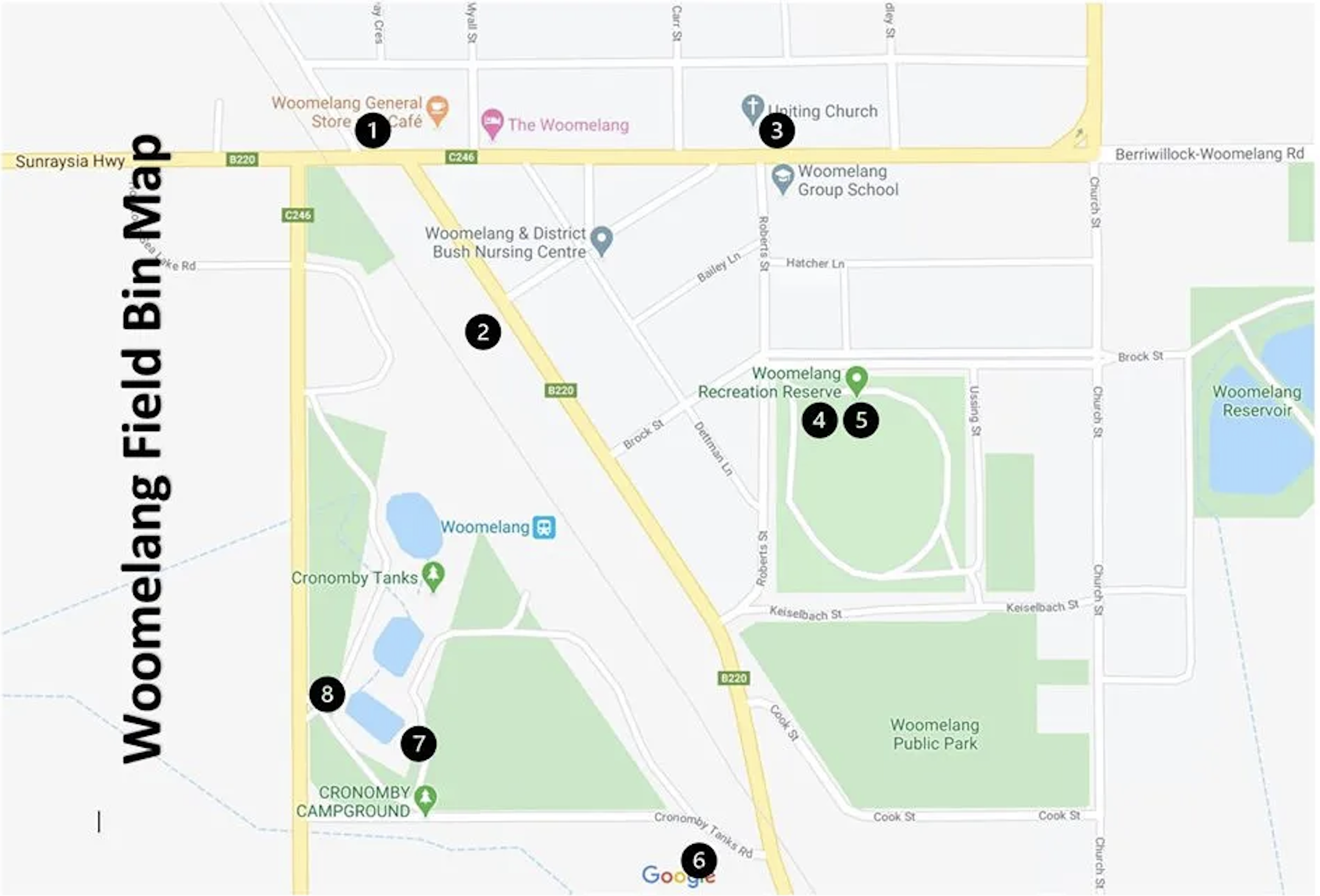
Map courtesy of Woomelang! Whats On!
Artwork / Subjects
The Woomelang trail contains eight mini silos or field bins and nine principal wildlife subjects.
I would photograph every field bin from several angles, including the complete structure, the principal wildlife subject and tighter details of the artwork.
(Map location 3) Pygmy Possum - Bryan Itch
I love the bright Pygmy Possum on the dark background. This is a striking peice of art. ISO 160 35mm f8.0 1/100sec
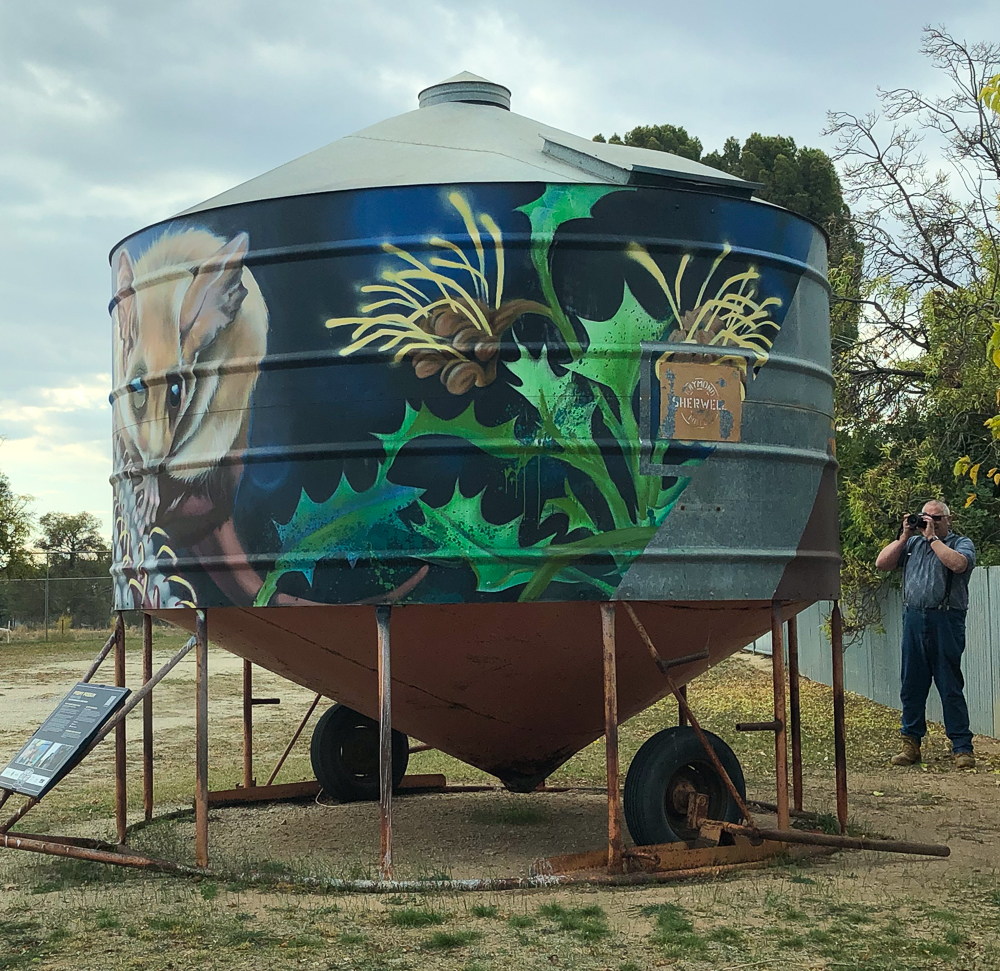
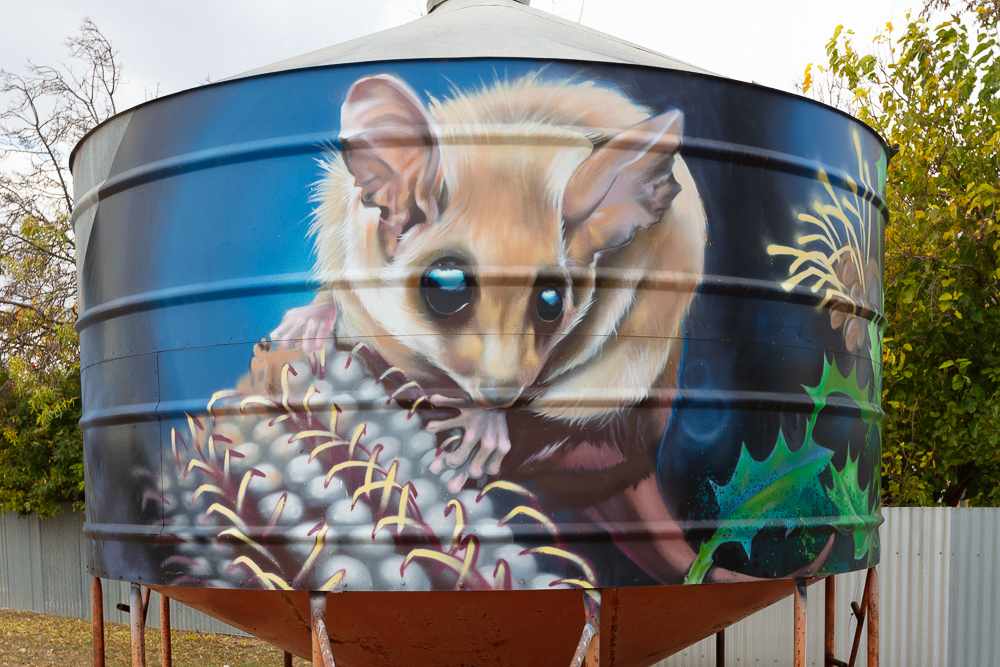
Bryan Itch painted the Pygmy Possum, using the large eyes and distinctive features of this tiny nocturnal marsupial to create one of the most immediately engaging works on the trail.
Photograph the complete field bin first, then move closer or use the 70-200mm to concentrate on:
- The eyes.
- Face.
- Fur texture.
- Paws.
- The relationship between the animal and surrounding vegetation.
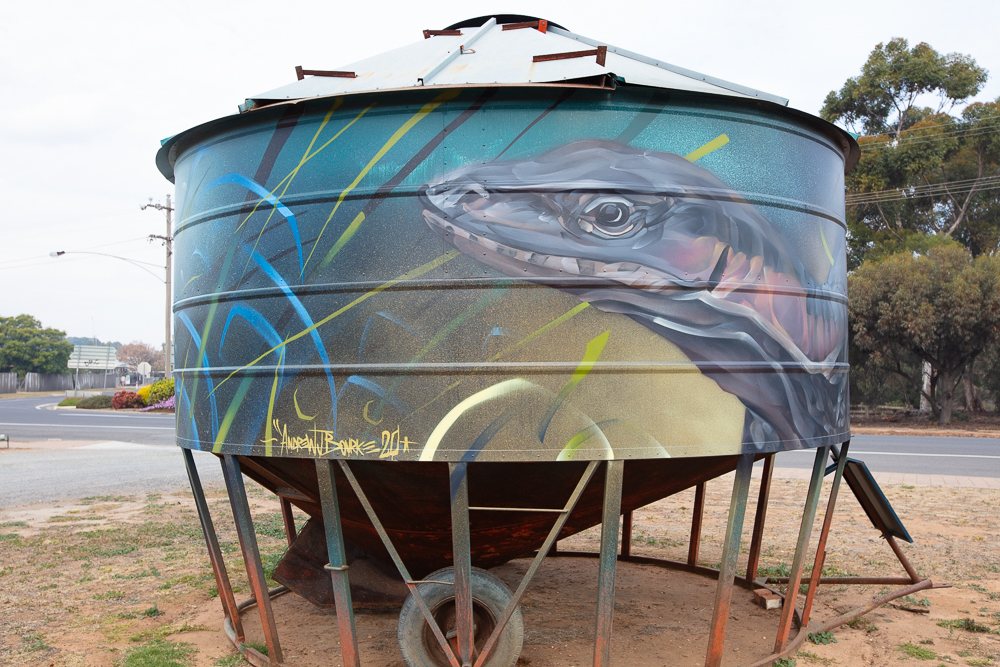
(Map Item 1) Rosenberg's Heath Monitor - Andrew J Bourke
Andrew J Bourke painted Rosenberg's Heath Monitor, a large monitor lizard associated with heathland and Mallee environments.
The scales and patterned skin make this a particularly good subject for close detail photography.
This one is right at the start of the trail, besides the entry to the Liberty Service Station. ISO 160 35mm f8 1/100sec.
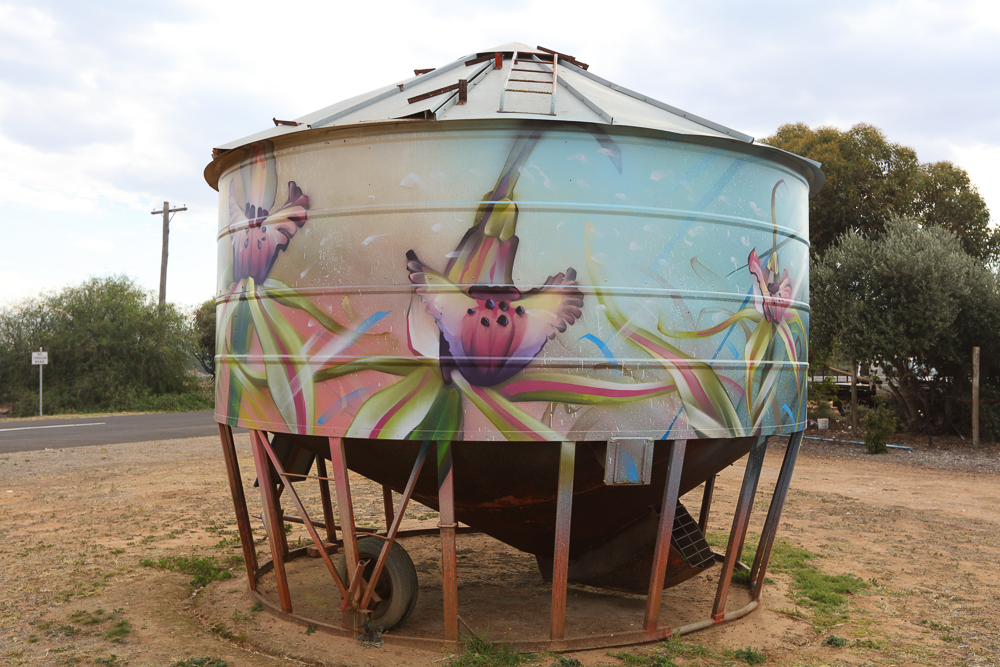
Look for compositions isolating:
- The head and eye.
- Scales.
- Claws.
- Pattern and colour.
- The way the animal wraps around the curved field bin.
(Map Location 7) Mallee Emu-Wren - Jimmy Dvate
Jimmy Dvate painted the Mallee Emu-Wren, one of the most characteristic threatened birds of the Mallee environment.
ISO 160 35mm f8.0 1/320sec
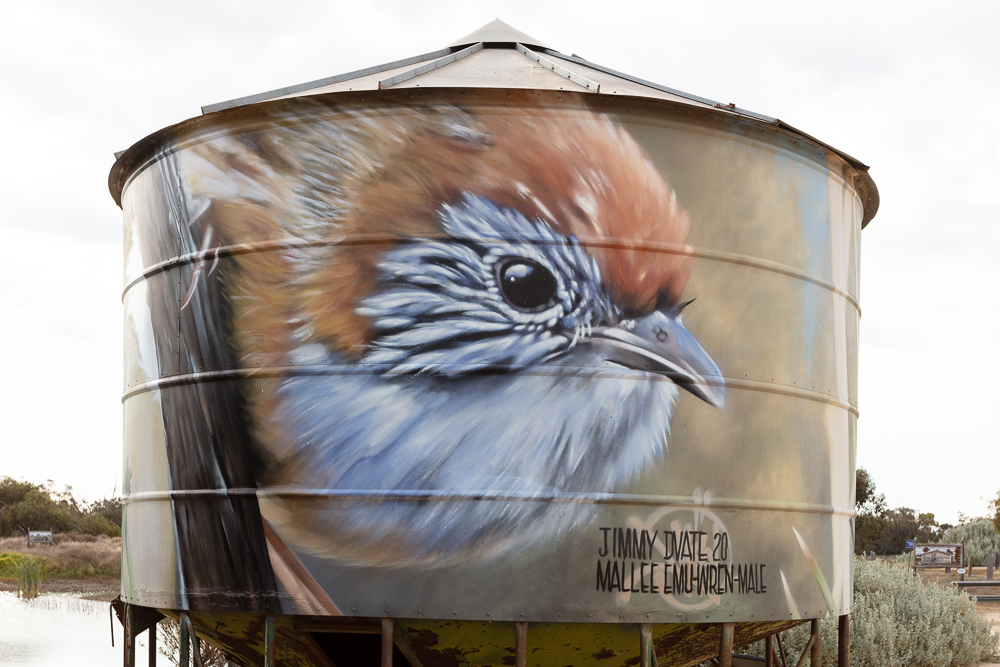
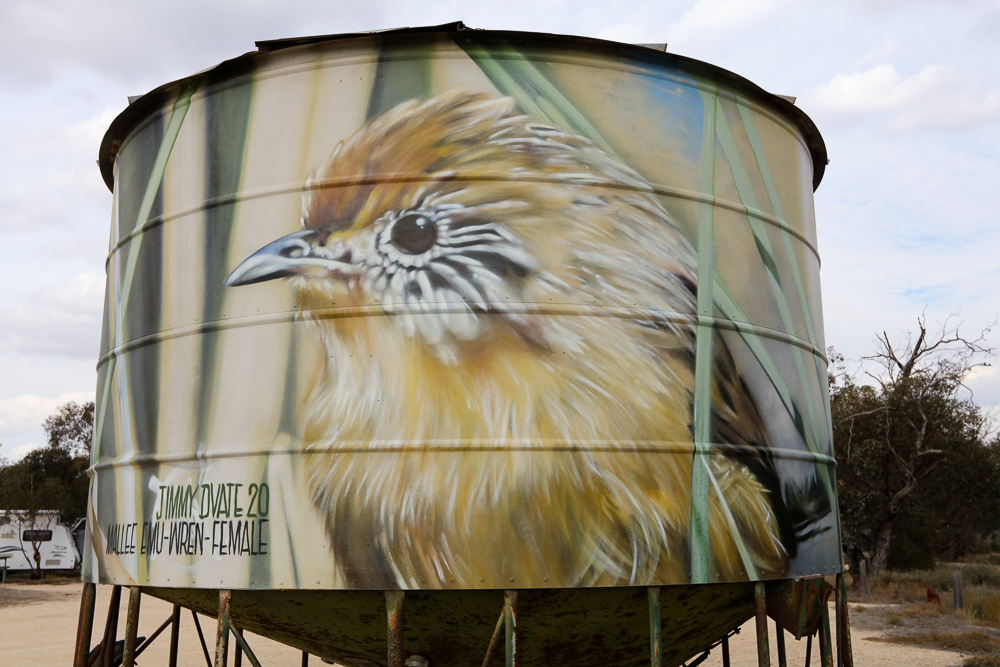
Dvate's detailed wildlife style makes this one of the artworks where the 70-200mm should be particularly useful.
Photograph both the complete composition and tighter studies of the bird, plumage, eye and surrounding vegetation.
(Map Location 4) Spotted-tailed Quoll - Kaff-eine
Kaff-eine painted the Spotted-tailed Quoll.
This silo is one of two in the Football Ground / Recreation Reserve. ISO 160 35mm f8.0 1/125
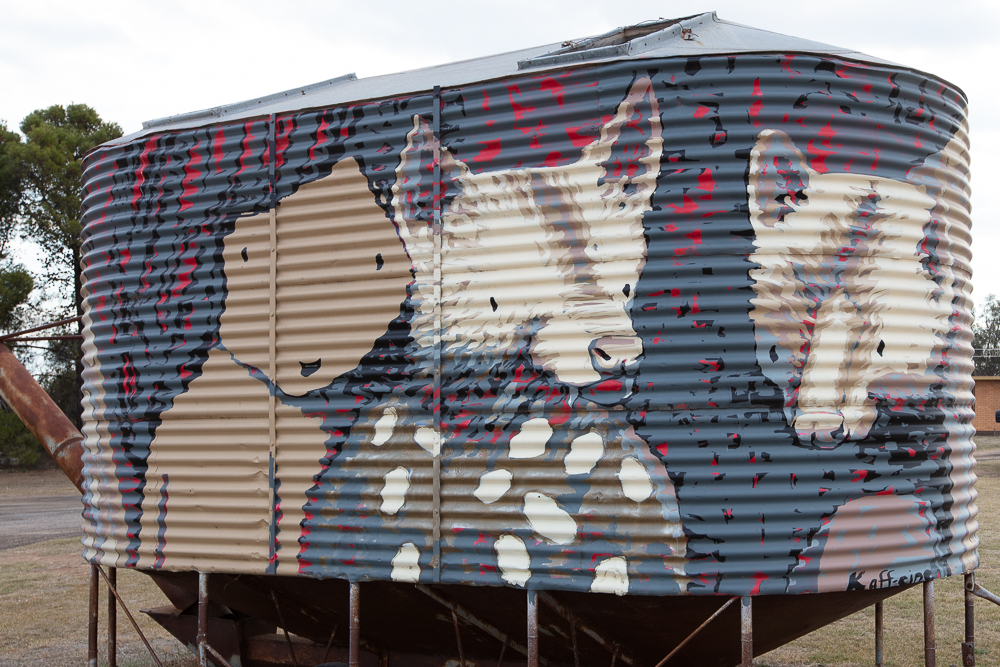
The spotted coat, face and interaction between the animal and the other elements of the composition provide several photographic possibilities beyond the straightforward complete-silo photograph.
Look particularly for:
- The complete animal.
- Face and eyes.
- Spotted fur.
- Paws.
- Human and wildlife elements within the composition.
(Map Location 5) Malleefowl - Mike Makatron
Ohh, and yes, it is 'malleefowl' and not 'mallee fowl'.
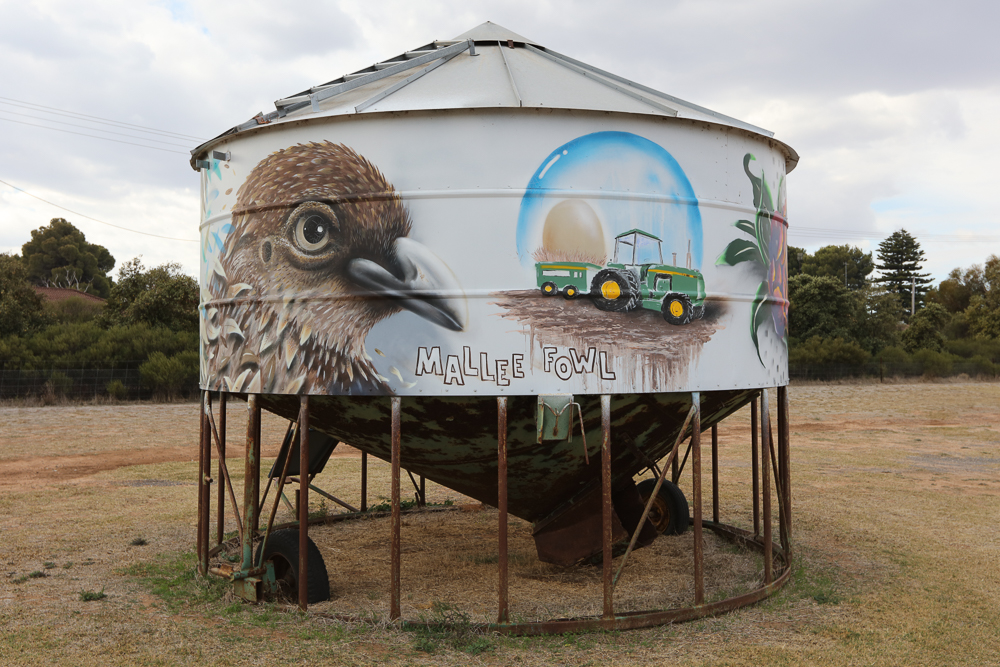
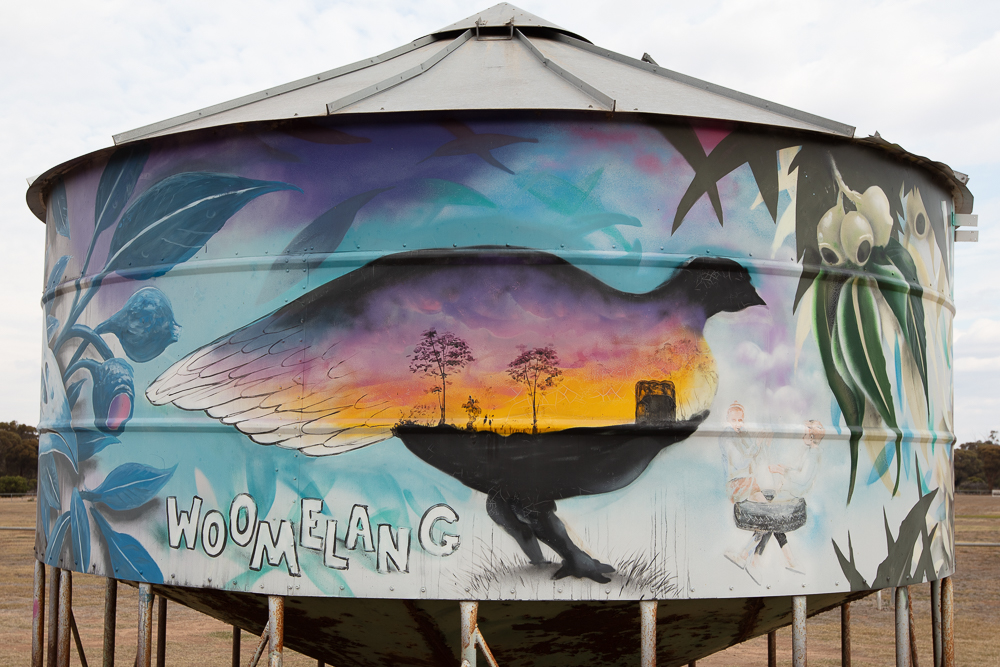
The second of two silos in the Football Ground, this one depicts the ground dwelling Malleefowl. The artist indicated that he is depicting "the cycle of life from egg to bones". ISO 160 35mm f8.0 1/200
Mike Makatron painted the Malleefowl, one of the birds most strongly associated with Australia's Mallee country.
The artwork explores aspects of the bird and its life cycle.
Photograph the complete field bin, then use a longer lens to isolate the bird and individual narrative details.
(Map Item 2) Western Whipbird - Chuck Mayfield
This is a great example of the various scenes that are placed around the silo. Here, Dooley Pohlneer has incorporated the Western Whipbird with some native flowers that he found at the Woomelange Cemetery. ISO 160 35mm f8 1/200sec.
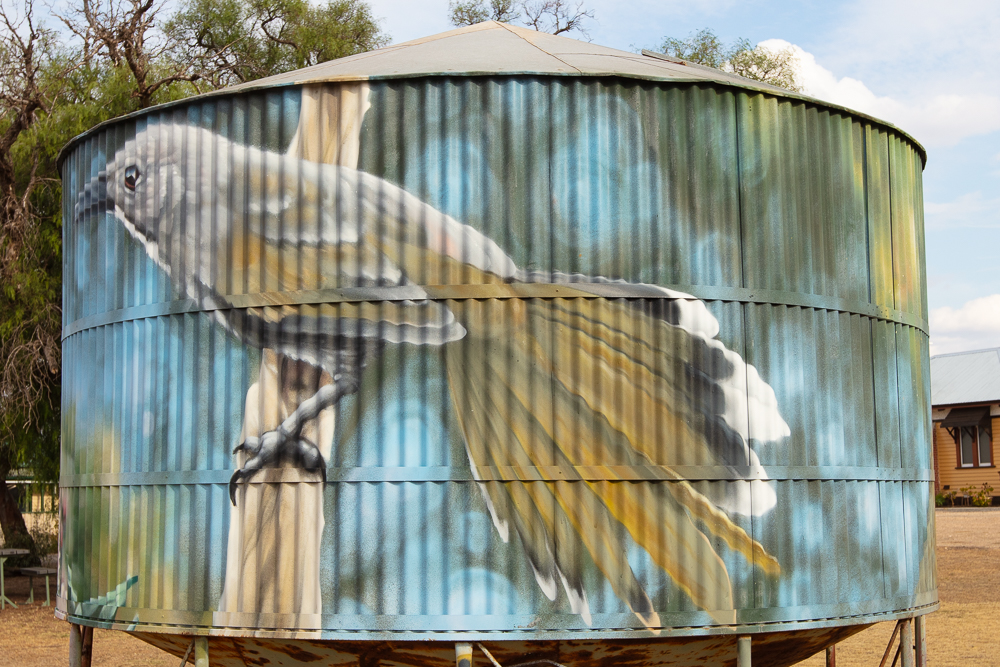
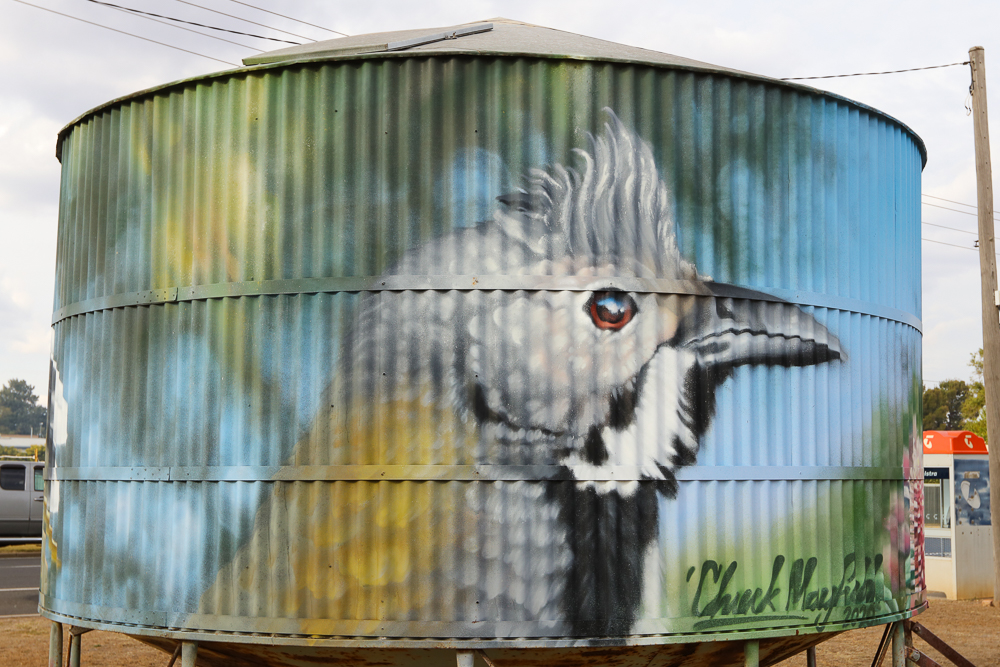
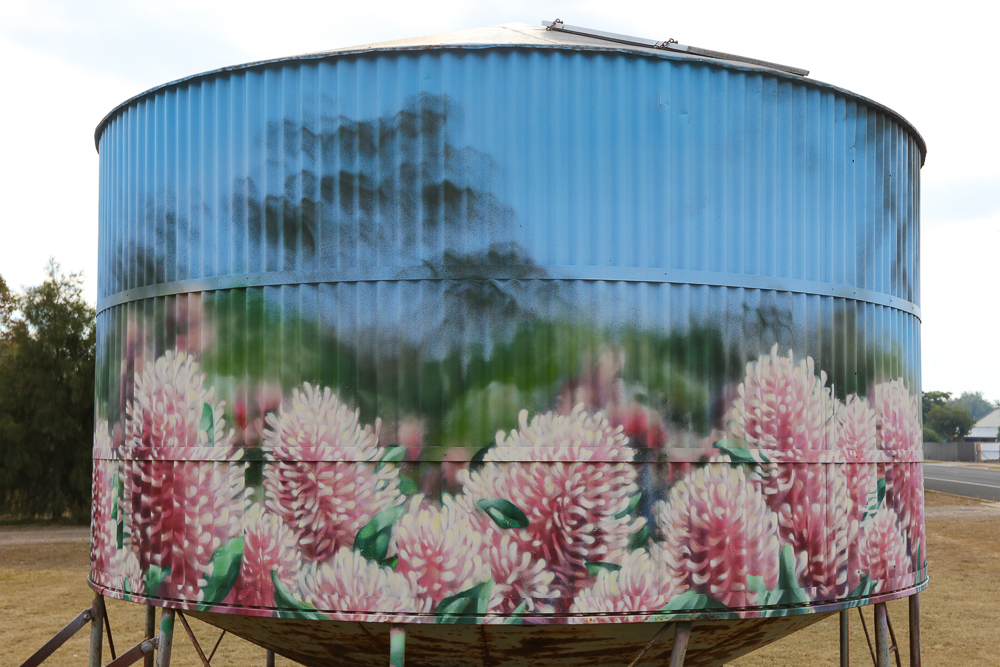
Chuck Mayfield painted the Western Whipbird.
The bird's elongated form and subtle colouring make this a quieter artwork than some of the more intensely coloured field bins.
Look for clean compositions in which the bird is separated from distracting background elements.
(Map Location 6) Lined Earless Dragon - Goodie
ISO 160 35mm f8.0 1/160sec
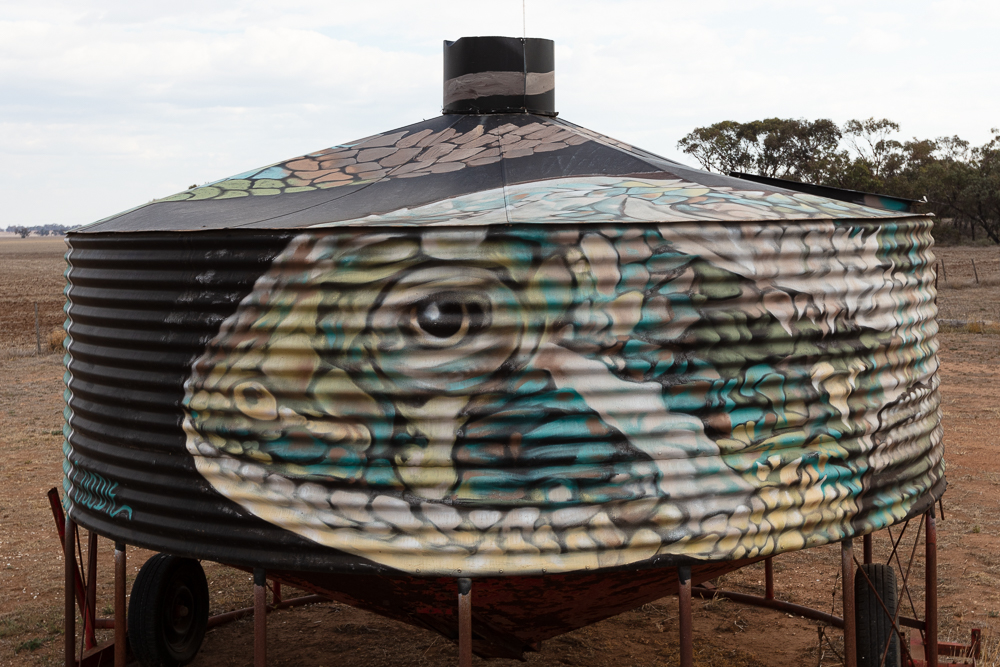
Goodie painted the Lined Earless Dragon.
The reptile's scales and mottled pattern make it particularly suitable for close photographic studies.
Use the 70-200mm to isolate the eye, head, skin texture and sections where the animal's body follows the curve of the field bin.
(Map Location 8) Major Mitchell's Cockatoo - Bryan Itch
This silo is on the side of the road as you drive into Woomelang from the south (C246). ISO 160 35mm f8.0 1/250sec
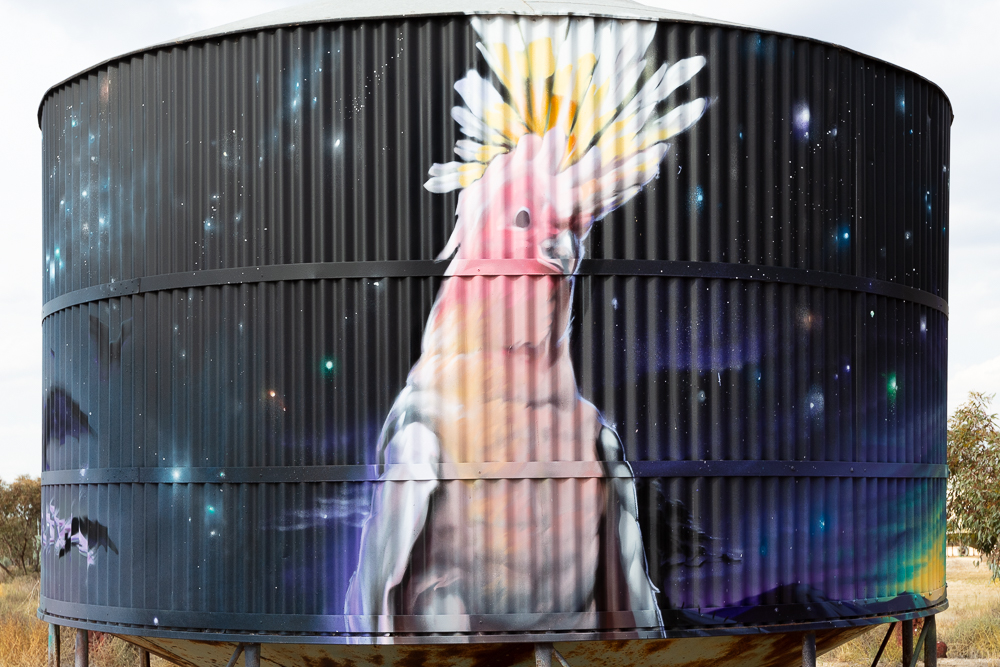
Bryan Itch also painted the Major Mitchell's Cockatoo, now commonly known as the Pink Cockatoo.
The bird's pink plumage and spectacular red-and-yellow crest make this one of the strongest colour subjects on the trail.
Photograph both the complete bird and tight details of:
- The eye.
- Crest.
- Feather structure.
- Pink, red and yellow colour transitions.
South-eastern Long-eared Bat - Chuck Mayfield
The same field bin also contains a South-eastern Long-eared Bat by Chuck Mayfield.
This is an important field bin to photograph from more than one direction, because photographing only one face will omit part of the artwork.
Make a deliberate sequence showing:
- The Major Mitchell's Cockatoo side.
- A three-quarter view showing the cylindrical structure.
- The Long-eared Bat side.
- Close details of both animals.
Artist
The Woomelang Mini Silo Art Trail is a collaborative project rather than the work of a single artist.
Seven artists contributed to the collection:
- Jimmy Dvate.
- Andrew J Bourke.
- Kaff-eine.
- Mike Makatron.
- Chuck Mayfield.
- Bryan Itch.
- Goodie.
This gives Woomelang an important photographic advantage.
Rather than seeing one artist's style repeated across a large structure, the photographer can compare seven different interpretations of Mallee wildlife within a single compact town.
Differences in realism, colour, composition, line, texture and the use of the curved field-bin surfaces become part of the story.
Photographing the Artwork
Woomelang should be photographed as a trail rather than as eight unrelated roadside objects.
Begin with several photographs establishing Woomelang itself before working through the individual field bins.
Photograph Every Field Bin
At each location, make a consistent documentary sequence:
- A wide photograph showing the field bin in its Woomelang setting.
- A complete photograph of the painted field bin.
- A three-quarter view showing its cylindrical form.
- The principal wildlife artwork.
- One or more close details.
- A photograph incorporating the surrounding town or Mallee landscape.
Walk Around the Field Bins
Unlike a flat wall mural, the artwork occupies curved structures.
Walk around each field bin wherever public access safely permits.
A composition that appears incomplete from one direction may become much stronger after moving only a few metres around the structure.
Show the Scale
One of Woomelang's defining characteristics is that these are mini silos.
Include several photographs containing a person, vehicle, building or other familiar object to establish scale.
This will make the contrast with the enormous grain silos elsewhere on the Silo Art Trail immediately apparent.
Photograph the Trail
Include transitional photographs between the individual artworks.
Useful subjects include:
- Woomelang streets.
- Trail signs.
- Old buildings.
- Railway heritage.
- Agricultural machinery.
- Roadside Mallee vegetation.
- Large skies.
These photographs prevent the finished gallery from becoming a catalogue of isolated painted cylinders.
Apple Map – Artwork and Nearby Photographic Locations
This Apple Map identifies Woomelang Mini Silo Art Trail and the five nearest silo-art locations for which Auspano pages currently exist. Marker 1 is the principal artwork; the remaining markers link the wider photographic trail.
Mapped locations
Location
Each mobile silo has several viewpoints from around its rim. However, you can walk around these in a few seconds. The issue is to find the right composition using particular camera-lens combination.
Each silo is, obviously, stationary, and you can walk up to them and touch them. This means a tripod is not really necessary. Compared to the typical silo art, these are also very low. The bottom of the silo / art is less than a metre off the ground, and the top is about 3m above ground. This typically means that an adult head is about the centre of the silo / art and therefore unlikely to create much if any tombstoning. So tilt-shift lenses or other techniques (e.g. drones) are not required to correct the tombstoning.
That leaves the key issue as exposure. Being Western Victoria, it usually sunny, and the sun of course shines more on one part of the silo than the other parts. Getting the exposure right, and in particular not blowing out the sun-lit highlights is a slight problem, but not a large one. I kept the ISO at 160 - which is low enough to not cause any noise, but still slightly 'brighter' than 100. I just used manual exposure, 35mm to fill the frame, while being a comfortable distance from it. I tried for optimum depth of field - without diffraction (f10 for my lens) - but the speed was too slow. So I opened up to F8 to allow me to increase my shutter speed a bit (1/100 - 1/200 range).
Access & Parking
The Woomelang Mini Silo Art Trail is designed to encourage visitors to explore the town.
The artworks are distributed around Woomelang and can be visited using a combination of walking and short vehicle movements.
Current regional visitor information lists:
- Car parking.
- Picnic facilities.
- Family-friendly access.
At each field bin, park only where it is safe and legal to do so.
Do not block:
- Driveways.
- Farm entrances.
- Local businesses.
- Heavy-vehicle access.
- Residential access.
Large Vehicles and Caravans
When travelling with a large tow vehicle and caravan, I would not attempt to drive the complete rig directly to every mini silo.
A better approach is to park the caravan at the accommodation or camping location and explore Woomelang in the tow vehicle alone.
This will make it considerably easier to stop safely, change viewpoints and revisit individual field bins as the light changes.
Accessibility
Current regional visitor information lists disabled access as available, with visitors advised to contact the operator for specific requirements.
There is no substantial bushwalk involved, and most of the artwork can be approached relatively closely by road.
However, because the collection is distributed around town, conditions differ between individual field-bin locations.
Surfaces may include:
- Footpaths.
- Gravel.
- Grass.
- Roadside verges.
- Uneven natural surfaces.
Visitors with limited mobility should use the trail map to approach each artwork by vehicle and assess the final short approach individually.
Best Light
Woomelang is unusual because the individual artworks face different directions.
There is therefore no single time when every field bin will necessarily receive ideal light.
Early Morning
Early morning provides:
- Low-angle light.
- Quieter streets.
- Long shadows.
- Potentially softer Mallee skies.
Work through the field bins that are receiving attractive morning light rather than rigidly following the trail order.
Late Afternoon
Late afternoon provides warm light and can be particularly effective when the artwork is photographed together with the surrounding Mallee environment.
Revisit field bins that were poorly illuminated during the morning.
Bright Overcast
Bright overcast may be the best overall condition for systematically documenting the entire trail.
Because the bins face different directions, soft cloud-filtered light reduces the problem of one artwork being brightly illuminated while another is in deep shadow.
It also provides even colour and reduces glare from the painted metal.
After Rain
If conditions are safe, the richer colours of wet roads, vegetation and soil can provide an attractive setting for the painted field bins.
Check for reflections and water droplets on the painted metal surfaces.
Nearby Locations
(1a) Woomelang Carpet Python Mural
This one is not a mobile silo, but is still well done. It a snake on the side of the General Store.
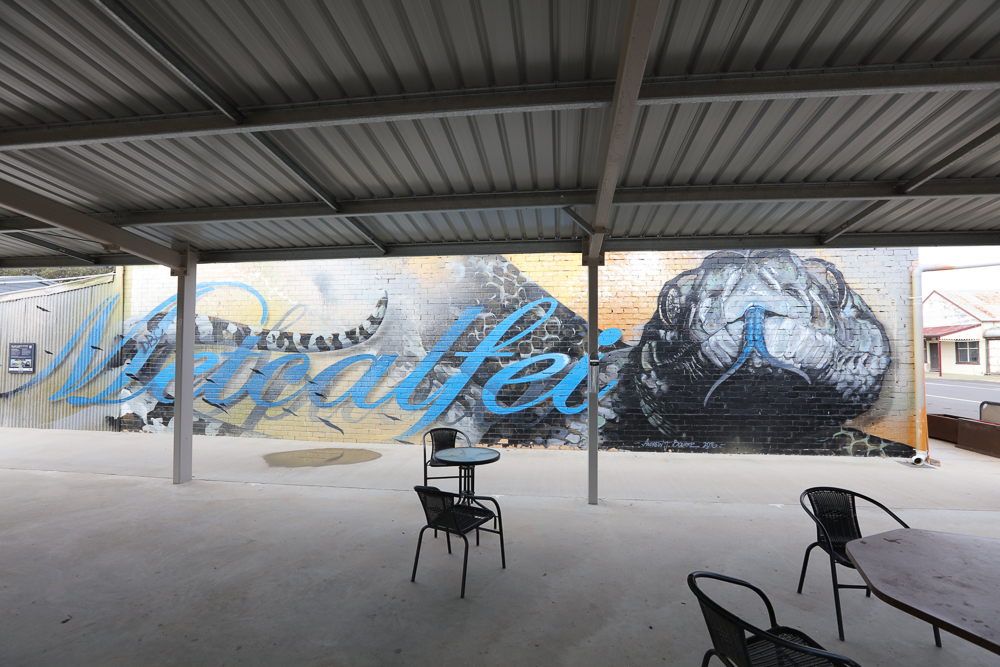
Before the mini silo project, Andrew J Bourke painted an endangered Carpet Python mural on the Woomelang General Store.
This work helped establish the threatened-species theme subsequently used for the mini silo trail.
It should therefore be treated as an important companion photograph to the field-bin collection.
Cronomby Tanks Precinct
The Cronomby Tanks Precinct provides a mixture of local history, recreation and additional art.
The precinct includes Woomelang's own silo art and iron art, together with camping and walking opportunities.
It is useful photographically because it broadens the Woomelang story beyond the mini field bins.
Kerosene Tin Shearing Shed
Woomelang's Kerosene Tin Shearing Shed is an unusual piece of rural architecture constructed using flattened kerosene tins.
Look for:
- Overall architectural photographs.
- Corrugated and metal textures.
- Weathering.
- Construction details.
- Connections with local agricultural history.
Woomelang Railway and Rural Heritage
Woomelang's history as a rural railway town provides additional subjects that can help establish a sense of place.
Look for railway infrastructure, grain-handling elements, old buildings, signs and other details associated with the town's agricultural history.
Lascelles Silo Art
Lascelles Silo Art is approximately 14 km north of Woomelang and is one of the most logical neighbouring silo-art stops.
Rone's enormous, restrained portraits of local farming couple Geoff and Merrilyn Horman provide an extraordinary contrast with Woomelang's small, brightly painted mobile field bins.
Photographing both locations on the same day demonstrates the enormous variation in scale possible within the silo-art movement.
Sea Lake Silo Art and Lake Tyrrell
Sea Lake provides another major silo-art destination and access to the extraordinary landscape of Lake Tyrrell.
Lake Tyrrell is particularly important photographically for:
- Minimalist landscapes.
- Reflections when water conditions permit.
- Sunrise.
- Sunset.
- Night-sky photography.
Patchewollock Silo Art
Patchewollock Silo Art is another important northern Wimmera Mallee silo-art location.
Fintan Magee's monumental portrait of local farmer Nick "Noodle" Hulland again provides a striking contrast with Woomelang's miniature trail.
Rosebery and Brim Silo Art
Travelling south brings the photographer to Rosebery and Brim, two of the major works on the original Wimmera Mallee Silo Art Trail.
Together with Woomelang and Lascelles, these locations can form a very strong multi-day photographic study of the region's public art.
Nearby Auspano silo-art pages
- Sea Lake Silo Art — approximately 26 km in a straight line; road distance will be longer.
- Brim Silo Art — approximately 49 km in a straight line; road distance will be longer.
- Patchewollock Silo Art — approximately 54 km in a straight line; road distance will be longer.
- Albacutya Silo Art — approximately 60 km in a straight line; road distance will be longer.
- Rainbow Silo Art — approximately 65 km in a straight line; road distance will be longer.
Use the linked pages for verified viewpoints, access notes and additional nearby subjects. Check current road conditions before travelling between remote Mallee locations.
How to Get There
Woomelang is located in Victoria's northern Wimmera Mallee, between the major silo-art destinations around Brim, Rosebery, Lascelles and Sea Lake.
From Lascelles
Woomelang is approximately 14 km south of Lascelles.
This makes the two locations particularly easy to photograph during the same journey.
From Hopetoun
Woomelang can be approached from Hopetoun via the regional road network through the northern Wimmera Mallee.
Allow additional time for roadside landscape photographs, particularly during early or late light.
Following the Silo Art Trail
Woomelang lies within the broader Wimmera Mallee silo-art region and can be incorporated into a sequence including:
- Brim.
- Rosebery.
- Woomelang.
- Lascelles.
- Patchewollock.
- Sea Lake.
Unlike the other locations, however, allow enough time at Woomelang to leave the vehicle and explore the town rather than treating it as a single roadside photograph.
Driving from the State Capital
The state capital is used as a consistent reference point. The actual route varies with the traveller's starting point, traffic, roadworks and closures.
State capital to artwork
Calculating the driving route with Apple Maps…
Distance and time are estimates and may change with conditions.
Where to Stay
Woomelang
For photographing the complete Mini Silo Art Trail, staying in Woomelang itself is the most useful option.
Local accommodation includes Woomelang Cabins, while free camping is available at the Cronomby Tanks Precinct.
Staying locally provides the opportunity to:
- Photograph some field bins in late-afternoon light.
- Revisit differently oriented bins the following morning.
- Photograph the town during blue hour.
- Explore Cronomby Tanks.
- Photograph the wider Mallee landscape.
Sea Lake
Sea Lake is a strong alternative base if Woomelang forms part of a larger photographic trip incorporating Lake Tyrrell.
It offers a broader range of visitor facilities while providing access to both silo art and one of north-west Victoria's most distinctive landscape locations.
Hopetoun
Hopetoun is another practical regional base, particularly when combining Woomelang with Brim, Rosebery and other southern silo-art locations. Hopetoun has supermarkets, fuel, bakery, resturants, motel, cafe, etc. Further afield from Hopetoun and Sea Lake, about an hour away to the north-east is Swan Hill, with many many options (and train and bus links to Melbourne). Warracknabeal is a similar distance to the south south west.
We stayed at the Hopetoun Lake Lascelles Campground. If you are RV'ing, Caravaning, or tenting, then I recommend this location. It is a reasonably large lake, with camp spots all around it. It is within walking distance of Hopetoun itself.
Travelling with a Large Caravan
When travelling with a large caravan, confirm current site dimensions, access and turning space before arrival.
For photographing the trail itself, I would leave the caravan at the overnight base and explore Woomelang using the tow vehicle alone.
Photography Recommendations
What I took - what was in my kit
I took my LowePro Backpack loaded with Canon 5DSR body, Canon 16-35mm, handheld.
I expected to need to be able to 'go wide' to get these silos in, but in the end, I shot at the higher focal length range of this 16-35mm f2.8 lens. I purposely chose to go handheld, as there is a range of views in the 3600 of these silos, and I wanted to be more mobile.
Techniques
Manual exposure
If you are going to stitch photos, then you need them to all have the same exposure, and you need to be using manual expsoure. Being 'old school' I also generally prefer to shoot manual when I have the time. I know that I have various programable settings on the camera, but slowing down to shoot and think about composition and exposure has some benefits. I didn't need to shoot manual, I just shot that way as I prefered it.
16-35mm
The 16-35mm is considerably more useful at Woomelang than at many conventional silo-art locations because the field bins are relatively small and some are positioned in confined town settings.
Use it for environmental photographs, but avoid moving unnecessarily close at 16mm because this can distort the cylindrical structures.
24mm Tilt-Shift
The 24mm tilt-shift is less essential here than at enormous silos such as Brim, but it can still be useful where buildings, poles or other strong vertical elements surround a field bin.
It can also produce very clean documentary photographs with controlled geometry.
24-70mm
The 24-70mm would be my principal lens for the Woomelang trail.
It should handle:
- Complete field bins.
- Three-quarter views.
- Environmental compositions.
- Individual wildlife subjects.
- Town and streetscape photographs.
70-200mm
The 70-200mm is particularly valuable for the artwork details.
Use it for:
- Eyes.
- Feathers.
- Fur.
- Scales.
- Claws.
- Faces.
- Sections of artwork wrapping around the bins.
Fuji GX680
The Fuji GX680 is less necessary for perspective control here than at monumental grain silos.
However, it could produce an excellent small series of carefully composed environmental portraits showing selected field bins within Woomelang.
Rather than photographing all eight with the GX680, I would select the two or three strongest combinations of artwork, structure and environment.
Tripod
A tripod is generally unnecessary while initially walking the trail.
Handheld photography will make it much easier to explore viewpoints quickly.
Use the tripod selectively for:
- Tilt-shift photographs.
- Fuji GX680 photographs.
- Blue-hour work.
- Precisely aligned multi-frame images.
Controlling Perspective
Perspective control at Woomelang presents a different problem from the towering grain silos elsewhere on the Silo Art Trail.
Because the field bins are relatively small, there is usually little need to point the camera steeply upwards.
The greater danger is working too close with an ultra-wide lens, which can exaggerate the nearest part of the cylindrical structure and distort the artist's original proportions.
First Choice - Step Back
Wherever space permits:
- Move farther away.
- Use the 24-70mm.
- Try approximately 35-70mm.
- Keep the camera reasonably level.
This should provide a natural representation of most field bins.
24mm Tilt-Shift
Your 24mm tilt-shift becomes useful when the field bin is positioned close to buildings or other strong vertical elements.
Level the camera and use modest shift to refine the composition rather than tilting the camera.
Because these structures are short compared with conventional grain silos, large amounts of upward shift should rarely be necessary.
As at the larger silo sites, use shift rather than tilt for normal perspective control.
Fuji GX680
With the Fuji GX680, keep the film plane vertical and use modest front rise or lateral shift where required.
The movements are likely to be more useful for refining the relationship between the field bin and surrounding architecture than for fitting the complete artwork into the frame.
Avoid excessive rear movements if the objective is an accurate documentary representation of the artwork.
Cylindrical Distortion
Remember that some apparent distortion is inherent in the artwork because it has been painted onto a curved field bin.
Do not attempt to "correct" the natural curvature of the structure.
The objective is to minimise camera-induced distortion while preserving the artist's use of the cylindrical surface.
DJI Mavic 2 Pro
A drone is unlikely to improve photographs of the individual mini silos simply by providing a higher viewpoint.
Its more interesting potential would be an environmental photograph showing several trail locations within the layout of Woomelang.
Before any flight, check current CASA airspace and operating restrictions using a CASA-verified drone safety application, identify a legal launch and recovery location and obtain any landowner permission required.
Do not fly over people, roads, private property or other areas where the flight would breach current operating requirements.
If a legal and safe flight does not produce information unavailable from ground level, there is little reason to use the drone at this location.
Suggested Photographic Sequence
The trail effectively starts at the junction of the B220 and BC246 roads, which is the General Store and Cafe, and where you can get hard copies of the trail map. Another difference is that these silos are painted all around. While a couple of large silos have paintings either side, most are designed to be viewed from one direction only. The Woomerang Silos typically have four or more aspects to the paintings. The paintings are also by different artists, so they are unalike in terms of both subject matter and style.
-
Collect the current trail map.
Begin at the Woomelang General Store or another local information point and establish the location of all eight field bins.
-
Photograph the Carpet Python mural.
This provides a useful introduction to the threatened-wildlife theme of the trail.
-
Make an establishing photograph of Woomelang.
Show the small Mallee town before concentrating on individual artworks.
-
Begin the mini silo trail.
At each field bin, photograph the setting before moving closer.
-
Photograph each complete field bin.
Keep the sequence visually consistent so the finished gallery clearly records the complete collection.
-
Walk around each structure.
Look for three-quarter compositions and artwork extending around the curved surfaces.
-
Switch to the 70-200mm.
Record eyes, feathers, fur, scales and other wildlife details.
-
Pay particular attention to the two-sided field bin.
Photograph both the Major Mitchell's Cockatoo and the South-eastern Long-eared Bat.
-
Photograph transitions between the silos.
Streets, signs, buildings and rural details will connect the individual artworks into a coherent trail.
-
Visit Cronomby Tanks.
Extend the story into Woomelang's history, landscape and other public art.
-
Photograph the Kerosene Tin Shearing Shed.
Concentrate on both the complete structure and unusual metal construction details.
-
Finish with the Mallee landscape.
Use late-afternoon light to place Woomelang and its artworks within the wider agricultural environment.
How Long Should a Photographer Stay?
Woomelang deserves considerably more time than a conventional single silo-art stop.
A visitor simply following the trail and viewing all eight field bins should allow approximately 45-60 minutes.
For a serious photographic record of every artwork, I would allow approximately 2-3 hours.
This allows time to:
- Locate every field bin.
- Photograph each complete structure.
- Walk around the artwork.
- Use the 70-200mm for details.
- Photograph the town between locations.
- Visit the Carpet Python mural.
For a complete Auspano photographic study incorporating Cronomby Tanks, the Kerosene Tin Shearing Shed and the surrounding Mallee landscape, I would allocate approximately half a day.
An overnight stay would be worthwhile if the intention is to revisit individual field bins under both morning and late-afternoon light.
My Priority Photographs
- Woomelang establishing photograph.
- Carpet Python mural on the General Store.
- Trail sign or map establishing the Mini Silo Art Trail.
- Pygmy Possum - complete field bin.
- Pygmy Possum - eye and facial detail.
- Rosenberg's Heath Monitor - complete artwork.
- Heath Monitor - scales and eye detail.
- Mallee Emu-Wren - complete artwork.
- Mallee Emu-Wren - feather detail.
- Spotted-tailed Quoll - complete artwork.
- Spotted-tailed Quoll - face and spotted-fur detail.
- Malleefowl - complete artwork.
- Malleefowl - detail showing the narrative elements.
- Western Whipbird - complete artwork.
- Lined Earless Dragon - complete artwork.
- Lined Earless Dragon - scales and eye detail.
- Major Mitchell's Cockatoo - complete artwork.
- Major Mitchell's Cockatoo - crest and feather detail.
- South-eastern Long-eared Bat - complete artwork.
- Three-quarter photograph of the shared field bin showing how the Cockatoo and Bat occupy opposite sides.
- Photograph demonstrating the small scale of a field bin.
- Several mini silos photographed within their Woomelang setting.
- Street or rural photographs connecting the individual trail sites.
- Cronomby Tanks.
- Kerosene Tin Shearing Shed.
- Wider Mallee landscape around Woomelang.
Artwork Information
| Location | Woomelang, Victoria |
|---|---|
| Artwork | Woomelang Mini Silo Art Trail |
| Created | 2020 |
| Number of field bins | Eight |
| Wildlife subjects | Nine principal wildlife artworks |
| Artists | Jimmy Dvate, Andrew J Bourke, Kaff-eine, Mike Makatron, Chuck Mayfield, Bryan Itch and Goodie |
| Theme | Threatened wildlife of the Mallee |
| Subjects | Pygmy Possum, Rosenberg's Heath Monitor, Mallee Emu-Wren, Spotted-tailed Quoll, Malleefowl, Western Whipbird, Lined Earless Dragon, Major Mitchell's Cockatoo and South-eastern Long-eared Bat |
| Structures | Mobile agricultural field bins / mini silos |
| Trail format | Eight field bins distributed around Woomelang |
| Starting point | 67 Brook Street, Woomelang VIC 3485 |
| Entry | Free |
| Opening | Open at all times |
| Accessibility | Disabled access listed; contact operator for specific details |
| Principal lens | 24-70mm |
| Detail lens | 70-200mm |
| Perspective-control lens | 24mm tilt-shift where useful |
| Suggested trail photography time | 2-3 hours |
| Suggested complete Woomelang visit | Approximately half a day |
Photography Summary
Primary subjects: Woomelang mini silo art trail
Best light: Soft light helps retain colour across the artworks.
Suggested kit: Wide and standard zoom; polariser
Photo Subjects
Explore related Auspano photography guides by subject.
Photographer Comments & Updates
Have you photographed this location? Share your photographs, viewpoints, photography tips or recent access updates, or ask a question about visiting. When uploading your own photographs, please include your name and the date each photograph was taken. Date any access or track-condition observations; visitor reports may become outdated, so check official information before travelling.