Photographing Goorambat Silo Art
About the Artwork
Goorambat Silo Art is a collection of large-scale rural murals created by Australian artist Jimmy Dvate in the small north-eastern Victorian town of Goorambat.
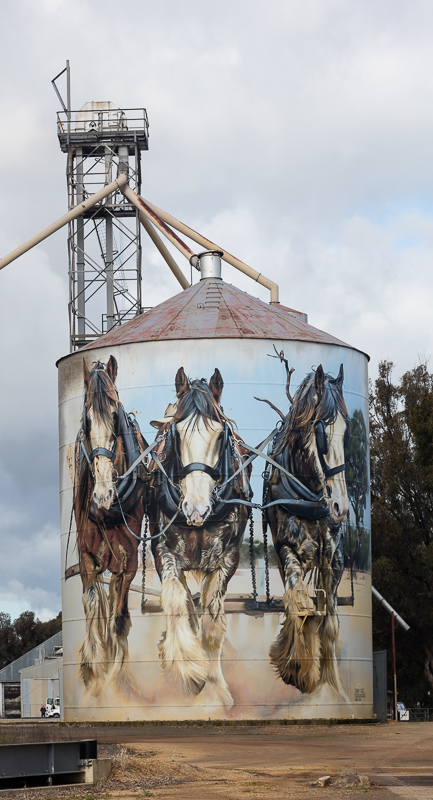
The principal silo installation consists of three painted silos completed in two stages during 2018 and 2019.
The first stage was created for the 2018 Wall to Wall Festival and combines two closely related subjects:
- Milli the Barking Owl, painted on the tall concrete silo.
- A farming and woodland landscape representing the habitat required by the Barking Owl, painted on a shorter silo.
Jimmy Dvate returned to Goorambat in 2019 to paint another short silo with three enormous Clydesdale horses: Clem, Sam and Banjo.
The combination is particularly appropriate to Goorambat.
The Barking Owl and habitat murals draw attention to native wildlife and conservation, while the Clydesdales recognise the animals that were once fundamental to farming and agricultural transport throughout the district.
In 2021, Dvate added another significant artwork nearby, painting a Nankeen Kestrel named Rusty on the south-facing wall of the Goorambat oat shed.
Although Rusty is not one of the three principal silo murals, it should be included when photographing the complete Goorambat public-art story.
Artwork / Subjects
Milli the Barking Owl
The dominant Goorambat artwork is the enormous Barking Owl painted on the tall concrete silo.
The individual bird used as the model was Milli, a Barking Owl living at Healesville Sanctuary.
Jimmy Dvate wanted an accurate and dynamic representation of the bird, and extensive photographic reference material was produced before the final pose was selected.
The resulting image is much more than a conventional perched-bird portrait.
Milli appears alert and powerful, and the enormous eyes become one of the strongest visual elements in the complete silo installation.
Photograph the owl at several scales:
- The complete concrete silo.
- The complete owl.
- The head and eyes.
- Feather details.
- Talons and other anatomical details.
- The relationship between the owl and adjoining habitat mural.
The Barking Owl's Habitat
The shorter adjoining silo continues Dvate's conservation theme by depicting the farming and woodland environment associated with the Barking Owl.
This part of the installation is important because it changes the interpretation of the owl mural.
Rather than simply presenting an enormous native bird, Dvate links the animal directly to the landscape it requires for survival.
Photograph this silo both separately and together with Milli.
Look for details of:
- Trees.
- Farmland.
- Vegetation.
- Landscape transitions.
- The way the painted landscape follows the curved silo surface.
Clem, Sam and Banjo - The Clydesdales
Jimmy Dvate returned to Goorambat in 2019 to paint the north-facing short silo.
The mural depicts three magnificent Clydesdale horses named Clem, Sam and Banjo.
The horses represent the importance of Clydesdales to farming before tractors and motor vehicles became commonplace.
Two of the horses, Banjo and Clem, were locally bred by the Trewin family. Sam was bred in Queensland and is Banjo's grandson.
The Clydesdale mural provides a very different photographic subject from Milli.
Instead of concentrating primarily on one enormous face, look for the relationship and rhythm created by the three horses.
Photograph:
- The complete three-horse composition.
- All three heads together.
- Individual horse portraits.
- Eyes.
- Harness.
- Muzzles.
- Mane and hair details.
- The interaction between adjoining horses.
Rusty the Nankeen Kestrel
In 2021, Jimmy Dvate returned to Goorambat and painted Rusty the Nankeen Kestrel on the south-facing wall of the oat shed.
Rusty extends the native-wildlife theme beyond the original silo installation.
Because the kestrel is on a different type of agricultural structure, it also provides useful visual variety within a Goorambat gallery.
Photograph the complete building first and then use a longer lens for the bird, eye, plumage and other details.
Artist
The Goorambat silo murals were painted by Jimmy Dvate.
Dvate is particularly well known for large-scale paintings of Australian native flora and fauna.
Conservation frequently plays an important role in his work, with locally relevant native species used to draw attention to the animals and habitats of the area in which a mural is located.
This approach is particularly evident at Goorambat.
Milli is not presented in isolation. The adjoining landscape helps explain the habitat upon which Barking Owls depend.
The Clydesdales broaden the story by recognising another group of animals closely associated with the history of the district: working horses.
Dvate's detailed, relatively realistic painting style is particularly rewarding photographically because it provides strong images at two very different scales.
From a distance the murals read as enormous wildlife and agricultural portraits. With a telephoto lens, individual feathers, eyes, hair, vegetation and painted surface details become photographic subjects in their own right.
Photographing the Artwork
Understand the Complete Site First
Do not begin by immediately setting up in front of Milli.
Walk around the permitted public viewing areas first and establish the relationship between:
- Milli.
- The habitat silo.
- The Clydesdale silo.
- The oat shed and Rusty.
The artworks face different directions, so the strongest photograph of each may require a different shooting position and different light.
Milli and Her Habitat
One of the most important compositions should show Milli together with the adjoining habitat mural.
This explains Dvate's conservation message more effectively than a tight photograph of the owl alone.
Then move closer photographically and isolate the owl.
The Clydesdales
The three Clydesdales should initially be photographed as a group.
Pay particular attention to the spacing between the horses and the curvature of the silo.
Move laterally rather than automatically accepting the first frontal viewpoint.
Small changes in camera position can significantly alter the apparent relationship between the three painted horses.
Wildlife Details
The 70-200mm should be particularly productive at Goorambat.
Look for:
- Milli's eyes.
- Owl feather patterns.
- Talons.
- Clydesdale eyes.
- Harness details.
- Mane and muzzle textures.
- Rusty's eye.
- Kestrel plumage.
- Paint and concrete texture.
Include Goorambat
Make several wider photographs showing the artwork within the small rural township.
These environmental images help establish scale and prevent the finished gallery from becoming a collection of isolated mural details.
Map
Location
Goorambat Silo Art is located in the small rural township of Goorambat, approximately 16 kilometres north of Benalla in north-eastern Victoria.
The silos are located beside the main road through Goorambat.
Location:
Halls Road / Devenish Road,
Goorambat VIC 3725
Google Maps: Goorambat Silo Art
Access & Parking
Goorambat Silo Art is a roadside attraction with dedicated public viewing areas.
Visitor facilities currently include car and coach parking.
There are two principal viewing areas for the silo artwork, with verge parking and additional parking available in the vicinity.
The artwork is associated with working agricultural structures, so remain within public areas and respect:
- Fences.
- Operational signs.
- Private property.
- Heavy-vehicle access.
- Agricultural operations.
Large Vehicles and Caravans
The availability of coach parking makes Goorambat easier for larger vehicles than many small roadside art locations.
Nevertheless, with a large tow vehicle and caravan, assess the available turning space before entering a parking area.
Avoid using operational agricultural areas simply because they appear to provide convenient turning room.
If staying nearby, leaving the caravan at the accommodation and returning with the tow vehicle alone will make it much easier to move between viewpoints as the light changes.
Accessibility
Goorambat Silo Art is relatively easy to view and does not require a long walk, steep track or stairs.
Current official visitor information indicates that the attraction welcomes visitors with access needs, although visitors requiring particular facilities should confirm their requirements before travelling.
The principal artwork can be viewed from public areas close to the road.
Some photographic positions may involve:
- Grass.
- Gravel.
- Roadside verges.
- Uneven ground.
A photographer with limited mobility should still be able to see and photograph the principal silo subjects from relatively close to the vehicle.
Best Light
Goorambat benefits particularly from spending enough time to examine the light on both sides of the silo complex.
The Barking Owl/habitat artwork and Clydesdale mural do not present exactly the same orientation, so one side may be considerably better illuminated than the other at a particular time.
Early Morning
Early morning provides quieter roads and low-angle light.
It is particularly useful for environmental photographs showing the silos within the surrounding rural landscape.
Examine the direction of light before deciding whether to begin with Milli or the Clydesdales.
Late Afternoon
Late-afternoon light can add warmth and dimensionality to the curved silo surfaces.
It can be especially attractive on the Clydesdales, where directional light can complement the modelling already present in Dvate's painting.
Bright Overcast
Bright overcast is excellent for a comprehensive documentary record of Goorambat.
Soft light reduces the problem created by the murals facing different directions and provides:
- Even colour.
- Reduced glare.
- Good feather and hair detail.
- More manageable contrast.
- Consistent illumination across a multi-image gallery.
Blue Hour
If staying nearby, consider returning around blue hour.
A deep blue sky can complement the muted agricultural setting and provide a very different interpretation from the conventional daytime record.
Take care not to trespass or interfere with any operational activity while working in low light.
Nearby
Sophia - Goorambat Uniting Church
Sophia should be considered an essential part of a photographic visit to Goorambat rather than an optional extra.
The enormous mural was painted by Australian artist Adnate inside the Goorambat Uniting Church.
The work depicts a female figure representing Sophia, the personification of divine wisdom.
The mural occupies the interior wall behind the altar and creates a dramatically different photographic environment from the outdoor silo artwork.
Photograph:
- The complete church interior with Sophia.
- A symmetrical view along the nave.
- The mural and altar together.
- The face.
- Eyes and hands.
- Architectural details framing the artwork.
The church interior is an excellent location for the 24mm tilt-shift because it allows the camera to remain level while preserving the vertical geometry of the building.
Be quiet and respectful inside the church and remember that it remains a place of worship rather than simply an art gallery.
Rusty the Nankeen Kestrel
Do not leave Goorambat without locating Jimmy Dvate's Rusty the Nankeen Kestrel on the oat shed.
This 2021 artwork extends Dvate's wildlife theme and provides another useful comparison of how the artist adapts his work to different agricultural structures.
Goorambat Public Art
Goorambat contains additional public art beyond the silos and Sophia.
Look around the town for smaller murals and painted structures, including artwork around the public facilities.
These smaller works can provide useful transitional photographs within a broader Goorambat gallery.
Devenish Silo Art
Devenish is the next major silo-art location north of Goorambat.
Cam Scale's murals honour the military service of people from the Devenish district.
The human portraits and military theme provide a strong contrast with Goorambat's wildlife and agricultural subjects.
St James Silo Art
Continue north beyond Devenish to St James.
Tim Bowtell's four-silo installation tells the story of Clydesdale wheat transport, an early wheat truck, Sir George Coles and the original St James store, and wheat-bag sewers Tom and Dick Wren.
St James and Goorambat work particularly well together because both incorporate Clydesdales while otherwise telling very different stories.
Benalla
Benalla is approximately 16 kilometres south of Goorambat and provides considerably more photographic opportunities.
Look particularly for:
- Benalla street art.
- Lake Benalla.
- Benalla Art Gallery.
- Botanic Gardens.
- Historic buildings.
Winton Wetlands
Winton Wetlands provides an excellent landscape and wildlife extension to a Goorambat visit.
It is particularly useful photographically because Goorambat introduces a conservation theme through the Barking Owl, while Winton allows the photographer to work with actual wetland habitat and birdlife.
The wetlands also contain significant public art, including the large CFA water-tank mural painted by Guido van Helten.
How to Get There
From Benalla
Goorambat is approximately 16 kilometres north of Benalla.
From Benalla, follow the local road network north towards Goorambat.
The silos are prominent as you approach the township and are located beside the main road.
Following the North East Victoria Silo Art Trail
Goorambat forms part of an excellent sequence of north-eastern Victorian public-art locations.
A logical south-to-north photographic route is:
- Benalla.
- Goorambat.
- Devenish.
- St James.
- Tungamah.
- Katamatite.
Do not allocate all of the available time to the silo itself.
Goorambat deserves a longer stop because Sophia, Rusty and the other town artworks substantially increase the photographic possibilities.
Travelling with a Caravan
Goorambat is straightforward to incorporate into a regional touring itinerary.
With a large tow vehicle and caravan, use designated public parking and remain clear of agricultural access.
If Goorambat is being photographed as a half-day location, leaving the caravan at a Benalla-area base and visiting with the tow vehicle alone will provide much greater freedom to move between the silos, church and other artworks.
Techniques used
- Techniques
- Normal Style
- Long Exposures
- Nuetral Density Filters
- High Dynamic Range
- Focus Stacking
- Remove People
- Photo Stitching
- Movements
- Tombstoning
- ISO
- Shutter Speed
- Depth of Field
- Diffraction
- Moving the eye around the picture
- Golden and Blue Hour
- Infra-Red Photography
- Raw vs JPG (JPEG)
- Camera Modes
- Expose to the Right
- Sharpness
- Fore, Middle, Far
- Rule of Thirds
Kit used
Where to Stay
Benalla
Benalla is the most practical photographic base for Goorambat.
It is close enough to allow an early-morning or late-afternoon return to the silos while also providing a much larger range of accommodation, food, fuel and other services.
Benalla also provides substantial additional photographic subjects, including street art, Lake Benalla and nearby Winton Wetlands.
Camping and Accommodation Along the Trail
Smaller towns along the North East Victoria Silo Art Trail may provide additional camping or accommodation opportunities.
These can be useful when the objective is to photograph several silo sites around sunrise and sunset rather than returning to a larger regional centre each night.
Travelling with a Large Caravan
With a large tow vehicle and caravan, I would favour an established caravan park around Benalla as the base for Goorambat, Devenish and the southern part of the trail.
Before booking, confirm:
- Total site length.
- Turning space.
- Access width.
- Whether a drive-through site is available.
Leaving the caravan at the park and photographing Goorambat with the tow vehicle alone will make the photographic day considerably easier.
Photographic Recommendations
16-35mm
The 16-35mm is useful for environmental photographs and where available working distance is restricted.
It can also be useful inside the Uniting Church when photographing Sophia.
Avoid automatically using 16mm simply to fit the complete silo into the frame.
Moving farther away and using a longer focal length will generally preserve Dvate's proportions more accurately.
24mm Tilt-Shift
The 24mm tilt-shift is particularly useful at Goorambat.
For the tall Milli silo, level the camera and use upward shift rather than pointing the camera steeply upwards.
This preserves parallel verticals while retaining the complete owl within the frame.
The lens should also be excellent inside the Uniting Church.
A level camera combined with rise/shift can produce a clean, architecturally controlled photograph of Sophia framed by the church interior.
24-70mm
The 24-70mm would remain my principal general-purpose lens.
Use it for:
- Milli and the habitat silo together.
- Complete Clydesdale compositions.
- Rusty and the oat shed.
- Environmental views.
- Goorambat streetscapes.
70-200mm
The 70-200mm is especially valuable at Goorambat.
Use it to photograph:
- Milli's eyes.
- Feathers.
- Clydesdale portraits.
- Harness details.
- Rusty's head and plumage.
- Paint texture.
- Selected details within Sophia.
Fuji GX680
The Fuji GX680 is particularly interesting for the tall Barking Owl silo.
Scout the composition digitally first, then set up the GX680 only for the strongest one or two viewpoints.
Its front rise allows the film plane to remain vertical while including the upper part of the silo.
I would also seriously consider using the GX680 inside the church for Sophia if practical and permitted.
The combination of architectural geometry, controlled movements and the large mural could produce a very different image from the digital coverage.
Tripod
A tripod is particularly useful for:
- 24mm tilt-shift photographs.
- Fuji GX680 photographs.
- Shifted multi-frame images.
- Sophia inside the church, if tripod use is permitted.
- Blue-hour photographs.
Controlling Perspective
Perspective control is particularly important at Goorambat because the artwork includes a very tall concrete silo, shorter cylindrical silos and realistic animal subjects.
The objective is not merely to make the silo edges parallel.
It is also important to avoid distorting the proportions of Milli and the Clydesdales.
First Choice - Increase Shooting Distance
Wherever public space permits, move farther from the silos before reaching for the widest lens.
Greater shooting distance combined with the 24-70mm or 70-200mm will generally provide more natural proportions than standing close with the 16-35mm.
This is particularly important for the Clydesdales.
Photographing the horses from too close can exaggerate the nearest animal and change the apparent relationship between the three heads.
Using the 24mm Tilt-Shift
Your 24mm tilt-shift is probably the best specialist tool for the definitive photograph of Milli.
Mount the camera on a tripod and level it carefully.
Keep the sensor plane vertical and use upward shift to include the top of the concrete silo.
This avoids converging verticals without relying on substantial software correction.
If one frame does not provide enough coverage, make a shifted sequence:
- Lower frame.
- Central frame.
- Upper frame.
Keep the camera body stationary and move only the lens shift.
Stitching these frames can produce an exceptionally high-resolution record of the artwork.
For conventional silo documentation, use shift rather than tilt.
Using the Fuji GX680
With the Fuji GX680, keep the film plane vertical and use front rise to include the upper part of the silo.
Front lateral shift can refine the composition if the ideal camera position is not directly opposite the artwork.
Avoid unnecessary rear movements when the objective is an accurate representation of the silo geometry.
Tilt becomes useful only when there is a deliberate reason to alter the plane of focus.
For the principal documentary photograph, rise and shift are the important movements.
Perspective Inside the Uniting Church
Sophia presents a different perspective-control problem.
A very wide conventional lens pointed upwards can cause the church walls and architectural elements surrounding the mural to converge.
With the 24mm tilt-shift or GX680:
- Position the camera carefully on the centre line of the church.
- Level the camera.
- Keep the sensor or film plane vertical.
- Use rise to include the upper mural and architecture.
This should produce a much more formal and balanced architectural interpretation of Sophia.
Using the DJI Mavic 2 Pro
A drone could potentially reveal the relationship between the silos, Goorambat township and surrounding agricultural landscape.
It could also provide a more elevated camera position that reduces the extreme upward viewpoint associated with the tall Milli silo.
However, do not assume that drone operation is permitted simply because the artwork is publicly accessible.
Before flying:
- Check current CASA airspace and operating restrictions.
- Use a CASA-verified drone safety application.
- Identify a legal launch and recovery location.
- Confirm any landowner permission required.
- Maintain required separation from people.
- Remain clear of roads, vehicles and agricultural operations.
If a flight is legal, safe and appropriately authorised, concentrate on photographs that genuinely require an elevated viewpoint.
A particularly useful image would show the silos within the small Goorambat township and the surrounding agricultural landscape.
That tells the viewer considerably more than simply raising the drone to silo height and making another frontal photograph.
Suggested Photographic Sequence
-
Walk around the public viewing areas.
Locate Milli, the habitat mural, Clydesdales and Rusty before setting up specialist equipment.
-
Make an establishing photograph.
Show the principal silo complex within Goorambat.
-
Photograph Milli and her habitat together.
This is the photograph that best explains Dvate's conservation concept.
-
Photograph Milli separately.
Make both a conventional record and a perspective-controlled version with the 24mm tilt-shift.
-
Switch to the 70-200mm.
Photograph the owl's eyes, feathers and other details.
-
Photograph the habitat silo.
Record the complete landscape and selected vegetation details.
-
Move to the Clydesdales.
Begin with all three horses together.
-
Photograph Clem, Sam and Banjo individually.
Concentrate on eyes, heads, harness, hair and interaction between the horses.
-
Locate Rusty.
Photograph the complete oat shed before making tighter kestrel studies.
-
Use the Fuji GX680.
Make one or two carefully controlled images of the strongest silo compositions.
-
Visit Sophia.
Photograph the church interior first, then the mural and selected details.
-
Photograph the remainder of Goorambat.
Look for public art, streetscapes and agricultural details that establish the town around the major artworks.
How Long
A casual visitor could see the principal Goorambat silo artwork in approximately 20-30 minutes.
For a serious photographic record of Milli, the habitat silo and Clydesdales, allow approximately 1-1.5 hours.
With the 24mm tilt-shift, 70-200mm and Fuji GX680, I would allow approximately 1.5-2 hours at the silo precinct.
However, I would not stop there.
Adding Rusty, Sophia and the other public art turns Goorambat into a much more substantial photographic location.
Allow approximately 3-4 hours for a comprehensive photographic study of Goorambat.
Half a day would not be excessive if the light is particularly good or if you are working carefully with the GX680.
Priority Photographs
- Goorambat silo complex establishing photograph.
- Milli and the habitat mural together.
- Complete Milli Barking Owl silo.
- 24mm tilt-shift perspective-controlled photograph of Milli.
- Milli's face and eyes.
- Owl feather details.
- Complete habitat silo.
- Landscape and vegetation details within the habitat mural.
- Complete Clem, Sam and Banjo Clydesdale composition.
- All three Clydesdale heads together.
- Individual Clydesdale portraits.
- Eyes, harness, mane and muzzle details.
- Fuji GX680 architectural interpretation of the silo complex.
- Complete Rusty Nankeen Kestrel/oat-shed composition.
- Rusty portrait and feather details.
- Goorambat streetscape with silo context.
- Complete Sophia and Uniting Church interior.
- Symmetrical central-axis photograph of Sophia.
- Perspective-controlled Sophia photograph using the 24mm tilt-shift.
- Sophia portrait details.
- Other Goorambat public art.
- Goorambat agricultural context.
- Elevated silo/town/landscape composition if drone use is legal, safe and appropriately authorised.
Artwork Information table
| Location | Goorambat, Victoria |
|---|---|
| Artwork | Goorambat Silo Art |
| Artist | Jimmy Dvate |
| Stage 1 | 2018 - Barking Owl and habitat |
| Stage 2 | 2019 - Clem, Sam and Banjo Clydesdales |
| Additional artwork | 2021 - Rusty the Nankeen Kestrel on the oat shed |
| Principal silo structures | Three painted silos |
| Principal subjects | Milli the Barking Owl, Barking Owl habitat, and Clydesdales Clem, Sam and Banjo |
| Theme | Native wildlife, conservation, habitat and agricultural heritage |
| Location | Halls Road / Devenish Road, Goorambat VIC 3725 |
| Entry | Free |
| Opening | Open at all times |
| Parking | Car and coach parking available |
| Principal general lens | 24-70mm |
| Perspective-control lens | 24mm tilt-shift |
| Detail lens | 70-200mm |
| Technical camera | Fuji GX680 with front rise / shift |
| Suggested silo photography time | 1.5-2 hours with full photographic equipment |
| Suggested complete Goorambat visit | Approximately 3-4 hours |