Photographing Ladies Bath Falls
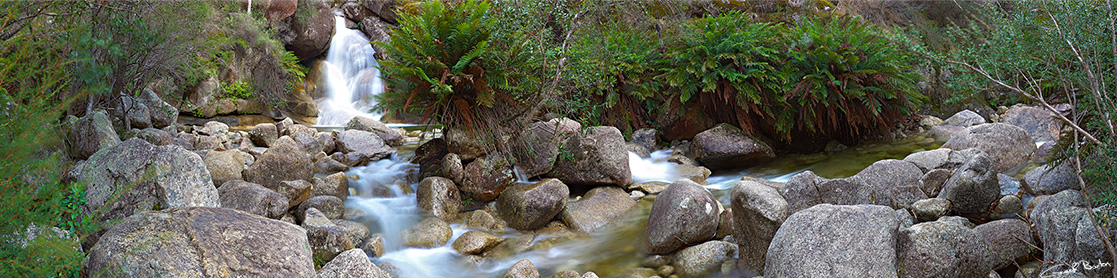
About the falls
Ladies Bath Falls is a drop of 6 or 7 metres. It is part of the way up the Mount Buffalo Road towards the summit of Mount Buffalo. The falls is actually on the same path as Eurobin Lower and Eurobin Upper Falls and just near the entrance to the Mount Buffalo National Park. The location is about 320km North of Melbourne and it is on the edge of Victorian Alpine Region - a lovely spot for site seeing and photography.
Ladies Bath Falls is one of the most attractive and easily reached waterfalls in Mount Buffalo National Park in north-eastern Victoria.
The waterfall is situated beside Mount Buffalo Road, not far above the Ovens Valley, and is generally one of the first major natural attractions encountered when driving up Mount Buffalo from Porepunkah.
Water tumbles over smooth granite into a remarkably clear pool surrounded by large boulders, ferns and forest vegetation.
For photographers, the location has an excellent combination of moving water, reflective pools, polished granite, foreground rocks, moss, ferns and filtered forest light.
The waterfall itself is not especially high, but its intimate setting makes it exceptionally photogenic.
The site also has an interesting historical association. During the early days of tourism on Mount Buffalo, travellers ascending to the Mount Buffalo Chalet would stop beside the creek to cool off. Men and women traditionally used separate bathing areas, and this pool became known as Ladies Bath.
The same walking track continues beyond Ladies Bath Falls to Lower Eurobin Falls and Upper Eurobin Falls, making the area particularly rewarding for photographers because several different waterfall compositions can be photographed during a relatively short walk.
The waterfalls are most impressive after rain and during periods of snowmelt, when substantially more water moves through the creek.
Viewpoints
I have only really seen one viewpoint here, and that is from the path that crosses the bottom of the falls. It is possible to scramble onto rocks at the bottom, and also at the left (as seen in photo above).
-
Ladies Bath Falls - Classic View
The classic photograph looks upstream towards the main cascade, with the clear pool occupying the centre of the composition.
Large granite boulders in the foreground provide excellent visual anchors and can be used to lead the eye towards the waterfall.
Best for: waterfall landscapes, long exposures, granite foregrounds and forest photography.
Recommended lens: approximately 16-35mm or 24-70mm.
A focal length around 24-35mm often produces a natural-looking composition without making the waterfall appear too distant.
-
Granite Boulders and Foreground Flow
One of the strongest photographic characteristics of Ladies Bath Falls is the abundance of smooth granite boulders below the main pool.
Instead of photographing only the waterfall, move your attention downstream and look for flowing water passing between the rocks.
With a moderately long exposure, small rivulets can become soft white lines that lead naturally back towards the waterfall.
Best for: leading lines, long exposures, intimate landscapes and foreground-rich compositions.
Recommended lens: 16-35mm.
Try placing the camera relatively low while remaining on safe, stable ground.
-
Waterfall Detail
A longer lens allows the falls to be separated from the surrounding environment.
Look for smaller compositions where water passes over individual granite ledges or disappears behind darker boulders.
These photographs often work particularly well when the surrounding forest is in deep shade.
Recommended lens: 70-200mm.
Longer focal lengths can turn the falls into a more graphic composition of white water, dark stone and green vegetation.
-
The Clear Granite Pool
The pool beneath the falls is unusually clear and can reveal submerged rocks in shades of gold, green and grey.
On calm days the pool can become an important subject in its own right rather than simply the space beneath the waterfall.
Best for: colour, reflections, underwater detail and minimalist compositions.
A polarising filter can help control surface glare and reveal submerged rocks, but compare the result carefully because complete removal of reflections can make the surface look unnaturally flat.
-
Vertical Waterfall Composition
Ladies Bath Falls works particularly well in vertical orientation.
A portrait-format composition can incorporate the upper waterfall, the pool and foreground rocks within the same frame.
The vertical format also emphasises the way the water moves down through the granite channel.
Try leaving enough space around the cascade so that the photograph does not feel unnecessarily cramped.
-
Ferns, Moss and Forest Details
The vegetation surrounding Ladies Bath Falls provides excellent secondary photographic material.
Ferns, moss, wet bark, lichen and small plants can provide strong intimate landscapes, particularly after rain.
Overcast conditions are ideal because they produce soft, low-contrast light and saturated greens.
Recommended lenses: 70-200mm or macro lens.
-
Lower Eurobin Falls
The walking track continues beyond Ladies Bath Falls to Lower Eurobin Falls.
Here the creek spreads across the large granite face, producing a very different photographic subject from the enclosed pool at Ladies Bath.
Best for: flowing water over granite, diagonal compositions, textures and broader waterfall landscapes.
The smooth rock may look inviting but Parks Victoria warns that algae can make these granite surfaces extremely slippery.
Remain on the established track and viewing areas.
-
Upper Eurobin Falls
The track climbs farther to the base of Upper Eurobin Falls.
This section provides more dramatic views of the creek spilling across Mount Buffalo's massive granite escarpment.
Best for: larger waterfall scenes, granite landscapes and environmental compositions.
A 24-70mm lens is generally the most useful choice here, with a 70-200mm valuable for isolating individual sections of flowing water.
-
High-Flow Conditions
Ladies Bath and Eurobin Falls change considerably according to rainfall and snowmelt.
After sustained rain, the gentle cascade can become much more powerful and the smaller channels between rocks begin carrying substantial water.
These conditions are excellent photographically but also increase the hazard from slippery surfaces and fast-flowing water.
Photograph from established positions rather than moving closer to the water simply to obtain a more dramatic viewpoint.
-
After Rain
The period immediately after rain is one of the best times for photography at Ladies Bath Falls.
Wet granite becomes darker and more reflective, moss and ferns become saturated with colour, and the waterfall carries additional volume.
Overcast skies also reduce harsh reflections and allow longer shutter speeds without extreme filtration.
Water Flow & Conditions
Water flow depends on recent rainfall and catchment conditions. Moderate flow usually preserves rock texture while providing clear movement; after heavy rain expect spray, slippery surfaces and rapidly changing hazards.
Other Things to Look Out For
How I photographed the Falls
What I took - what was in my kit
I took a Canon 5D MkII, Canon 24-105 mm lens, Manfrotto 190 Tripod, and of course a range of lens wipes, spare batteries, sunscreen and bug repellant.
Techniques
I like to use Slow Shutter Speeds to blur the water on a waterfall. I also like to Expose to the Right to ensure that the brightest part of the water is pure white, or nearly purely white (nothing looks so bad as dirty looking water coming over a waterfall). Waterfalls normally require High Dynamic Range to get some light into the shadows behind trees etc. but in this case the lighting was perfect and the technique was not needed.
Location
Apple Map – Waterfall and Nearby Photographic Locations
This Apple Map identifies Ladies Bath Falls and five nearby Auspano photographic locations.
Photographic locations
How to Get There
From Melbourne, drive north along the Hume Freeway (M31) towards Wangaratta / Sydney. After some 215km on the freeway, and just a few kilometres after Glenrowan take the Snow Rd (C522) exit to Milawa. Follow this road for 44km before turning right onto Great Alpine Road (B500) through Myrtleford towards Bright. The road passes through Porepunkah, and crosses the Ovens river before hitting a roundabout. Take the third exit on the roundabout to C535 to Mount Buffalo. There is a car park some 8.3km up this road. Park there and follow the Eurobin Falls Walking Trail some 250 metres to the falls.
From Melbourne
Mount Buffalo National Park is approximately 325 kilometres north-east of Melbourne.
Parks Victoria suggests allowing approximately 3½ hours driving time under normal conditions.
A typical route is:
Melbourne → Hume Freeway → Wangaratta → Great Alpine Road → Porepunkah → Mount Buffalo Road
Alternatively, travellers can leave the Hume Freeway at the Snow Road interchange before Wangaratta and approach via Myrtleford and Porepunkah.
Melbourne to Ladies Bath Falls driving directions
From Bright
Travel west from Bright to Porepunkah and turn onto Mount Buffalo Road.
Continue climbing towards Mount Buffalo National Park until reaching the roadside parking area for Ladies Bath and Eurobin Falls.
From Porepunkah
Porepunkah is the nearest township to the Mount Buffalo Road entrance and provides the simplest approach to the falls.
Follow Mount Buffalo Road uphill into the national park and watch for the signed roadside parking area.
Walking to the falls
The walk to Ladies Bath Falls is short and is generally considered one of the easier walks in Mount Buffalo National Park.
The track continues beyond the pool to Lower and Upper Eurobin Falls.
Parks Victoria advises visitors to remain on the track for their own safety.
Current access and conditions
Conditions on Mount Buffalo can change rapidly because of snow, ice, bushfire risk, fallen trees and seasonal road closures.
At the time this page was prepared, Parks Victoria advises that snow chains are currently required to be carried on Mount Buffalo until further notice.
Several higher roads, including roads to Lake Catani and The Horn, are subject to seasonal winter closures.
These restrictions do not necessarily close Ladies Bath Falls itself, but they can affect a broader photographic itinerary on Mount Buffalo.
Always check current conditions before leaving Bright or Porepunkah.
Apple Map – Driving from the State Capital
The route ends at the road-accessible destination configured above. Driving distance and time are Apple Maps estimates.
State capital to destination
Calculating the driving route with Apple Maps…
Current Access / Conditions
There are no known issues with getting to this location.
Best Time to Visit
The Bright region is very popular all year around. In summer, it is a fairly cool location. In winter, it has the snow, and of course in Spring and Autumn it has foliage changes. The falls obviously get more water over them after rains, but this is pretty unpredictable in this region. I have found visitors to these sites at any time of year, but I have also been by myself early in the morning and late at night. I recommend anytime of the year, and just choosing different times of the day.
Autumn - March to May
Autumn is an excellent period for waterfall photography because daytime temperatures are comfortable and forest light becomes softer.
Nearby Bright also develops its famous autumn colour, making the region particularly rewarding for a multi-day photographic visit.
Good for: waterfalls, forest, autumn colour and river photography.
Winter - June to August
Winter can produce excellent waterfall flow, particularly following rain or snowmelt.
However, road conditions can include snow and ice and higher sections of Mount Buffalo are subject to seasonal closures.
Carrying snow chains may be compulsory when directed by Parks Victoria.
Good for: strong waterfall flow, moody forest, snow and dramatic mountain conditions.
Spring - September to November
Spring is probably the best overall period for photographing Ladies Bath Falls.
Rainfall and melting snow can increase creek flow while forest vegetation becomes fresh and colourful.
Parks Victoria also notes that wildflowers become increasingly prominent around Mount Buffalo during the milder months.
Good for: waterfalls, wildflowers, forest details and mountain landscapes.
Summer - December to February
Summer produces lower water levels unless recent rain has occurred, but the pool becomes especially attractive in warm weather.
Direct sunlight can produce difficult contrast around the waterfall, so early morning, late afternoon or overcast conditions are preferable for serious photography.
Good for: clear pool photography, forest, swimming-hole atmosphere and general travel photography.
Best weather for photography
For waterfall photography I would actively favour an overcast day following recent rain.
This provides:
- Stronger water flow.
- Saturated greens.
- Darker wet granite.
- Reduced contrast.
- Longer usable shutter speeds.
- Fewer distracting bright highlights on the water.
Accessibility
Ladies Bath Falls Walk
Parks Victoria describes the walk to Ladies Bath Falls as an easy short walk, but this should not be interpreted as formal wheelchair accessibility.
The route is a natural walking track and the waterfall environment includes uneven surfaces, rocks, slopes and potentially wet sections.
Visitors using wheelchairs, walking frames or other mobility aids should therefore not assume that the falls themselves can be reached comfortably.
Slippery surfaces
This is the most important access and safety issue for photographers.
Parks Victoria specifically warns that the rocks around Ladies Bath and Eurobin Falls can be extremely slippery.
Smooth granite can carry an almost invisible layer of algae, particularly where water flows across the rock.
Photographers should resist the temptation to step onto wet granite simply to improve a composition.
Roadside parking
Parks Victoria lists a car park at the trailhead, allowing visitors to begin the walk directly from Mount Buffalo Road.
This reduces the amount of walking required compared with many waterfall locations, although the trail itself remains a natural bushwalking route.
Alternative accessible photography
For photographers with limited mobility who are visiting Mount Buffalo, The Gorge Day Visitor Area is a much stronger accessibility option.
Parks Victoria has formally assessed the Gorge precinct and provides a wheelchair-accessible viewing area, accessible parking and an accessible toilet.
The viewing deck includes unobstructed views suitable from both sitting and standing positions.
Nearby Locations
-
The Gorge
The Gorge provides one of Mount Buffalo's most spectacular landscape viewpoints.
Sheer granite cliffs drop away from the plateau and provide broad views across the valleys and surrounding ranges.
Best for: sunrise, mist, mountain landscapes, cliffs and panoramic photography.
Early morning is especially rewarding when fog remains trapped in the valleys below.
-
Mount Buffalo Chalet
The historic Mount Buffalo Chalet is one of Australia's most distinctive alpine buildings and provides an excellent architectural counterpoint to the park's natural subjects.
Best for: heritage architecture, alpine travel photography and environmental images incorporating the surrounding plateau.
-
Lake Catani
Lake Catani provides a very different photographic environment, surrounded by Snow Gums and alpine vegetation.
Calm mornings can produce reflections of the surrounding forest and sky.
Best for: reflections, Snow Gums, sunrise, mist, camping and night photography.
Access can be affected by seasonal road closures, particularly during winter.
-
The Horn
At 1,723 metres, The Horn is the highest point in Mount Buffalo National Park.
The summit is reached by a short walk from the picnic area and provides enormous views across the Great Dividing Range.
Best for: sunset, mountain layers, panoramic landscapes and dramatic skies.
Parks Victoria identifies The Horn as a popular sunset location.
-
Rollasons Falls
Rollasons Falls provides another worthwhile waterfall location within Mount Buffalo National Park.
It requires more walking than Ladies Bath Falls but rewards the photographer with another set of forest and waterfall compositions.
Best for: waterfalls, forest, long exposures and intimate landscapes.
-
Bright
Bright is the major tourism centre near Mount Buffalo and is an excellent accommodation base.
Photographic subjects include the Ovens River, historic streets, autumn colour and surrounding mountain landscapes.
Best for: autumn colour, river landscapes, street photography and mountain scenery.
-
Porepunkah
Porepunkah lies close to the entrance road for Mount Buffalo and is another convenient base for photographers.
The Ovens and Buckland valleys provide useful sunrise, mist and rural landscape opportunities.
Nearby Auspano pages
- Beechworth and Surrounds — approximately 42 km in a straight line; road distance may be considerably longer.
- Mount Buller — approximately 59 km in a straight line; road distance may be considerably longer.
- Benalla Street and Silo Art — approximately 78 km in a straight line; road distance may be considerably longer.
- Goorambat Silo Art — approximately 89 km in a straight line; road distance may be considerably longer.
- Devenish Silo Art — approximately 95 km in a straight line; road distance may be considerably longer.
Where to Stay
Mount Buffalo is just near the towns of Bright and Porepunkah. Porepunkah is a relatively small town, while Bright is a well known accomodation spot for people staying to visit the locale area. I normally stay at Bright, and have found several good quality hotels. There is a range of accomodation here from hotels to caravan parks to free camping. There are three caravan parks at the foot of Mount Buffalo, just besides Porepunkah. 'Free camping' is available on Mount Buffalo at Catani camping site -- but this is only during the November to April period and it should be booked well in advance at the website.
Bright
For most photographers, Bright is the best overall accommodation base.
It provides the widest choice of caravan parks, cabins, motels, apartments, restaurants and shops, while remaining close enough to Mount Buffalo for early morning and evening photography.
Bright also provides worthwhile photographic subjects of its own, especially the Ovens River and autumn foliage.
Porepunkah
Porepunkah is closer to the Mount Buffalo Road entrance and is particularly convenient for photographers whose primary focus is the national park.
Staying here reduces the amount of driving required before an early start.
Lake Catani Campground
During its normal operating season, Lake Catani Campground provides the opportunity to stay directly on the Mount Buffalo plateau.
This is particularly valuable for sunrise, sunset and astrophotography around Lake Catani, The Gorge and the upper plateau.
The campground is reached by a 2WD gravel road from Mount Buffalo Road.
Seasonal closures apply, especially during winter.
Photography Recommendations
-
16-35mm wide-angle lens
Probably the most useful lens for the classic view because it allows foreground rocks, pool and waterfall to be incorporated within the same composition.
-
24-70mm standard zoom
Excellent for more natural-looking waterfall compositions and particularly useful at Lower and Upper Eurobin Falls.
-
70-200mm telephoto
Highly recommended for isolating smaller cascades, granite details, ferns and sections of moving water.
-
Tripod
A tripod is one of the most useful pieces of equipment at Ladies Bath Falls.
It allows lower ISO settings and controlled shutter speeds while maintaining sharp granite and vegetation.
Position tripod legs only on dry, stable surfaces and do not allow the search for a composition to encourage unsafe movement onto wet rock.
-
Polarising filter
Particularly useful for waterfall photography.
It can reduce glare on wet rock and foliage and help reveal details below the surface of the pool.
Rotate the filter while watching the live-view image rather than automatically applying maximum polarisation.
-
Neutral density filter
Useful in brighter conditions when a longer shutter speed is required.
A 3-stop or 6-stop filter will usually be more practical than an extremely strong 10-stop filter in the shaded forest environment.
-
Choose the shutter speed deliberately
There is no single correct shutter speed for waterfalls.
Try several:
- 1/10 to 1/4 second to retain considerable water texture.
- 1/2 to 2 seconds for a smoother traditional waterfall effect.
- Several seconds for very soft flowing water.
I would normally favour retaining some texture rather than making the water completely featureless.
-
Bracket difficult exposures
Forest shade combined with bright white water can exceed the comfortable dynamic range of a single exposure.
Expose carefully to retain highlight detail in the water.
-
Use foreground rocks
The boulders below the pool are one of the features that distinguish Ladies Bath Falls from many other waterfalls.
Use them deliberately rather than trying to exclude them.
-
Look behind you
Photographers naturally face the waterfall, but some of the most interesting intimate compositions may be downstream in the creek, forest and granite boulders.
-
Carry a lens cloth
Mist, rain and spray can rapidly produce droplets on filters and front elements.
Check the lens frequently, particularly during long exposures.
-
Wear footwear with excellent grip
This is more important than carrying an additional lens.
Parks Victoria specifically warns about slippery granite around these falls.
Suggested photographic sequence
For a full photographic day on Mount Buffalo beginning at Ladies Bath Falls, I would organise the day approximately as follows.
-
Early morning - Ladies Bath Falls
Arrive while the forest light is soft and before visitor numbers increase.
Begin with the classic wide composition including foreground boulders, pool and waterfall.
-
Morning - foreground and long exposures
Work downstream from safe track-side positions and photograph moving water around the granite boulders.
-
Mid-morning - waterfall details
Change to the 70-200mm and isolate sections of cascade, ferns, moss and wet granite.
-
Late morning - Lower Eurobin Falls
Continue along the track and photograph the creek flowing across the exposed granite face.
-
Late morning / midday - Upper Eurobin Falls
Continue to the upper section and use a combination of wide and telephoto compositions.
-
Midday - picnic or drive to the plateau
Use the least attractive waterfall light for travel and lunch.
-
Afternoon - Lake Catani
If the access road is open, photograph Snow Gums, shoreline vegetation and reflections.
-
Late afternoon - The Gorge
Photograph the cliffs and distant ranges as lower light begins to create separation in the landscape.
-
Sunset - The Horn or The Gorge
Choose The Horn when skies are clear enough for distant mountain views, or The Gorge when valley cloud and mist are more promising.
-
Blue hour - Mount Buffalo plateau
Remain after sunset for cooler colours and mountain silhouettes.
-
Night - Lake Catani or plateau astrophotography
On a clear night, finish with stars above Snow Gums or granite formations from a safe, established visitor area.
How long should a photographer stay?
Ladies Bath Falls itself can be photographed in approximately one to two hours, but I would not recommend visiting it in isolation.
Allow at least half a day if Lower and Upper Eurobin Falls are also important.
For a serious photographic visit to Mount Buffalo, I recommend two nights in Bright, Porepunkah or on the plateau.
This provides several chances for favourable waterfall conditions plus sunrise, sunset and alpine landscape photography elsewhere in the park.
My priority photographs
If time is limited, I would regard these as the essential photographs:
- The classic wide view of Ladies Bath Falls with the clear pool.
- A vertical composition including waterfall, pool and foreground boulders.
- A long exposure using the granite rocks below the pool as foreground.
- A photograph showing submerged stones through the clear water.
- A tighter telephoto photograph of the main cascade.
- A close study of ferns, moss and wet granite.
- A wider view of Lower Eurobin Falls flowing across the granite face.
- A telephoto detail from Upper Eurobin Falls.
- A photograph showing the broader Mount Buffalo forest environment.
- A complementary mountain landscape from The Gorge or The Horn later in the day.
Ladies Bath Falls is an excellent example of a location where small-scale landscape photography can be more rewarding than a grand vista.
The strongest photographs come from combining moving water with the texture and shape of Mount Buffalo's granite, then paying equal attention to the pool, foreground rocks and surrounding forest.
I would therefore avoid treating the falls as a single viewpoint. Photograph the complete scene first, then progressively reduce the scale: waterfall, pool, rocks, individual cascades, ferns, moss and reflections.
Field composition sequence
Start with a wider frame that explains the creek setting, then move to smaller cascades, moss and water-worn rock. Compare a short exposure that retains water texture with a longer exposure; avoid entering slippery or restricted areas.
Photographing Moving Water
Compare several shutter speeds rather than assuming the longest exposure is best. Begin around 1/4 second, one second and several seconds, checking highlights and fine water texture after each change.
Suggested Photographic Sequence
Work through the location in an order that makes the best use of changing light and conditions.
How Long Should a Photographer Stay?
Allow enough time to photograph the location in more than one light or weather condition where practical.
My Priority Photographs
Use this section for the practical photographic shot list for the location.
Waterfall Information
| Waterfall | Ladies Bath Falls |
|---|---|
| Coordinates | -36.71742, 146.83737 |
| Flow | Rainfall dependent |
| Recommended light | Overcast or soft light |
Include only facts that can be verified. Remove rows that are not relevant or cannot be reliably documented.
Photo Subjects
Explore related Auspano photography guides by subject.
Photographer Comments & Updates
Have you photographed this location? Share your photographs, viewpoints, photography tips or recent access updates, or ask a question about visiting. When uploading your own photographs, please include your name and the date each photograph was taken. Date any access or track-condition observations; visitor reports may become outdated, so check official information before travelling.