Photographing Lake Boga Silo Art
About the Artwork
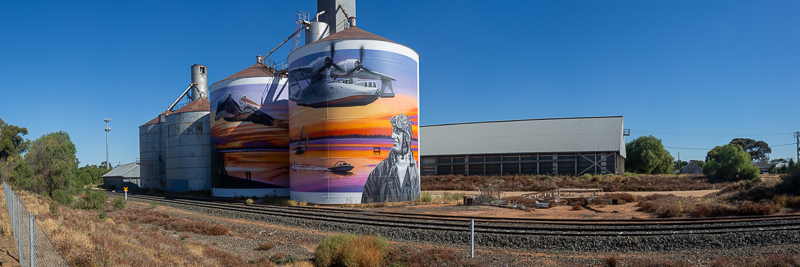
Lake Boga Silo Art is a large historical and environmental mural painted by Victorian artist Tim Bowtell on the GrainCorp silos at Lake Boga in north-western Victoria.
Painted in October 2023, the mural tells the remarkable story of Lake Boga's connection with Australia's flying boats during the Second World War.
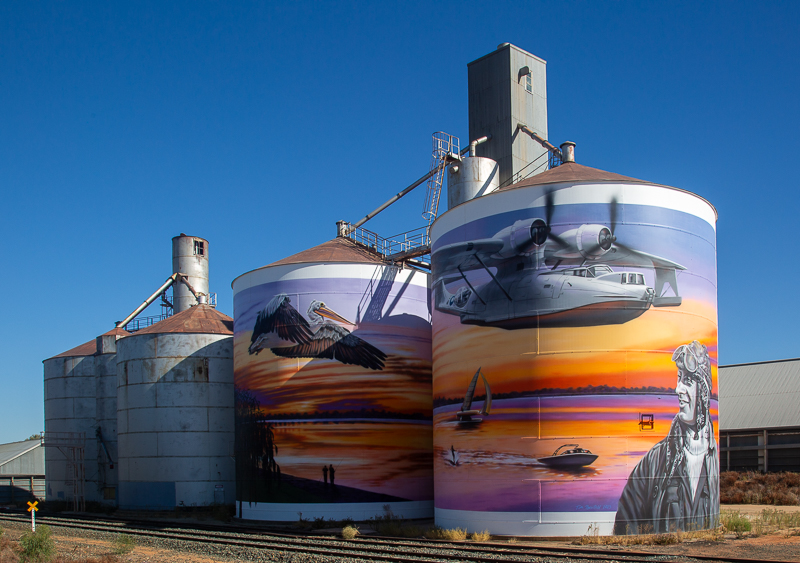
The principal historical subjects are a Catalina flying boat and pioneering Australian aviator George Urquhart "Scotty" Allan.
These historical elements are combined with a colourful Lake Boga sunset and images representing the modern recreational use of the lake, including sailing and water skiing.
Pelicans provide another connection with the lake and its wildlife.
The result is more than a conventional historical mural.
Bowtell combines aviation history, water, wildlife, recreation and landscape to tell the broader story of Lake Boga.
This makes the artwork particularly interesting photographically because many of the subjects depicted on the silos can also be photographed elsewhere around Lake Boga.
A comprehensive photographic visit should therefore extend beyond the silo itself to the lake and the nearby Flying Boat Museum.
Artwork / Subjects
The Catalina Flying Boat
The Catalina flying boat is one of the defining images within the Lake Boga mural.
During the Second World War, Lake Boga became an important inland base for Australia's flying boats.
Its inland location provided greater protection from the possibility of enemy attack from the sea, while the large expanse of water provided a suitable operating environment for flying boats.
The Catalina is therefore not simply an attractive aircraft included within the mural.
It represents one of the most important periods in Lake Boga's history.
Photograph:
- The complete aircraft within the mural.
- The cockpit and nose.
- Wings and engines.
- Aircraft markings.
- The relationship between the Catalina and the painted water.
- The aircraft together with Scotty Allan.
George Urquhart "Scotty" Allan
The principal human figure in the mural is pioneering aviator George Urquhart "Scotty" Allan.
Allan had an extraordinary aviation career extending from the pioneering years of flight through to the Second World War.
Born in Scotland, he joined the Royal Flying Corps during the First World War and later came to Australia, where he became associated with some of the most famous names in early Australian aviation.
His career included flying with the aviation enterprises associated with Charles Kingsford Smith and Charles Ulm.
His inclusion in the Lake Boga mural connects the local flying-boat story with the much broader history of Australian aviation.
Photograph:
- The complete portrait.
- Face and eyes.
- Aviation clothing and details.
- The portrait together with the Catalina.
Lake Boga Sunset
The mural incorporates the warm colours of a Lake Boga sunset.
This is an important visual device because it connects the historical imagery with the physical landscape immediately surrounding the town.
It also creates an obvious photographic challenge:
photograph the painted Lake Boga sunset and then photograph the real lake at sunset.
These two images could work particularly well beside one another in an Auspano gallery.
Pelicans
Pelicans within the mural represent the birdlife associated with Lake Boga.
Use the 70-200mm to isolate the painted birds and then look for an opportunity to photograph actual pelicans around the lake.
This provides another useful connection between the artwork and its environment.
Sailing and Water Skiing
The mural also depicts the recreational character of modern Lake Boga.
Sailing and water skiing illustrate the continuing importance of the lake to the local community.
These smaller narrative elements deserve separate photographs because they help move the story beyond its Second World War history.
Look for:
- Boats.
- Water skiers.
- Human figures.
- Reflections and painted water.
- Transitions between historical and modern imagery.
Artist
Lake Boga Silo Art was painted by Victorian artist Tim Bowtell.
Bowtell has produced a substantial body of large-scale public art, including several major Victorian silo projects.
His work is particularly effective where a community wants to tell a complex historical story rather than simply place one large portrait onto a silo.
At Lake Boga, Bowtell combines several distinct subjects into a coherent composition:
- Aviation.
- Scotty Allan.
- The Catalina.
- The lake.
- Sunset.
- Wildlife.
- Modern recreation.
This narrative approach can also be seen in Bowtell's other silo works, including St James and Colbinabbin.
For the photographer, the advantage is that the mural continues to reveal smaller stories after the obvious complete-silo photograph has been made.
Photographing the Artwork
Start with the Complete Installation
Begin from the designated viewing area opposite the silos.
Before concentrating on individual subjects, make a clean photograph showing the complete painted silo installation.
Leave enough space around the structures to establish that the artwork occupies an agricultural silo complex.
Photograph the Complete Story
Look for a composition that simultaneously includes the principal historical elements:
- Scotty Allan.
- The Catalina.
- The lake.
- The sunset colours.
This should become one of the principal documentary photographs of the location.
The Catalina and Scotty Allan
After photographing the complete mural, concentrate on the two major historical subjects.
Make photographs of each separately and then look for compositions connecting the portrait with the aircraft.
Look for the Smaller Stories
The 70-200mm should be particularly useful for exploring the less obvious elements within the mural.
Look for:
- Pelicans.
- Sailing.
- Water skiing.
- Aircraft details.
- Scotty Allan's face.
- Painted reflections.
- Colour transitions in the sunset.
- Paint and concrete texture.
Connect the Artwork with the Real Lake
One of the strongest photographic opportunities at Lake Boga is the ability to compare Bowtell's painted interpretation with the actual environment.
After photographing the silo, continue to the lake and look for:
- Pelicans.
- Boats.
- Water recreation.
- Sunset.
- Reflections.
- Wide lake landscapes.
This gives the final gallery considerably greater depth than a conventional silo-art record.
Map
Location
Lake Boga Silo Art is located at the GrainCorp silos beside the railway line at Lake Boga, approximately 15 minutes south of Swan Hill in north-western Victoria.
Address:
43 Station Street,
Lake Boga VIC 3584
Some tourism listings describe the location simply as the Murray Valley Highway, Lake Boga.
Google Maps: Lake Boga Silo Art
Access & Parking
A dedicated visitor viewing area has been established on VicTrack land opposite the silos.
The site was specifically developed so visitors could view and photograph the murals without parking unsafely beside the Murray Valley Highway or entering the operational silo property.
The viewing area was planned to include:
- An all-weather surface.
- Visitor parking.
- Safety and directional signage.
- Fencing.
Use this public viewing area rather than entering GrainCorp or railway property in search of a closer photographic position.
Large Vehicles and Caravans
The viewing-area project was specifically designed to accommodate cars and recreational vehicles.
This makes Lake Boga more promising for a large touring combination than many informal roadside silo-art sites.
Nevertheless, with a large tow vehicle and caravan, assess the current entrance, parking layout and turning space before entering.
Do not use GrainCorp land or railway property for turning.
If staying locally or at Swan Hill, leaving the caravan at the accommodation will provide much greater flexibility when photographing the lake, museum and silo from several locations.
Accessibility
Lake Boga Silo Art is a roadside attraction requiring very little walking to see the principal mural.
The dedicated viewing area opposite the silos was designed with an all-weather surface, making access considerably easier than locations requiring visitors to cross rough paddocks or roadside verges.
The artwork is large and can be viewed and photographed from near the vehicle.
This should make the site practical for many photographers with limited mobility.
However, do not assume that every possible photographic viewpoint is formally wheelchair accessible.
Photographers wanting to move beyond the principal viewing area may encounter:
- Gravel.
- Grass.
- Roadside surfaces.
- Uneven ground.
Best Light
Morning
Morning can provide clear, directional light and relatively quiet conditions around the viewing area.
Side lighting may help reveal the cylindrical form and concrete texture of the silos.
If the mural face is partly shaded, use the time to concentrate on details or continue to the Flying Boat Museum before returning later.
Late Afternoon
Late afternoon is a high-priority period for Lake Boga.
Warm light complements the sunset colours incorporated into Bowtell's mural and helps connect the painted scene with the real landscape.
Ideally, photograph the silo during late afternoon and then move to the lake for the actual sunset.
Bright Overcast
Bright overcast remains one of the best conditions for producing an accurate documentary record of the complete mural.
Soft light provides:
- Even illumination.
- Controlled contrast.
- Reduced glare.
- Strong reproduction of the painted colours.
- Good detail in Scotty Allan and the Catalina.
Sunset
Sunset is particularly important at Lake Boga because sunset itself forms part of the artwork.
If conditions are promising, photograph the silos during the approach to sunset and then relocate to the lake.
Look for:
- Warm sky colour.
- Reflections.
- Silhouetted trees.
- Pelicans.
- Boats.
- Open-water foregrounds.
Nearby
Lake Boga Flying Boat Museum
The Lake Boga Flying Boat Museum should be considered an essential companion location to the silo art.
The museum explains the remarkable wartime story represented on Bowtell's mural.
Its principal attraction is a restored Catalina flying boat.
Visiting the museum before or after photographing the silos provides the historical context needed to understand why the Catalina appears so prominently in the artwork.
Photographically, look for:
- The complete Catalina.
- Cockpit and nose.
- Engines.
- Wing details.
- Historical photographs.
- Tools and wartime equipment.
- Interpretive displays.
Check current photography restrictions before photographing museum interiors or displays.
Lake Boga
The lake itself should form a substantial part of the photographic visit.
Subjects include:
- Sunrise and sunset.
- Reflections.
- Pelicans and other birdlife.
- Boats.
- Sailing.
- Water skiing when present.
- Jetties and shoreline structures.
- Wide open-water landscapes.
Try deliberately to find real-world counterparts to subjects represented on the silo mural.
Lake Boga Story Wall
The Lake Boga Story Wall provides another interpretation of the region's people, landscape, culture and history.
The hand-cut glass mosaic was designed by artist Zhou Xiaoping.
Its colour, texture and smaller scale provide a useful visual contrast with Bowtell's enormous silo mural.
Swan Hill
Swan Hill is approximately 15 minutes north of Lake Boga and provides the principal regional service centre.
It also substantially expands the photographic possibilities.
Subjects include:
- The Murray River.
- River Red Gums.
- Historic buildings.
- Riverfront landscapes.
- Pioneer Settlement.
- PS Pyap and paddle-steamer heritage.
Lake Charm and Kerang
Travelling south from Lake Boga leads towards Lake Charm and Kerang.
The broader Kerang Lakes region provides further opportunities for wetland landscapes, bird photography, reflections and sunset.
Nullawil Silo Art
Nullawil Silo Art can be incorporated into a broader regional silo-art itinerary.
Smug's enormous portrait of a farmer with his Kelpie provides a very different visual treatment from Bowtell's multi-subject historical narrative at Lake Boga.
How to Get There
From Swan Hill
Lake Boga is approximately 15 minutes south of Swan Hill via the Murray Valley Highway.
The silos are prominent near the town and railway line.
Follow local signage to the designated public viewing and parking area rather than stopping on the highway shoulder.
From Kerang
From Kerang, travel north towards Swan Hill along the Murray Valley Highway.
Lake Boga is reached before Swan Hill.
This approach works well when combining Lake Boga with the wetlands, lakes and birdlife around Kerang.
Travelling with a Caravan
The Murray Valley Highway provides straightforward sealed-road access to Lake Boga.
The dedicated silo viewing area has been developed with recreational vehicles in mind.
With a particularly large combination, however, assess the entrance and turning area before committing the complete rig.
If based at Lake Boga or Swan Hill, leave the caravan at the accommodation and explore the museum, lake and other photographic locations with the tow vehicle alone.
Techniques used
- Techniques
- Normal Style
- Long Exposures
- Nuetral Density Filters
- High Dynamic Range
- Focus Stacking
- Remove People
- Photo Stitching
- Movements
- Tombstoning
- ISO
- Shutter Speed
- Depth of Field
- Diffraction
- Moving the eye around the picture
- Golden and Blue Hour
- Infra-Red Photography
- Raw vs JPG (JPEG)
- Camera Modes
- Expose to the Right
- Sharpness
- Fore, Middle, Far
- Rule of Thirds
Kit used
Where to Stay
Lake Boga
Lake Boga is the preferred photographic base if sunrise, sunset and the lake itself are important parts of the visit.
Staying locally allows the photographer to:
- Photograph the lake around sunrise.
- Visit the Flying Boat Museum during the day.
- Photograph the silos in late-afternoon light.
- Return to the lake for sunset.
- Revisit the silo the following morning if required.
Swan Hill
Swan Hill is the better choice when a larger regional service centre is preferred.
Its proximity means that Lake Boga can still be revisited easily around the best light.
Swan Hill also offers a much wider range of restaurants, fuel, accommodation and photographic subjects.
In this case, Jenny and I were visiting as part of a family holiday. So we stayed at the Big 4 Holiday Park at Swan Hill.
Travelling with a Large Caravan
When travelling with a large tow vehicle and caravan, confirm the dimensions of any caravan-park site before booking.
Ask specifically about:
- Total usable site length.
- Drive-through availability.
- Turning room.
- Access-road width.
- Room to leave the tow vehicle attached if desired.
For a photographic visit, either Lake Boga or Swan Hill can provide a practical base from which to explore with the tow vehicle alone.
Photographic Recommendations
16-35mm
Use the 16-35mm primarily for environmental photographs rather than as the automatic solution for fitting the complete silos into the frame.
It can be particularly useful for:
- Silo plus dramatic sky.
- Lake landscapes.
- Museum environmental photographs where permitted.
- Foreground-led sunset compositions.
Avoid working unnecessarily close at 16mm because this can exaggerate the cylindrical structures and distort the painted imagery.
24mm Tilt-Shift
The 24mm tilt-shift should be extremely useful at Lake Boga.
The dedicated viewing area provides an opportunity to establish a carefully aligned position opposite the silos.
Level the camera and use upward shift to include the upper artwork while maintaining parallel verticals.
This should produce a substantially more accurate documentary record than pointing a conventional 24mm lens upwards.
24-70mm
The 24-70mm would be my principal general-purpose lens.
Use it for:
- The complete mural.
- Catalina and Scotty Allan together.
- Individual mural sections.
- Environmental views.
- Lake Boga landscapes.
70-200mm
The 70-200mm should receive considerable use.
Look for:
- Scotty Allan's face.
- Catalina details.
- Pelicans.
- Water skiers.
- Sailing details.
- Paint and concrete texture.
- Actual birdlife around Lake Boga.
- Compressed sunset landscapes across the lake.
Fuji GX680
Lake Boga is a very good candidate for one or two carefully controlled photographs with the Fuji GX680.
The combination of strong silo geometry and detailed narrative artwork suits the camera's movements particularly well.
Scout the strongest camera position digitally before setting up the GX680.
I would concentrate on one definitive complete-silo photograph rather than attempting to reproduce every digital composition.
Tripod
A tripod is recommended for:
- 24mm tilt-shift photography.
- Fuji GX680 photography.
- Shifted multi-frame photographs.
- Lake sunset.
- Blue hour.
- Long exposures of water where appropriate.
Circular Polariser
A circular polariser can be particularly useful at Lake Boga because water forms such an important part of the broader photographic story.
Use it selectively to:
- Control reflections.
- Reveal or conceal detail beneath the water surface.
- Increase separation between clouds and blue sky.
- Reduce glare from painted surfaces.
Do not automatically maximise the polarising effect.
Reflections may be an important compositional element, particularly around sunrise and sunset.
Controlling Perspective
Perspective control is particularly worthwhile at Lake Boga because the mural combines strong vertical silo geometry with recognisable human and aircraft subjects.
Excessive wide-angle perspective can alter both the silo proportions and the apparent shape of the painted Catalina.
First Choice - Increase Shooting Distance
Begin by moving as far back within the safe designated viewing area as practical.
Where possible, use the 24-70mm at approximately 35-70mm.
Increasing camera-to-silo distance helps:
- Reduce exaggerated foreground perspective.
- Preserve the width-to-height relationship of the silos.
- Maintain natural proportions in Scotty Allan's portrait.
- Preserve the apparent shape of the Catalina.
Using the 24mm Tilt-Shift
Your 24mm tilt-shift is ideal for a technically controlled photograph of the complete mural.
Mount the camera on a tripod and level the camera body carefully.
Keep the sensor plane vertical and use upward shift to include the upper parts of the silos.
Do not tilt the entire camera upwards unless there is a deliberate creative reason to introduce converging verticals.
If the complete mural cannot be comfortably recorded in one frame, make a shifted sequence:
- Lower frame.
- Central frame.
- Upper frame.
Keep the camera body completely stationary and move only the lens shift.
Stitching the resulting files can produce a very high-resolution perspective-controlled master image.
For this purpose use shift, not tilt.
Using the Fuji GX680
The Fuji GX680 allows the same principle to be applied using full camera movements.
Keep the film plane vertical and use:
- Front rise to include the top of the silos.
- Lateral shift if the safest tripod position is not perfectly centred on the composition.
- Minimal front tilt unless deliberately altering the plane of focus.
Avoid unnecessary rear tilt or swing for the principal documentary photograph because this changes the geometry you are trying to preserve.
The ideal GX680 image would be a carefully composed record showing the Catalina, Scotty Allan and broader mural while maintaining the silo geometry.
Aircraft Proportions
The Catalina makes perspective particularly important.
Aircraft have recognisable geometric proportions, and photographing the mural obliquely or from too close can make the painted wings, fuselage and engines appear distorted.
For a detailed Catalina photograph, move farther away and use the 70-200mm rather than approaching closely with an ultra-wide lens.
Using the DJI Mavic 2 Pro
A drone could potentially produce a very interesting environmental photograph at Lake Boga because the story represented on the silo is directly connected with the surrounding landscape.
An elevated view could potentially show:
- The painted silos.
- Lake Boga township.
- The lake.
- The surrounding agricultural landscape.
That relationship is much more photographically interesting than simply raising the drone to silo height for a frontal photograph.
However, the presence of roads, railway infrastructure, GrainCorp property, visitors and other operational areas means that a flight should never be assumed to be permissible.
Before flying:
- Check current CASA airspace and operating restrictions.
- Use a CASA-verified drone safety application.
- Identify a legal launch and recovery location.
- Obtain any landowner permission required.
- Maintain required separation from people.
- Remain clear of the Murray Valley Highway and railway operations.
- Remain clear of GrainCorp operational areas.
If a flight is legal, safe and appropriately authorised, prioritise a composition connecting the silo mural with Lake Boga itself.
Suggested Photographic Sequence
-
Begin at the designated viewing area.
Walk the safe public area and establish the strongest overall angle before setting up specialist equipment.
-
Make the complete establishing photograph.
Show the entire painted installation with enough surrounding space to establish the agricultural structures.
-
Use the 24mm tilt-shift.
Produce a technically controlled complete mural with parallel verticals.
-
Make a shifted multi-frame version.
This can become the high-resolution master record of the artwork.
-
Photograph the Catalina.
Record the complete aircraft and then switch to the 70-200mm for details.
-
Photograph Scotty Allan.
Make both the complete portrait and tighter facial studies.
-
Connect Scotty Allan and the Catalina.
Find the strongest composition showing the two principal historical subjects together.
-
Find the smaller stories.
Photograph pelicans, sailing, water skiing and sunset details.
-
Use the Fuji GX680.
Make one or two carefully controlled large-format compositions.
-
Visit the Flying Boat Museum.
Photograph the real Catalina and historical displays where photography is permitted.
-
Explore Lake Boga.
Look for actual pelicans, boats, recreational activity and landscape subjects represented in the mural.
-
Return to the silo in late-afternoon light.
Photograph the mural as the light becomes warmer.
-
Finish at the real Lake Boga sunset.
Create a companion image to the painted sunset incorporated into Bowtell's mural.
How Long
A casual visitor could view Lake Boga Silo Art in approximately 15-20 minutes.
For a comprehensive conventional photographic record, allow approximately 45-60 minutes.
With the 24mm tilt-shift, 70-200mm and Fuji GX680, I would allow approximately 1.5-2 hours at the silo precinct.
However, the silo should not be considered the complete Lake Boga photographic experience.
Adding the Flying Boat Museum and lake makes this at least a half-day photographic location.
For an Auspano visit incorporating the silo, museum, Story Wall, lake and sunset, I would allocate approximately 5-6 hours.
An overnight stay is worthwhile if you also want both sunset and sunrise over Lake Boga.
Priority Photographs
- Complete Lake Boga Silo Art establishing photograph.
- Perspective-controlled complete mural using the 24mm tilt-shift.
- High-resolution shifted multi-frame version.
- Fuji GX680 complete-mural interpretation.
- Catalina and Scotty Allan together.
- Complete Catalina.
- Catalina cockpit and aircraft details.
- Complete Scotty Allan portrait.
- Scotty Allan face and eyes.
- Painted Lake Boga sunset.
- Pelican detail.
- Sailing detail.
- Water-skiing detail.
- Paint and concrete texture.
- Silo within the Lake Boga town environment.
- Flying Boat Museum exterior.
- Restored Catalina at the Flying Boat Museum, where permitted.
- Lake Boga Story Wall.
- Actual pelicans on Lake Boga.
- Boats or sailing on the lake.
- Lake reflections.
- Actual Lake Boga sunset.
- Painted sunset / real sunset visual pairing for the final gallery.
- Elevated silo, township and lake composition if drone use is legal, safe and appropriately authorised.
Artwork Information table
| Location | Lake Boga, Victoria |
|---|---|
| Artwork | Lake Boga Silo Art |
| Artist | Tim Bowtell |
| Painted | October 2023 |
| Project completed | 2023 |
| Principal historical subjects | Catalina flying boat and George Urquhart "Scotty" Allan |
| Other subjects | Lake Boga sunset, pelicans, sailing and water skiing |
| Theme | Aviation history, Second World War heritage, Lake Boga landscape and recreation |
| Silo owner | GrainCorp |
| Address | 43 Station Street, Lake Boga VIC 3584 |
| Viewing | Dedicated public viewing area opposite the silos |
| RV access | Viewing area developed for cars and recreational vehicles |
| Principal general lens | 24-70mm |
| Perspective-control lens | 24mm tilt-shift |
| Detail lens | 70-200mm |
| Technical camera | Fuji GX680 with front rise / shift |
| Suggested silo photography time | 1.5-2 hours with full photographic equipment |
| Suggested complete Lake Boga visit | 5-6 hours, or overnight for sunset and sunrise |