4 Facts
| Manufacturer | Daimler-Benz Germany, but modified to suit the Australian DoD requirements within Australia. |
| Technical Designation | The Army used Unimog 435.113 vehicles, typically with the OM352 engine. Later models (e.g. Airforce) used the OM353 engine. |
| Gross Vehicle Mass (GVM) | The total (gross) legal weight of the Unimog and its cargo: 12 Tonne. |
| Tare or Weight empty. |
(The weight of the Unimog without cargo or fuel etc.). This varies on model etc., but about 5.2 Tonne. |
| Kerb Mass or Weight with fuel etc. but no 'payload' (cargo) | This varies on model etc., but about 5.5 Tonne. |
| Payload | Depends on empty weight, but about 6.5 Tonne. |
| Gross Combination Mass (GCM) | 24 Ton, meaning it can tow 12 Tonne. i.e. Gross Trailer Mass is 12 Tonne + 12 tonne Gross Vehicle Mass. |
| Unimog U1700L speed and gears. Unimog U1700L increase speed. |
Ok, the Unimog is a Universal Agricultural Equipment - i.e. Tractor, and as such it is a speed demon. :-) In terms of normal trucks and cars though, it is slow. The normal 8 speed Ex-military truck running Omnitrack 12.0 tyres (44 inch) will top out around 85km/hr, with 80km/hr usually being comfortable. Adding 395/85R20 tyres ups this speed by a couple of km/hr. However options exist for speed (and everything else) on these. A Class Overdrive will increase the speed to near 110km/hr. Changing Portal ratios will do similar. Changing the gearbox from the UG3/40 (8 speed) to the UG3/100 (also 8 speed, but different ratios) - will also achieve well over 100Km/hr. Note that, in standard form, the Mog has negative camber (tyres fold under) - this is great for rough work, but not ideal for high speed highway usage. Camber correction kits fix this issue. |
| ADF Published Mass table | |
a. Unladen |
|
(1) Without Winch: |
|
(a) Front Axle | 3,810 kg |
(b) Rear Axle | 2,790 kg |
| (c) Total | 6,600 kg |
(2) With Winch: |
|
(a) Front Axle | 4,060 kg |
(b) Rear Axle | 2,740 kg |
(c) Total | 6,800 kg |
b. Maximum Loading: |
|
(1) Front Axle | 5,300 kg |
(2) Rear Axle | 7,000 kg |
(3) Total | 12,000 kg |
| Ground Clearance | 440mm (17 3/8 inch) |
| Fording Depth | 1.2 M, but see additional information on this later in this page. |
| Fuel, fuel capacity and fuel usage. Unimog u1700 fuel economy. | Diesel 130L tank. (Unidan sell a 260L tank) Several people mount more than one fuel tank on the sides of the Mog (up to 4). You can also mount fuel tanks inside the cargo area. One Mog owner went around the Simpson desert with a 'IBC' chemical container (1000L) of petrol in the back for motorbikes. The Unimogs typically use about 20-23 l/100K for the truck on the open road, and more like 25-27 l/100k with a full expedition box fit out on the back. This means that their range is about 560-650 kms for the base truck, and around 480-520 kms for the expedition vehicles on the open road. Note that it is easy to change / add fuel tanks though, so for example two Unidan 260L fuel tanks could be used to give a range of ~2200 kms. Unimogadventures posted details of their 64,423km fuel usage. It was 13,549L for Average 21.03l/100Km in an 'expedition' type vehicle. My truck gets about 22-23l/100 cruising at 100km/hr. 
My own fuel consumption, based on using an overdrive at 100k/hr, for normal usage and towing a 4 tonne caravan are: 23.6lit without van on a combined city / country roads, and 27.96 lit/100k towing 4 tonne (over many hills) with a combined city / country roads. I am led to believe that I can improve my fuel consumption by several litres / 100k by dropping my speed by 5-10km/hr. |
| Voltage | 24 Volt, supplied by 2X 12V 'car batteries'. These are typically Delkor 100D-730 730CCA 100AH batteries, but in a pinch, several lower cost car batteries will fit. |
| Turning circle | 14.1m. i.e. poor for car, but very good for a truck. |
| Height | The Unimog height (including canopy) is 3.01M (laden) - 3.03m (unladen). Without canopy & frame i.e cab height 2.58m (laden) and 2.615m (unladen) The tray is about 1450mm off the ground. |
| Length & Width | Width - 2.49m (tray), Length 6.940m (with PTO winch) and 6.545m without PTO winch. |
| Pintle Hook Height, Receiver height | 3.85m Pintle Hook Height (laden) 705mm. Mog Central Hitch Receiver height 665mm (with 395/85R20 tyres). My caravan hitch height is 375mm. Which implies a 290mm (11.42 inch) drop is required to allow the Mog to connect up to a typical 'car tow' load such as a box trailer, camper van, or caravan. |
| Wheelbase | Track Width (standard Army tyres) 1840mm. Track width for 395/85R20 tyres ~2300mm. |
| Tray Internal Dimensions | Length 4.05m, Width 2.375m, Height 500m (tray sides) |
Unimog Gears, Gear ratios and Gearboxes. Many 4x4 car drivers expect the Unimog to be fitted with 4-High and 4-Low gears. This is not the case. Like anything on the Mog, there are many options: UG3/40, UG3/60, UG3/100 gearboxes, with or without "Working Gears" and "Crawler Gears". The Working Gears merely multiple the standard box by 5.757, with the Crawler Gears doing this again. The axle ratio is 2.182, but then the hubs also have a 2.714 ratio. The table below is based on gearbox ratios only (not including axle or hub), and assuming a top speed RPM of 2800 rpm on R12 tyres (roughly the same size as 365/80R20). Note that some drivers take their engines above this rpm, and there are many tyre choices. I use 395/85R20's which are about 4% larger than R12's. Others use R14's and R16's and up to 445/70R24. I see that 495/70R24 tyres are available.
| Forward | Gearbox Ratio (Overall Ratio) | Top Speed km/hr | Reverse | Gearbox Ratio | Top Speed km/hr |
|---|---|---|---|---|---|
| Crawl 1 | 431.19 (2553.49) | 0.20 | Crawl 1 | 417.60 | 0.20 |
| Crawl 2 | 298.95 | 0.28 | Crawl 2 | 289.67 | 0.29 |
| Crawl 3 | 197.53 | 0.43 | Crawl 3 | 191.57 | 0.44 |
| Crawl 4 | 145.17 | 0.59 | Crawl 4 | 140.53 | 0.60 |
| Crawl 5 | 98.43 | 0.86 | Crawl 5 | 95.45 | 0.89 |
| Crawl 6 | 68.27 | 1.24 | Crawl 6 | 66.29 | 1.28 |
| Crawl 7 | 45.07 | 1.89 | Crawl 7 | 43.75 | 1.94 |
| Crawl 8 | 33.14 | 2.56 | Crawl 8 | 32.15 | 2.64 |
| Working 1 | 74.90 (443.55) | 1.13 | Working 1 | 72.54 | 1.17 |
| Working 2 | 51.93 | 1.64 | Working 2 | 50.32 | 1.69 |
| Working 3 | 34.31 | 2.48 | Working 3 | 33.28 | 2.55 |
| Working 4 | 25.22 | 3.37 | Working 4 | 24.41 | 3.48 |
| Working 5 | 17.10 | 4.97 | Working 5 | 16.58 | 5.13 |
| Working 6 | 11.86 | 7.17 | Working 6 | 11.51 | 7.38 |
| Working 7 | 7.83 | 10.86 | Working 7 | 7.60 | 11.19 |
| Working 8 | 5.76 | 14.76 | Working 8 | 5.58 | 15.22 |
| Standard 1 | 13.01 (77.04) | 6.53 | Standard 1 | 12.60 | 6.75 |
| Standard 2 | 9.02 | 9.42 | Standard 2 | 8.74 | 9.73 |
| Standard 3 | 5.96 | 14.26 | Standard 3 | 5.78 | 14.71 |
| Standard 4 | 4.38 | 19.41 | Standard 4 | 4.24 | 20.05 |
| Standard 5 | 2.97 | 28.62 | Standard 5 | 2.88 | 29.51 |
| Standard 6 | 2.06 | 41.26 | Standard 6 | 2.00 | 42.50 |
| Standard 7 | 1.36 | 62.50 | Standard 7 | 1.32 | 64.39 |
| Standard 8 | 1.00 (5.92) | 85.00 | Standard 8 | 0.97 | 87.63 |
| Claas OD 1 | 10.15 (60.09) | 8.32 | Claas OD 1 | 9.83 | 8.65 |
| Claas OD 2 | 7.04 | 12.08 | Claas OD 2 | 6.82 | 12.47 |
| Claas OD 3 | 4.65 | 18.28 | Claas OD 3 | 4.51 | 18.85 |
| Claas OD 4 | 3.42 | 24.88 | Claas OD 4 | 3.31 | 25.70 |
| Claas OD 5 | 2.32 | 36.69 | Claas OD 5 | 2.25 | 37.84 |
| Claas OD 6 | 1.61 | 52.90 | Claas OD 6 | 1.56 | 54.49 |
| Claas OD 7 | 1.06 | 80.13 | Claas OD 7 | 1.03 | 82.56 |
| Claas OD 8 | 0.78 (4.62) | 108.97 | Claas OD 8 | 0.76 | 112.34 |
The table above shows that the Mog is really set up to for low speed / high torque. For example, Google indicates that a Toyota Landcruiser BJ75 has a 1.100:1 high range and 2.449:1 low range. (with an FJ60 0.909:1, 2.26:1) etc. with Gearbox Ratios (HZJ70/73/75 1st gear is 4.843:1, 5th gear is 0.845:1 (overdrive). The resulting range of (2.449 X 4.843 = 11.86:1 (1st low) to (1.10 x 0.845 = 0.9295:1 (5th gear high range) is typical of 4x4 cars. While even the standard Mog's first gear is 77.04:1 with a 8th gear of 5.92:1. This means that the Unimog's gearing is about 7 times lower than a typical 4x4 in both low and high range.
According to Google: "The super-crawler gear (not shown above) multiplies the first gear ratio by (55.874), and with the rear axle ratio (2.182) and hub ratio (2.714) included, the total crawl ratio is over 3,000." (e.g. 13.01 X 55.874 X 2.182 X 2.714 = 4,304.78:1 - or around 400 times lower than a 4x4 car's 1st low gear.)
4.1 Vin number
The Unimogs were manufactured prior to the VIN number being universally adopted. However, Mercedes was already using a chassis number, which was the basis for the Vin number. The VIN number of Daimler Benz trucks is WDB + the chassis number. WDB indicates it is a Mercedes (Daimler Benz) truck. Mine is WDB 435 113 60 XXX XXX
4.2 Bulbs
Side direction P21W, (BA15s) Side Light R5W, Rear direction indicator P21W, Tail light R10W, Stop lamp P21W, Backup lamp P21W, Licence plate (?) R10W , Low beam H4 (non-standard P45T-41 base), High beam H4 (also P45T-41 base), parking lights T4W, Fog Lamps H3.
4.3 Tyre Pressures
Source: (AFM Safety Unimog Cargo) Section 1, Chapter 2 page 3
Tyre Pressures: (Note this is for Army tyres on Army rims)
(1) Highway:
(a) Front ................................................................. 550 kPa 80PSI
(b) Rear .................................................................. 825 kPa 120PSI
(2) Cross-country:
(a) Front ................................................................. 550 kPa 80PSI
(b) Rear .................................................................. 700 kPa 100PSI
(3) Sand:
(a) Front ................................................................. 400 kPa 60PSI
(b) Rear .................................................................. 400 kPa 60PSI
For those of us that are not running the Army 12.0 tyres, but have changed to 395/85R20 - the recommended tyre pressures seem to be: 60psi for highway, 50-55 psi for gravel, 40-50psi for rocky roads, 20-25 psi for sand or mud, and down to 15 for emergencies (the tyres are normally on split rims).
4.4 Fuel, Lubricants, Filters
One of the first things to say is that people are always asking "what (oil/grease/etc.) does the Unimog need?". Castrol have devoted a whole page on what are the best / better oils for the Mog.
Thabo does a YouTube video on changing the oils.
The Oil data below is combined from AFM, Castrol, Penrite and from various Facebook chats. Both Castrol and Penrite website have full details on what to use on the Mog.
See Thabo’s YouTube video on changing oils for what type of oils to buy: Minute 0:56
| Fuel | Diesel 130L capacity (for standard DoD trucks) |
| Coolant | Cummins PGXL 20L capacity This is available from Penrite or Cummins. Penrite have 20 litre drums. (PGXLPMX020) About $200-250* per drum, available special order. *Update: 2025-04-18. I just checked. I can buy a 20L drum from Repco PGXL for $519 (down from $692). This drum, according to Repco's website: "Provides long Life protection for all metals. Provides anti freeze anti boil protection. Excellent protection for aluminium and heavy Diesel wet sleeve liners. Low toxicity compared to Mono Ethylene Glycol based coolants. Contains nitrite and molybdate for cylinder liner protection. Compatible with both OAT and conventional coolants. Premixed at 50/50 ratio so no mixing required. Requires no dosing with supplemental cooling Additive". I notice that Unidan offer Nulon Long Life Green at $47 for 5L in the concentrate - so a bit over $100 for 10L concentrate and 10 litres of distilled water. I also notice that Ben Nash (MogCentral) indicated in 2021 Facebook "I always dump the whole lot and refill with off the shelf E/Glycol so you can top up anywhere you like." At the sort of prices I see for PGXL that sounds like good advice. Penrite recommend Green OEM Coolant Concentrate - available in 5L containers - plus their Demineralised Water. They note that a total system flush is required though. |
| Engine Oil | DoD standard OMD-115 aka Castrol RX Super 15W-40 CJ-4/E9 Lots of discussion online about what OMD-115 is, or what should be used. SAE40 appears to be answer. Castrol RX Super 15W-40 CJ-4/E9 or Castrol Vectron 15W40. Penrite Convoy DFX 15W-40 (preferred), HPR Diesel 15 15-50 (semi Synthetic) as an alternative. (1) Capacity (Maximum) 15 L (2) Capacity (Minimum) 12 L |
| Transmission | (1) The DoD manuals say: Type OMD-115 Again, debate and ill-informed comments online. Castrol says : CASTROL SYNTRANS 75W-85 or even better CASTROL TRANSMAX MANUAL LONG LIFE 75W-85. Neither of these align with the DoD instruction which simply says use engine oil (OMD-115). This is probably for ILS* reasons though, and not the best solution for the transmission. I think Castrol’s answer would be better by far. Penrite say Pro Gear 75W-85. (2) Capacity 10.5 L Thabo changing it Minute 7:29 Thabo changing it Minute 8:01 * ILS = Integrated Logistic Support. i.e. they don't want to ship and store two different oils. They would prefer the troops to simply use engine oil in the field, the result being 'good enough'. |
| Front and rear differentials | CASTROL AXLE AP 85W-140 Penrite HD Multidrive Gear Oil 80W-90 (this appears to be in 200 litre drums) - Gear Oil 80W-90 Mineral is sold in 2.5 L containers though. Gear oil SAE 90 2.5 liters each |
| Front and rear hub drives | CASTROL AXLE AP 85W-140 Penrite HD Multidrive Gear Oil 80W-90 (this appears to be in 200 litre drums) - Gear Oil 80W-90 Mineral is sold in 2.5 L containers though. Gear oil SAE 90 0.25, 0.6 liters |
| Cab Steering linkage bevel gear boxes | The right hand drive unimogs have the steering wheel passing from right to left via two bevel gear boxes. The consensus appears to be that these should be filled with engine oil. (They are certainly low speed gear boxes and unlikely to be under stress). dribble liters |
| Hydraulic brakes and clutch | All-seam brake fluid DOT 4 |
| Power steering system | CASTROL AGRI TRANS PLUS 80W Penrite Convoy Fleetgear 10 Automatic transmission fluid Type TF |
| All grease points | All-season multi- purpose grease |
| Battery terminals | Petrolatum technical Vaseline. (and no, that is NOT a typo. Technical-grade Petrolatum. aka Petroleum Jelly. ) |
| Front Axle: | (1) DoD manuals specify Type OEP-220. "OEP" stands for 'Oil, Extreme Pressure'. The civilian equivalent would appear to be a 75W85 or 80w90 type oil. Castrol recommend Castrol Syntrax universal plus 75W90 (2) Capacity 2.5 L |
| Front Wheel Hub Drives: | (1) (1) DoD manuals specify Type OEP-220. "OEP" stands for 'Oil, Extreme Pressure'. The civilian equivalent would appear to be a 75W85 or 80w90 type oil. (2) Capacity 0.6 L each (Thabo changing it Minute 2:56) |
| Rear Axle: | (1) (1) DoD manuals specify Type OEP-220. "OEP" stands for 'Oil, Extreme Pressure'. The civilian equivalent would appear to be a 75W85 or 80w90 type oil. (2) Capacity 2.5 L (Thabo changing it Minute 5:26) |
| Rear Axle Hub Drives: | (1) Type OEP 220 (2) Capacity 0.6 L each |
| Steering System: | (1) Type OX-47 (grade 10) Castrol agri trans plus 80W (2) Capacity 2.25 L Move the steering wheel full right to get the steering wheel out of the road of the oil change. |
| Steering wheel oil filter | Take the plug out of the centre of the filter. Lift the front of the truck to let the fluid get in properly after filling. The reservoir has a mini-dip stick in the top of it. You also fill from the top. |
| Brake System: | (1) Type OX(AUST)-8 (2) Capacity 1.0 L |
| Clutch System | (1) Type OX(AUST)-8 (2) Capacity 0.2 L |
| Grease Nipples: | (1) DoD says:Type XG-274. Silmid does not list this as a standard Joint Service Designator grease. Shell however list it as "(obsolete) - General purpose mineral Microgel airframe grease for use in bearings and gearboxes". Again, I believe the reason that the DoD use this grease has more to do with ILS than anything else. It is a high pressure lithium grease. (2) In the servicing instructions they indicate "XG-291" - again, this is not a standard commercially available product, but does come back to "A multi-purpose grease designed for use in the aviation and shipping industries. It's a lithium complex soap thickened lubricant with a semi synthetic base fluid. It's designed to provide long-term lubrication in harsh operating environments." 3) MogCentral list Castrol Spheerol LMM Grease. Castrol describe this as 'Heavy Duty Extreme Pressure'. Castrol's Product Data Sheet indicates: "Castrol SpheerolTM LMM is a multi-purpose lithium grease containing molybdenum disulphide solid lubricant to enhance its load carrying properties under conditions of high or shock loading or to prevent scuffing or fretting. It contains oxidation and corrosion inhibitors, anti-wear additives, has good mechanical stability and can be used in the presence of moisture." Quantity as required. |
4.5 Oil filters
The U1700L's appear to have come with two different configurations of oil filters: a model with one oil filter, and another with two filters. My Unimog is the twin oil filter type. These are available from Mog Central. (Mog Central Twin oil-filters ) Note: one of the biggest issues with Australian fuel is water contanimation. This is not limited to small outback stations either. A friend of mine spent $6,000 replacing his petrol fuel system after filling up (exclusively) at the very busy Costco fuel station in Canberra. Mog Central have a kit that replaces the twin oil filters with a single water trapping Australian fuel filter. That improves the biggest fuel issue, and improves the availability of the filter elements too. (New filters available at most truck stops.)
4.6 Electrical Cable sizing
Electrical cables are not all equal. Basically the type and thickness of the insulation will determine the voltage the cable can carry, and its wear characteristics over its lifetime. The size of the internal wire will determine what current it can carry, and what the voltage drop will be across the wire when carrying that current. Two things on current:
1) every electrical connection has a fuse. This may be one you install, or it may be the wire itself. i.e. no fuse, means you have just made the wire itself a fuse.
2) Low voltage supply is the death of things like air compressors, and winches. When they say that they are "12v", they generally mean that they need 12.5-14v under load. Similarly "24v" generally means 25-28v under load. The wiring for a Runva EWB25000 rear winch (for example) will draw up to 280A on a 24V system. (see Runva's table below)
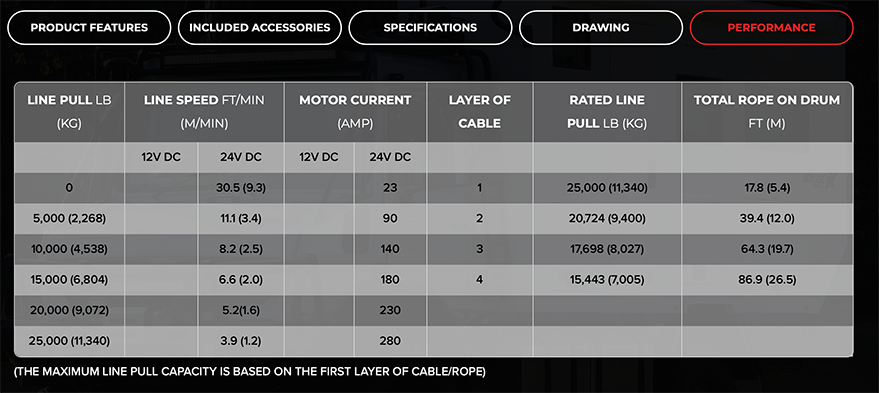
This means that the cable that supplies the rear winch needs to supply that 280A from the battery while providing ~24V+ to the winch. A voltage drop of only about 3%. Depending on the cable run, that distance is about 5 metres or 15 feet.
The table below uses "Famps" which is 'foot-amps'. 280A current times 15ft length equals 4,200 foot amps. Looking down the 24v, 3% drop column until we reach a number bigger than 4,200, we see an AWG wire size of AWG 2 is the minimum wire size that can achieve this performance.
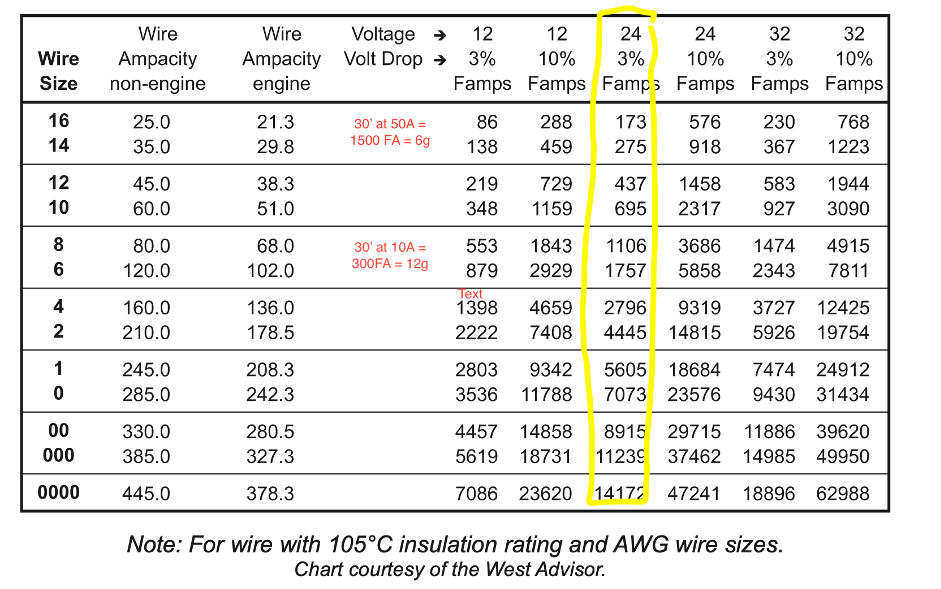
Blue Sea Systems also has a nice wire sizing chart that also has metric distances and wire sizes. They also have a foolproof Circuit Wizard that lets you set many options and tells you what wire size you need.
4.7 Roadworthy
In Victoria, before you can register a truck, a heavy vehicle road-worthiness tester must check the vehicle. (i.e. NOT your local mechanic) There is a site (www.vicroads.vic.gov.au) that has a list of Registered Heavy Vehicle Testers. For other states: the same basic process applies, and no doubt, like Victoria, it is hard to find details on the web from the State Government.
I tried booking in to some 6 heavy vehicle testers in Melbourne. IF they were willing to do it, then they had a 6 month backlog of trucks trying to get registered.
Northern Fleet Care said to come in next day, and then when I arrived, they denied any knowledge of the booking. The boss pointed out that he was not in the office so a booking could not have been made by his firm – despite me showing when I called and that the phone was answered by someone in his office. Seems his employees do not count as real people.
Big Wheels truck alignment Morwell – spoke to a lady there on Friday and booked it in for the following Monday. They opened at 8, I was there about 9, they expected to be able to give me a call in a few hours. These people were great to deal with, and they knew Unimogs. For me, the roadworthy process was a two step affair:
Step 1) This took about 3 hours. They lent me a car, and I went to sit in McDonalds about 2 km away and did office work remotely. They found some basic issues: a) I had two cracks in the cabin, b) I had a hole where either the crawler gear stick goes or the PTO(?); and c) they wanted reflectors on the tray front, sides and back.
[they also said I needed a ‘new’ accelerator cover – but when I tried to buy one from Ben at Mog Central, he said that there is no such thing and that they are not needed. I told Big Wheels about this and they removed the requirement.]
The cracks I welded (really really badly), the hole I filled with kneadable plastic, and the reflectors I got from ebay and just stuck on.
Step 2) I returned, and they checked the above, and then they did the brake and road test. I went to Maccas again, and they took about 2 hours. Each visit cost me some $360, for a total just over $700.
I must say here that this was easy compared to some horror stories on Facebook. This may have been due to the fact that these were nice guys, but I am more inclined to think it was due to this being their fourth Unimog. Going to someone that knows these vehicles is important. Driving a couple of hours to see them is not. (IMHO)
4.8 Driving the Unimog before it is registered.
Driving the Unimog before it is registered. Vicroads has a site where you can buy a permit to drive an unregistered vehicle. Unregistered vehicle permits. I am sure that the other states have a similar scheme. What I am not sure about is crossing borders - e.g. Vic->NSW. I had to buy 3 short term (2 or 3 day) permits to pick it up and get all the pre-work done on my Mog. It only takes about 10 mins on the computer to find the site and fill out the details. You can then print the resultant permission (I did) or keep it on your phone in case you are pulled up. My drives were long (4 x 2 hours) and I was never questioned.
4.9 Registration
Some owners get their Unimogs registered as Historic / Club vehicles, and this not only reduces the registration costs, but seems to affect the insurance. While I did not do this, and are therefore far from being an expert, my understanding is that to do this:
- you need to be a member of a car club (any);
- the roadworthy is carried out by the car club, and one would assume, is easier and cheaper than a Heavy Vehicle roadworthy;
- you need to have a log book in the car / Mog;
- (and this was the killer for me) you are limited to 60 days per year private use (this is in Victoria, other states limit it even more);
- you can attend club events, or trips to the mechanics, in addition to that 60 days (yes, officer, the nearest mechanic I trust is in Broome -- honest);
- it is only $50-$100 or so per year and cheaper insurance.
Note: there is some discussion that NOTHING is allowed to be done to the Mog in terms of alterations / modifications / enhancements under Historic registration. How true this is I don't know. My suggestion, if you are thinking of Historic registration, is to join Facebook / Ozmog group or the group in your state, and search the comments on there. I am sure you will find several people that have been down this path.
While much easier and cheaper than the full Heavy Vehicle option, I did not like the limited ability to use the vehicle imposed by Club registration, so I opted for 'normal' heavy vehicle registration, which now comes under a national code.
I have been to RTA offices in the western suburbs of Melbourne. I am not saying that they are rude or officious or anything – but they are SO busy. You can see queues running for 20 m outside of their offices. I was really not looking forward to doing something very new for me, and which facebook users tended to say was full of holes / mis-information etc. Given my experience with Morwell being quicker than Melbourne, I ended up going to Leongatha RTA. This involved:
- Waiting for 10 mins to book in to get it done. The booking was for some 12 days later.
- Getting the Unimog weighed on a public weigh bridge the morning of the booking. (This is in the rules, but I don't know if the VicRoads person looked at it)
- Going to the RTA, and parking some distance away, as I could not park nearby.
- The nice lady took some basic details and then asked me to bring the truck over.
- She then measured it (length, width, height), checked its manufacturing info (part information is on each door), photographed the Chassis number (on chassis, above the drivers side tyre – it is hard to see), and engine number (on top of the engine, in about the middle of the engine).
- I already had my ego plates, so she took down their number, and charged me some $2000 (I forget the details). That was it. This was very painless and even pleasant. It took 10-15 mins. NO issues about Elephant Ears or anything.
Overall, this was one of the easier things to do on the Unimog. No quibble about anything. I still have elephant ears on the Mog, etc. The only change to the Unimog was that it now has some reflectors on the side and front of the cargo tray.
While my experience was in Victoria, Jason Firmstone's experience was in NSW. Read his experience here. In summary, he tried to register as a Historic Vehicle, but his rego was rejected as he had modified his Unimog. It is my view that most ex-Army Mogs have been modified, and therefore would also be ineligible. He also discusses Motorhome registration, which is another option. If you are new to Mogs, or looking at getting one, I suggest you read his page.
4.10 Log books and driving the Mog post registration
Once registered, the Mog is a Medium Heavy Rigid Vehicle with a 12T GVM. It's actual weight is really irrelevant from a legal point of view, provided it is below 12T. To drive it you have to have a Medium Rigid (or Heavy Rigid, or Combination, etc.) license. BUT do you need to have use a log book?? The NHVR process applies for all states except WA & NT. They require a log book when you are driving a Fatigue Related Vehicle more than 100km from your 'home base' (which is not your home). Clear as mud.
A Fatigue Related Vehicle is something that exceeds 12T. The bottom line is that the Mog (when not towing) does not EXCEED 12T (GVM or GCM - again, your actual weight is irrelavent), and therefore it is not classed as a Fatigue Related Vehicle. The Mog has a 12T GVM and 24T GCM. Without towing, it is 12T - which is not more than (exceeding) 12T. If you tow a kiddies cart then you are now 12T + 20kg - which IS more than 12T. So, as soon as you tow something though, you EXCEED 12T, and it does apply. In this case:
1) you are ok provided you are within 100km of your 'home base'.
2) You need a logbook if traveling outside of that 100km. The 'home base' is where the truck would normally start from, e.g. your work location, truck storage location, or home.
The log book process limits the amount of driving you can do without breaks. As with anything legal though - check online yourself. NHVR Law & Policies for Heavy Vehicles Particularly the Fatigue related stuff. It is not easy to understand. Essentially, you need to take breaks every couple of hours, and these breaks get longer and longer (overnight, a day off, etc.) For most of us, this is not really an issue as you tend to break up a long drive anyhow, and 'stretch your legs'. If you are a couple, then you can simply swap drivers and continue for a while (though even a couple need to stop for breaks).
I got my my logbook in Mar 2025. I got it from Vicroads, but NHVR rules apply here. The Mog itself, does not exceed 12T, so rules on logbooks do not apply. However, tow anything and your GCM is now 12T+ and rules apply. WHY you are driving is irrelevant (recreation vs work). IF more than 100km from ‘home base', you need to have a logbook. To get mine, I simply went to Vicroads, waited 20 mins, told them that I was driving a 16.5T GCM rig (only ~9-9.5T actual weight), and paid the $30. You must have your license with you, and you must have your last logbook (if you have one). They write in all the details on the front page, and everyone signs. You then get 93 days of travel in that book before you move to the next. You can’t have two active at once (or in your possession) - so a few days before the 93rd day, you go in and do it again. You cancel the remaining days in the old log, and they check and sign the new log. Oh, and I tried electronic logs - there are a half dozen, but all paid for trucking company apps. Not really what you want.
Weigh Stations. As a truck, you are required to drive into all open weigh stations. That does not mean that you will be stopped and inspected. Most of the time you simply drive though a strip of side-road that measures height & weight, and they simply wave you on. However, several Mog owners have been fined for not driving in. Remember, regardless of your actual weight, you are a 12T (GVM) Truck.
Traffic Lights. Most traffic lights (and many fixed speed cameras) are triggered by two inductive 'coils' in the ground. You can see these as two square cuts in the asphalt just prior to the lights. Wires are laid in these, with a signal going around one square, and being sensed in the second square. Cars provide a conductive link between the two squares, so the sense signal increases and the traffic light knows that someone is there. The trouble with Mogs is that they can be too high to create this conductive link. Hence the lights don't know the Mog is there. Some owners drive up the side of the square to help trigger the lights. No idea if this works.
4.11 Insurance
The Unimog is not easy to insure.
Shannon’s (who I have other insurance through) would insure it, but only provided it was garaged inside a structure that was attached to an occupied building. E.g. a garage beside a home, or a car port. Given the size of the Unimog, this was impossible for me. I also tried RACV, but they said no.
Unidan have arranged something with Club 4X4 for insurance. I settled on them for insurance.
When I first talked to them, they wanted photos of the front, outside, underneath, speedo etc. but when supplied, they did not answer.
I rang them during working hours, and the contact found out where my emails / photos had gone. He raised these as priority. A couple of days later a very nice gent rang, and we sorted it all on the phone. He had many options, and would insure modifications etc. He also offered remote travel insurance (as an extra option), and said that if it did intend to travel remotely, I could simply up the insurance for a short time and drop it back later on. Only my wife and myself are insured to drive it, but that works for us.
In the end, my insurance was $2454 per annum, for an agreed sum (about $35K if I recall correctly) - BUT only the two named drivers.
NOTE: I read on Facebook that Club 4x4 have changed underwriters and will no longer insure Mogs. I guess I will find out this year. Elders (the farm people) do insure Mogs, but 'only for businesses' - not sure what that means. I suggest you get onto Facebook Ozmog and search for Insurance to find out the latest.
Ozmog uses currently talk of NTI (business), Elders (Business), Shannons (which have said yes to some, and no to others - without any obvious logic), Enthusiasts.com.au (but with restricted milage), KT Insurance (expensive).
4.12 Electrical
The Unimog uses a simple 24v truck electrical system, based on 2 X 12v lead acid starter batteries. In the case of the ex-Army U1700L's it also includes a generator instead of an alternator. This is to reduce the electro-magnetic interference that comes with an alternator.
The various online manuals do contain an electrical schematic, but Facebook OZMOG user Darren Harris (HarryTheDirtyDog) has made some improvements in its readability. His PDF version is available Electrical PDF File. Many thanks to Darren. The legend to suit is shown below.
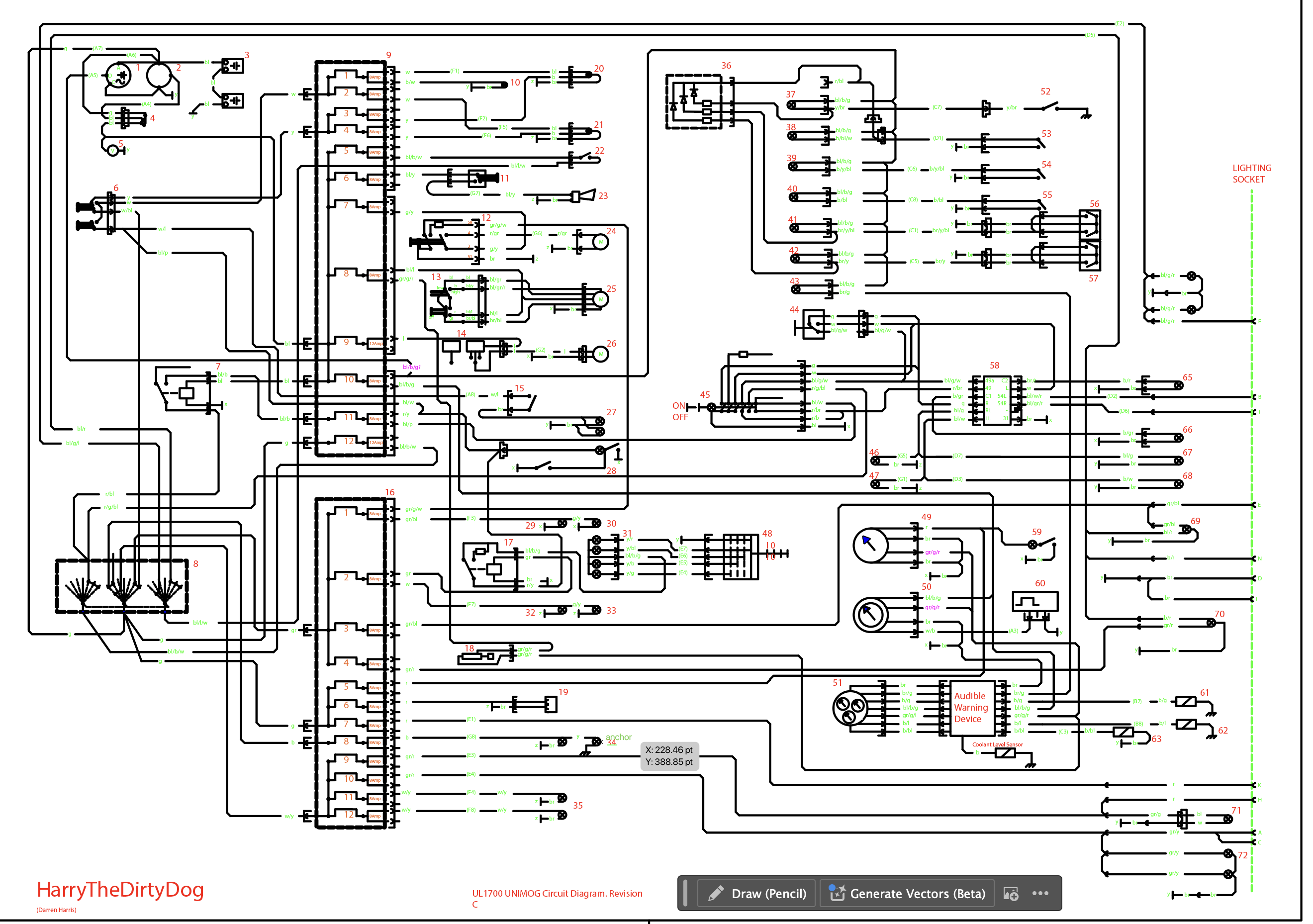
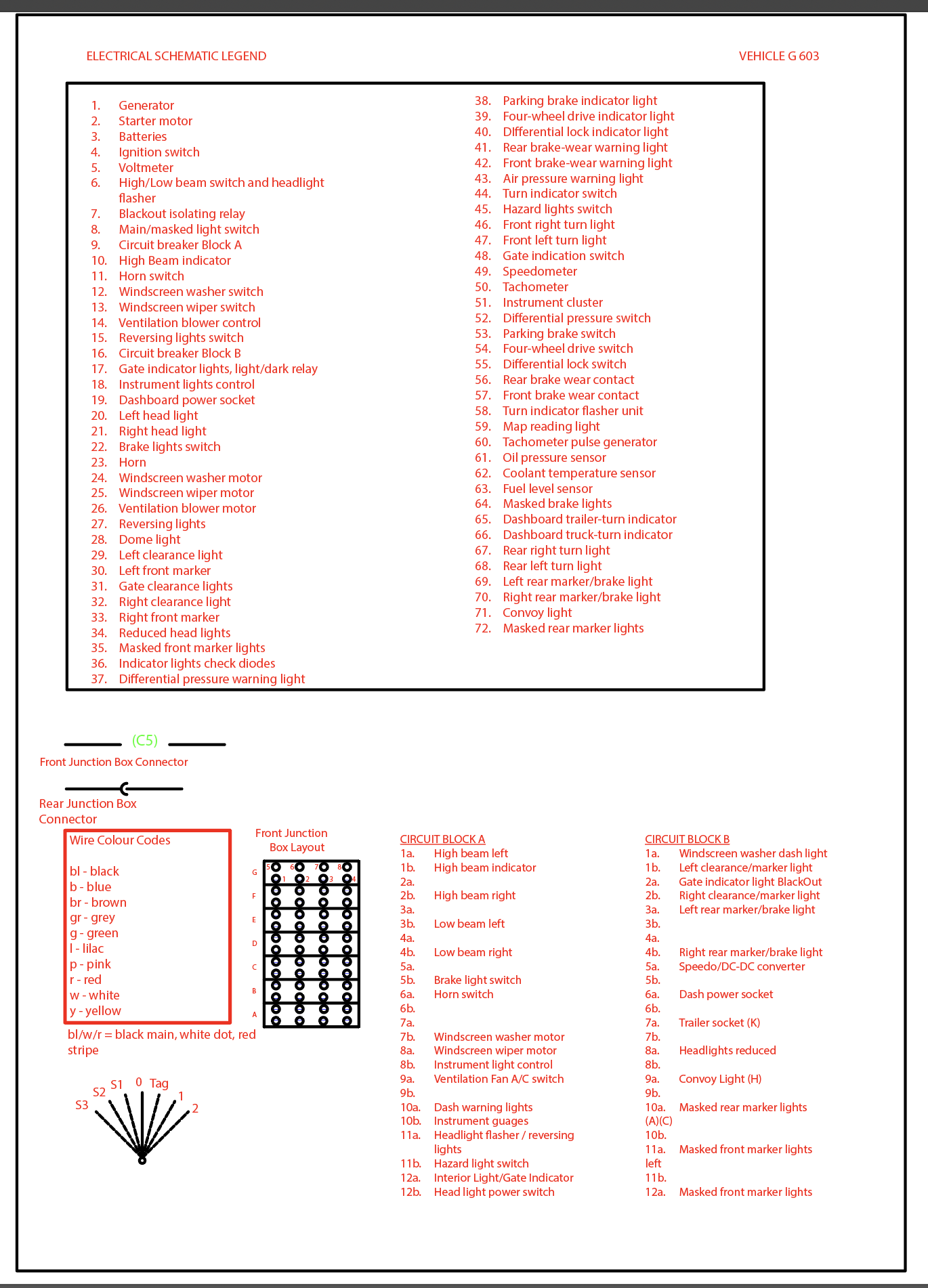
The modifications I did (am still doing) to the Mog are extensive, and detailed in Section 5.4 Electrical Modifications.
4.13 Gearbox
Based on AFMSafety G600 Unimog Data Summary.
| Item | Category | Details |
|---|---|---|
| a. | Type | UG 3/40-8/13.01 GPA |
| b. | Manufacturer | Daimler-Benz |
| c. | Ratios | |
| (1) Forward | 13.01/9.02/5.96/4.38/2.97/2.06/1.36/1.00:1 | |
| (2) Reverse | 12.06/8.74/5.78/4.24/2.88/2.00/1.32/0.97:1 | |
| d. | Shift Mechanism | manual with automatic engagement and disengagement of planetary gears, synchromesh on all ratios |
| e. | Transfer Case | front axle drive engaged by pneumatically operated dog-clutch system |
4.13 ADF Modifications
The ADF specified and purchased these vehicles during the late 1970's and took delivery of them during the 1980's. They are only now disposing of them, some 40+ years later. During their lifetime, the ADF decided to undertake a number of modifications to the U1700L Unimog. The modifications to a particular vehicle are recorded on the 'mod plate', which is on the drivers side seat base and visible from outside the vehicle with the drivers side door open.
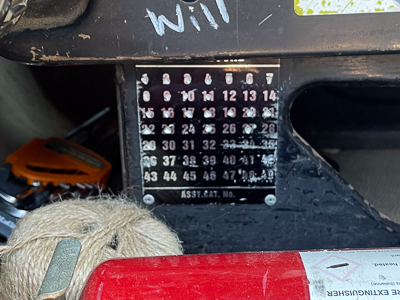
| Mod number |
Mod reference (EMEI Number) |
Details | Comments |
| 1 | G607-1 | Brush guard Modification | Cargo variant. Provides open area for access to engine bonnet spring catch. |
| 2 | G617-1 | Emergency Stop | All types. No details found. Included in G604 Medium Repair Manual. |
| 3 | G607-3 | Hydraylic Jack Stowage Bracket Modification | Cargo variant |
| 4 | G617-3 | Clearance Light Wiring Modification | All types |
| 5 | G617-2 | Coolant Heater Tanks Modification | All types |
| 6 | G617-4 | Accelerator Pedal Stop Bolt | All types |
| 7 | G607-4 | Tray Seating Grab Handle Modification | |
| 8 | G617-12 | Water Pump Jockey Pulley Bracket | All types |
| 9 | G617-6 | Brake Caliper Protection Shrouds | All types |
| 10 | G607-2 | Horn Relocation | Cargo variant |
| 11 | G617-7 | Change of Engine Shutdown Method | All types |
| 12 | (blank) | ||
| 13 | G617-9 | Fuel Tank Drain Plug | All types |
| 14 | G607-6 | Centre Seating | |
| 15 | G617-10 | Accelerator Pedal Cross Shaft | All types |
| 16 | G607-7 | Tail Light Strengthening Brackets | |
| 17 | G617-11 | Lifting and Tie down point modification | All types |
| 18 | G617-15 | Clutch Output Shaft Bearing Modification | All types |
| 19 | G617-13 | Tray Seat Legs Modifications | All types |
| 20 | G617-14 | Brake line Chafing Modification | All types |
| 21 | G617-18 | Tray Floor Headboard Assembly Modification | All types |
| 22 | G617-16 | Clutch Master Cylinder Removal Modification | All types |
| 23 | G617-20 | Engine Warning Device Modification | All types |
| 24 | (blank) | Possibly a DOKA specific mod. | |
| 25 | G617-21 | Modification Recording Plate Modification | All types |
| 26 | G627-2 | Hydraulic Control Valves Crane Modification | Crane Variant |
| 27 | G617-23 | Fitting Additional Blackout Driving Light Modification | All types |
| 28 | (blank) | ||
| 29 | G617-25 | Fitting of Austeyer Weapon Brackets Modification | All types |
| 30 | (blank) | ||
| 31 | G637-1 | Dump Truck Variant | |
| 32 | G627-3 | Inner Boom Rust Crane Modification | Crane Variant |
| 33 | (blank) | ||
| 34 | G617-27 | Trailer Safety Chain Anchor Brackets | All types (I believe removed / superseded by Mod 42) |
| 35 | (blank) | ||
| 36 | G617-29 | Transmission Shift Mechanism Modification | All types. Note, also a duplicate 36 is Air System Filter - but this does not appear to have been implemented in many vehicles. |
| 37-41 | |||
| 42 | G617-36 | Fitting of 12.5 Tonne TRL Safety Chain Mounts Modification | All types |
| M (gearbox) | G617-24 | Transmission Oil Distribution Pipe Modification | All types |
| (blank) | G617-26 | Handbrake Lever Modification | All types |
| Mod-1 | G627-4 | Crane Pressure Gauge and Lockout Circuit Modification | All types |