7 Fit out
7.1 Habitat (expedition vehicle) fit out
Ok, first thing is that we did not do this. I know that many people buy the Mog with the idea of turning it into an expedition vehicle, but we wanted it as a combo tow-tug for our caravan, and 4x4 camper. I have listed some expedition fit out sources below though.
- The Outfit YouTube channel. One of the better known Mog fit outs, Chris and Ange have some 46 videos of them fitting out their Mog, and more than 50 more on trips etc.
- Pat and Jele. Pat is an AeroSpace Engineer, and appears to know his way around tools & metal. They have some 112 videos on their 'Moggy', plus nearly a 100 on their travels around Australia.
- Jocke Selin. Jocke provides a more 'warts and all' approach to his modifications that I find handy. He talks through what he is doing and what works and does not work. He has some 45 Mog build videos plus some 350 other videos. Living in the UK, he has no Australian travel. Very enjoyable series though.
- A different approach to the custom box was taken by several people on Facebook, who fitted a (slightly?) modified Jayco caravan on the back of the body. At least one of these was a pop-up style van. This keeps the profile down to around the cab height. It appears that one Jayco model fits. Sorry, I don't know the model number.
Chasing the Dog video of Jayco conversion - Styromax make fiberglass composite panels for the rear of the Unimog (and caravans, trailers, RVs, etc. etc.), but they also support the DIY person by having a lot of design tools, Project Management & Budgeting Tools, and a Sample Pack that contains some side panel, different floor options, several conduit types, various seals, trims, etc. This kit, along with a sample handle-lock (that they also sell a range of options) would provide most of the products that you would need on an expedition frame. When you come to the build, they appear to custom cut & form the products you want and ship it to you.
7.1.1 Types of Habitats
Some 1000 Ex-Army Unimogs are out there, and around half of these have been turned into some form of expedition vehicle. In addition firms like EarthCruiser and Unidan make expedition Unimogs. This makes for a huge range of answers when it comes to the question: "What sort of camper can you make?".
Scott Davies (Facebook Scott Davies) has produced a wonderful looking, and apparently still tough, 'pop-top' type expedition vehicle. In his case, instead of the typical canvas top, his top walls come down over the bottom section to guard any windows / doors and to make a truly tough Mog-like exterior.
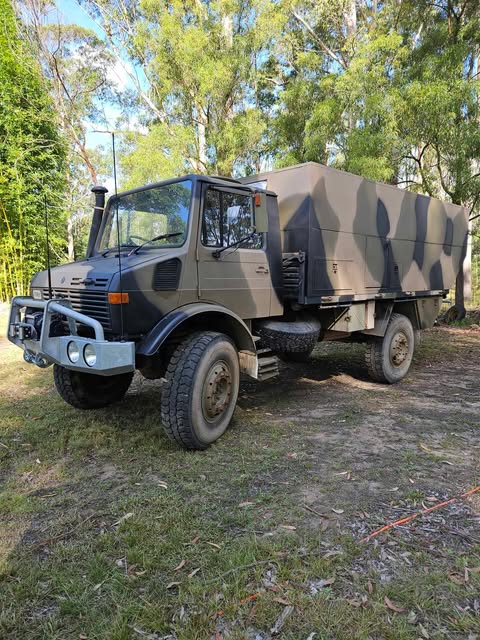
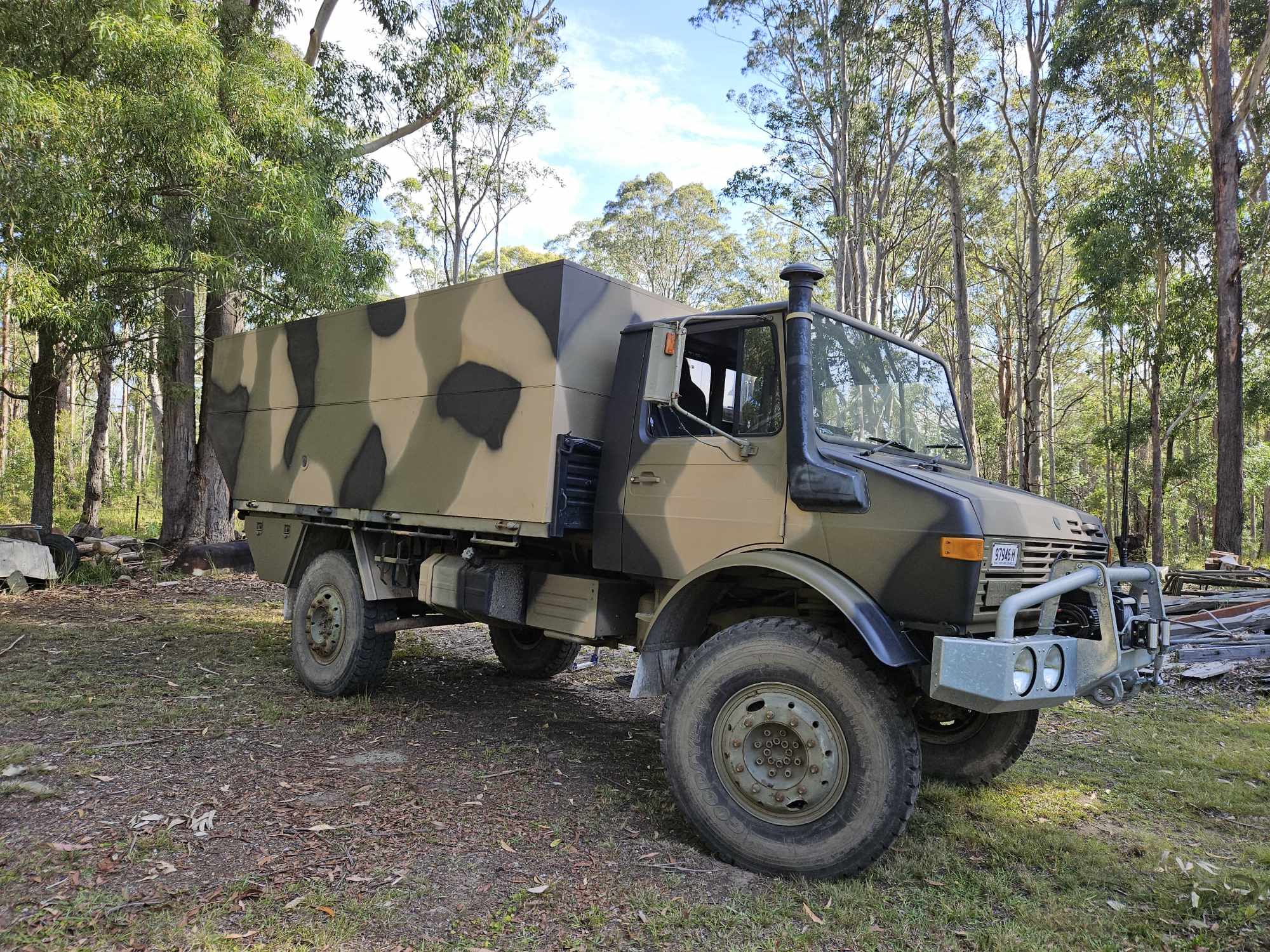
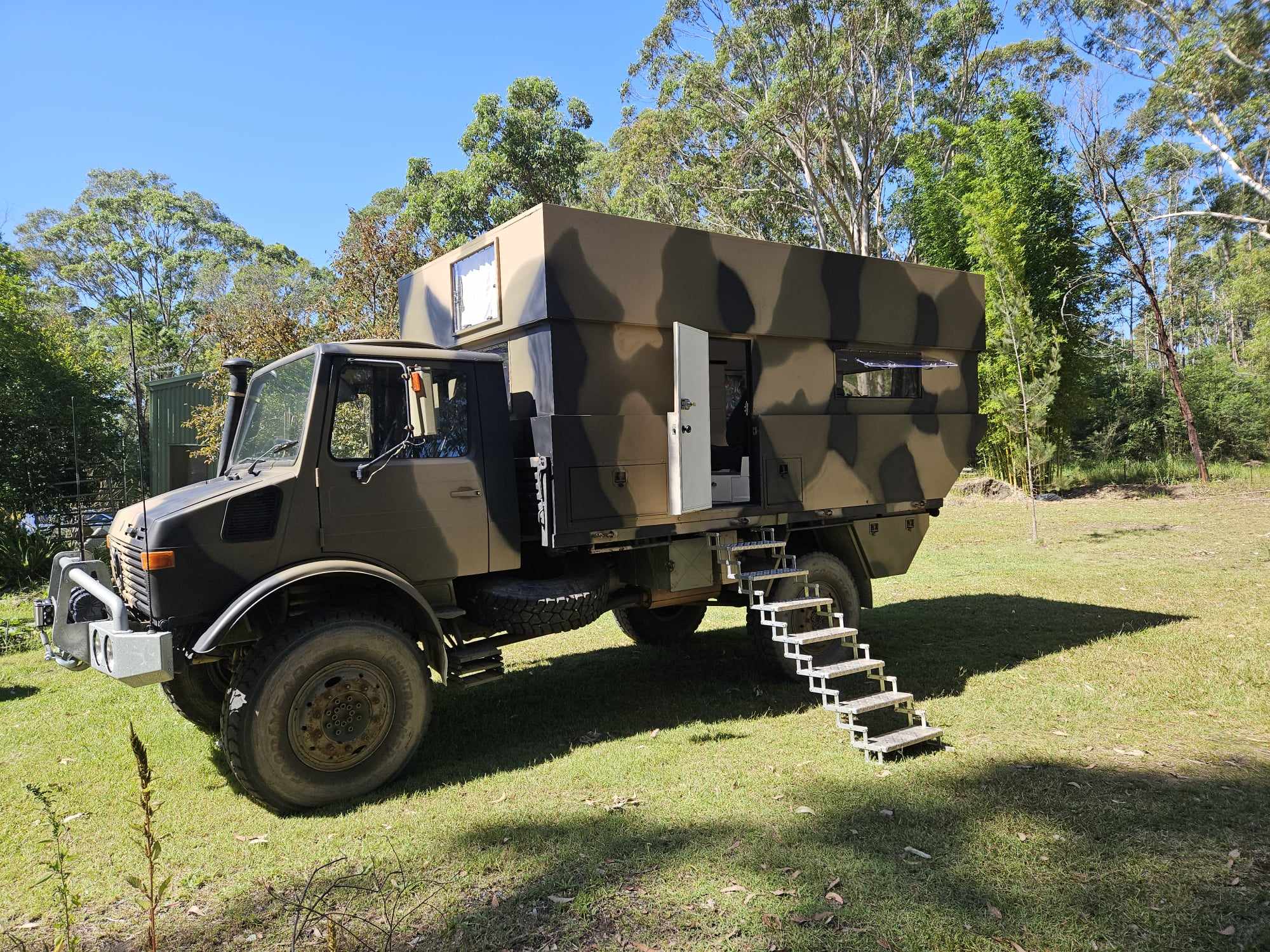
The concertina stairs are one answer. Others use ladders that are stored under the tray and removed when needed. In the case of stairs, some store these under the tray, and others store them inside the habitat.
7.2 Camper fit out
My Mog will not simply be a tow-tug. My concept is to take it, with the van, to a spot, stop, and decouple the Mog from the van, and then drive around the area. This is what we do with the current 4X4 vehicle. It works well for us. We have stayed in one spot anything from a few hours to about 1 week. Most of the travel without the van is a simple 1 hour trip or an afternoon etc., however we have had occasion when we have been gone overnight. We want to be able to do more of this with the Mog, so the Mog will be set up to camp for a few days.
7.2.1 Camper Tent
Yes, I know we can sleep in the back of the Mog. We intend to try this, and we were keen to look at Gary's approach to sleeping in the back of his Mog. It is exactly what we intend to try. Basically a stretcher down the side (one side for him, two sides for us). We already had one swag and several tents from our days car camping though. We intend to just use one of these if we want a tent. I also had a camp stretcher that I had used several times, and like, so I brought one of these for Jenny. Again, we had several sleeping bags already. So the basic tent camp was done.
7.2.2 Camper Kitchen
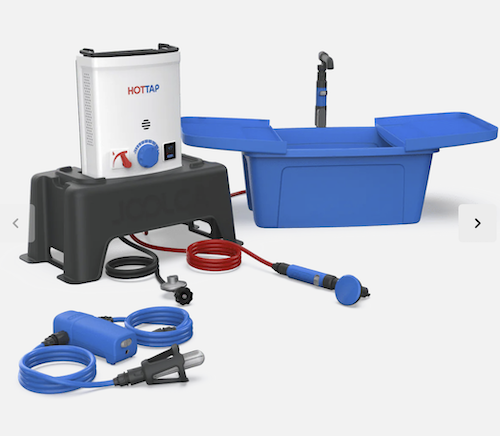
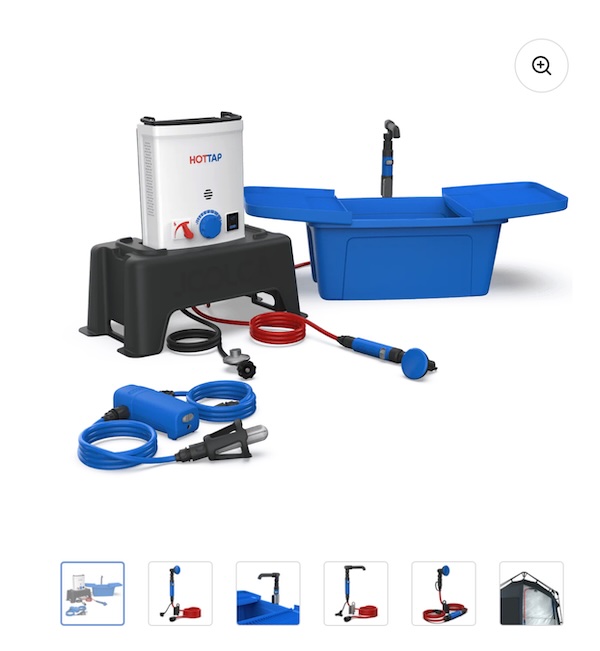
Most of the Kitchen gear we had was from when we bushwalked (i.e. ultra-light stuff). We used to have some kitchen gear from car based camping, but that had been thrown out years before hand. We do have several items intended for cooking on an open fire. So we got a new cooker. We already had camp tables (but plastic versions - I would only by stainless or aluminium tops in the future). We purchased a Joolca Hottap Nomad kit to provide the hot water for showers and cleaning. We already have 9kg gas bottles for our BBQ's and for the caravan. The caravan carries one for use and a second spare. We also purchased an Overedger (kitchen) pack to store our kitchen camp items. This stacks nicely on the Nomad box, and means that when we pull out a table, the Nomad and this, we are basically set up.
7.2.3 Camper Toilet
Ok, Jenny and I are OLD. I know it. Huge numbers of people camp remotely just using a small garden shovel. That was not going to happen. We have had many years of experience of chemical toilets in our caravan, and in the van, we swapped to an OGO 'composting' toilet. For a camping toilet, we wanted to try and have a composting toilet. We purchased a Joolca GottaGo toilet, and a canvas bag to suit.
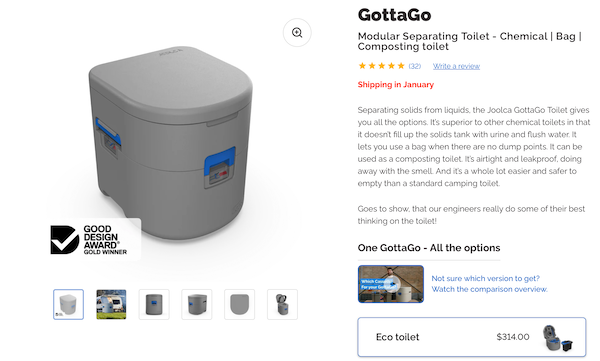
We have not used it yet, so I will not comment on it. We have used the Caravan's OGO though, and this is much better than the Dometic chemical cassette that it replaces. These toilets separate liquids from solids. The liquid bottle is easy to empty. The solids container contains peat moss (or similar) that mixes in with the solids. In the van, there is less smell, easier emptying and considerably more time between empties. Not having to find a dump point makes life much easier.
7.2.4 Camper Shower
Jenny and I don't mind going a day without a shower provided that the weather is mild. When it is hot though, we want a daily shower. Given we wished to be able to camp for a week or maybe even two without the caravan . . . we needed to have a shower. I went with the Joolca Nomad hot water / shower (see picture above). We have a gas bottle for the cooking, so it can double for hot water. The Joolca kit also gives washing up, hand washing, stand, small pump, etc. I am not sure how useful these other things will be, but it looks a good shower.
7.2.5 Camp Stretcher
BCF have a Wanderer Tourer Extreme super wide swag stretcher. $139 It is intended to put a swag on top. It handles 200kg, is over 2m long and 50cm high. Most of the other stretchers are very low. This one can have a mat put on top and then be used in the tent instead of having a swag on top too.
7.3 Tow Tug fit out
By 'Tow-Tug' I mean a vehicle that can LEGALLY tow a 4 Tonne caravan. Yes, I know your puny car could manage it, but just don't get caught or have an accident. You will not be covered. SO many Utes and 4x4 advertise that they can tow 3.5 Tonne - but check the weights. Let's take a 2024 Isuzu Ute MU-X 3.0 LS-M as an example. It is advertised with 3.5T towing. My research says it has Kerb Weight of 2045kg, with a Gross Vehicle Mass of 2700kg, and GCM of 5900kg. Firstly, 5900GCM - 2700GVM leaves only 3,200kg, NOT 3,500. However, a 3.5T van should have about 10% of its weight on the tow ball - thats 350kg. Kerb weight "includes the vehicle with a full tank of fuel, without occupants, luggage or cargo and with all standard equipment." So let's add two occupants of 80kg. The weight moves from 2045 + 80 + 80 + 350 = 2,555, leaving us 145 kg for bullbar, roof racks, luggage, spares, water, extra fuel, tow bar, driving lights, fridge, food, etc. And this is ignoring that the fact that 2,555 + 3,500 = 6,055 - some 150kg over GCM already. The bottom line is that these 'Utes that can tow 3500kg' can't do that in real world circumstances without breaking their GVM or GCM limits. The Queensland Government, in particular, has been pulling over vans, weighing them, and then not letting them proceed if they are not within limits.
For us, with a bullbar, roof-rack, tow bar, driving lights, Engel fridge and extra 150 litres of fuel -- we would be overweight before we added spares, food, etc. Now I am not knocking Isuzu - I am knocking virtually ALL 4x4 Japanese / European Utes. The US 'trucks' are better, but their 1500 models are still VERY limited in what they can carry and be legal. We have a Silverado 2500 HD LTZ. "It could tow anything" - yes? No, well not legally. Unless we are careful we are over the limit, and careful means NO food in Ute fridge, NO extra fuel in Auxiliary tank, and NO boat / fishing gear.
See Robert Pepper's view: Why so many caravans and 4x4s are overweight.
On the other hand, the Mog can be fitted out to tow a (12v) 4 Tonne van while having a few tonne in the back. It has a weight of about 5.5-6 tonne, GVM of 12t, and GCM of 24t. We can fit all our equipment in it and still not exceed 12 tonne with the caravan attached. However, it needs:
- A tow receiver / tow bar.
I brought the Mog Central Rear Towbar $685 (20241004). This fits around / under / within the existing Pintle hitch. Mog Central say that: "This is the ONLY legal towbar on the market that is ADR (Australian Design Rules) compliant for road use in Australia." I have no idea if it is or isn't. I do know that I could get it shipped 'free' with some other stuff from Mog Central, and that it works. - A tow hitch.
For most cars, this is not a problem. Head down to SuperCheap or Repco whatever and come back with one. For the Mog though, this is an issue. 1) The Mog is high. I need a drop hitch. 2) The Mog is going to bounce on bumps, so its tail will go up and down - regardless of what it is connected to. This will put a lot of pressure on the A-frame of a caravan, and it would tend to break the A-frame from most caravans. (Note, cars weigh a lot less than the Mog. In the case of 2T towing 2T, the two vehicles 'push each other'. In the case of the Mog, it will tend to do what it wants and force the van to comply - so greater shock loads and forces). Some 'bounce-reduction' is needed if the caravan is going to survive long term.
This is not a simple or cheap problem. See Drop Hitch for discussion on what I brought. - Brake controller. (See Caravan Brakes)
There are several on the market, but the Redarc Tow-Pro Elite ($415 20241003) is well spoken about by all the reviews I saw. This works by providing an electrical signal to the caravan that is proportional to the deceleration level of the Mog. It can be adjusted on the dash for gain, but also triggered on the dash. (i.e. if the van starts to mis-behave you can put the van's brakes on). It is a legal requirement to have one of these, but a its a safety requirement to have a good one. I went for the best I could find. I initially installed it in the back wall (I was in a rush) knowing that it would have to move when some other cabin modifications were done. This location is NOT good. The button / dial needs to be on the dash and readily accessible and visible to both the driver and passenger. This means about mid-dash. I have a new dash coming and will move the brake controller when that it is installed. - 24v -> 12v Turn signals converter. (See 12v Caravan Signals)
The Mog's electrics are 24v. There is a NATO connector at the rear that has all the various signals in it - but they are all 24v and not suitable for a 12v Caravan or Trailer.
Some owners have simply changed their trailer to have 24v LED lights. I did not want to do this as: 1) I want to be able to tow hire trailers / other people's trailers; 2) Many of the Caravan's lights would need to be changed (e.g. some 12 clearance light units to start with); and finally 3) I want the Mog to charge the 12v Caravan batteries on the move.
The Redarc Trailer Lighting Reducer takes in the 24v turn signals and gives out 12v compatible signals - for brake lights, tail / clearance lights, right indicator, left indicator. The REV model includes reversing lights, but my van does not have reversing lights. - 12 Pin Plug & Anderson power connector. (See Trailer Plugs)
The Bushtracker uses a high current 12 pin connector for all its signals. I also need to have a way of charging the van from the Mog. I initially took 12v from the Mog's 12v battery, via the 50A Anderson to charge the Caravan. I then realised that we often stop for several hours or overnight without disconnecting the Mog from the van. This would leave the Mog trying to charge the Caravan's much bigger batteries overnight. We tend to use about 120AH from the caravan's batteries overnight, and I don't want the Mog trying to charge them from its much smaller 240AH battery. I changed the Anderson to only provide 12V current when ignition was on. - Safety Chains.
The Mog Central Rear Towbar has small rings that are suitable for attaching safety chains. I ended up putting a bow shackle through this and onto the chains. The breakaway 12v van brakes was harder to find a spot for. The Breakaway should not be on any part of the hitch / chain - but there is nothing else nearby.
Optional equipment includes:
- Hitch camera.
If you want a divorce, then get one spouse to yell directions to other on how to reverse up to a hitch. We use the 5T Hitch-Ezy, which I thoroughly recommend as being the easiest heavy duty hitch I have seen - however, it is still not easy. A rear view of the hitch makes this super easy. - Caravan rear view camera.
I fitted this to our Chevy and absolutely love it. It is basically a replacement mirror for the car (Mog) where you see what is behind you (via video) - BUT when you connect the van, you see what is behind the van. It turns infra-red after dusk, so you can still see behind you at night. An all seeing rear vision mirror. Brilliant.
7.3.1 Tray Canopy
I have been using the standard ADF tray with sides and tarp. However, I don't like the lack of security in this configuration. Basically, anyone can open the tarp / tray and rummage through your gear. The more gear we keep in here, the more I want to secure it. My basic concept is just a metal tarp though. No beds, air-con, etc. etc. However, it is also a pain to have no storage in the cabin. We are used to a back seat that held some items, and a canopy door that you could quickly open to deposit shopping, purchases, firewood, etc. So my concept has evolved slowly to be a metal tarp with canopy doors all around. One big door would let me go inside and walk down the centre aisle. That would allow stuff to stack higher and for long items to be stored above the door heights. e.g. fishing lines, canoes, etc.
Tray dimensions. The Unimog Technical Manual User Handbook indicates that the Cargo tray internal dimensions are: Length 4050mm, Width 2375, and Height 500mm. (Note that this height is not to the top of the tarp)
7.3.2 Spare wheel holder
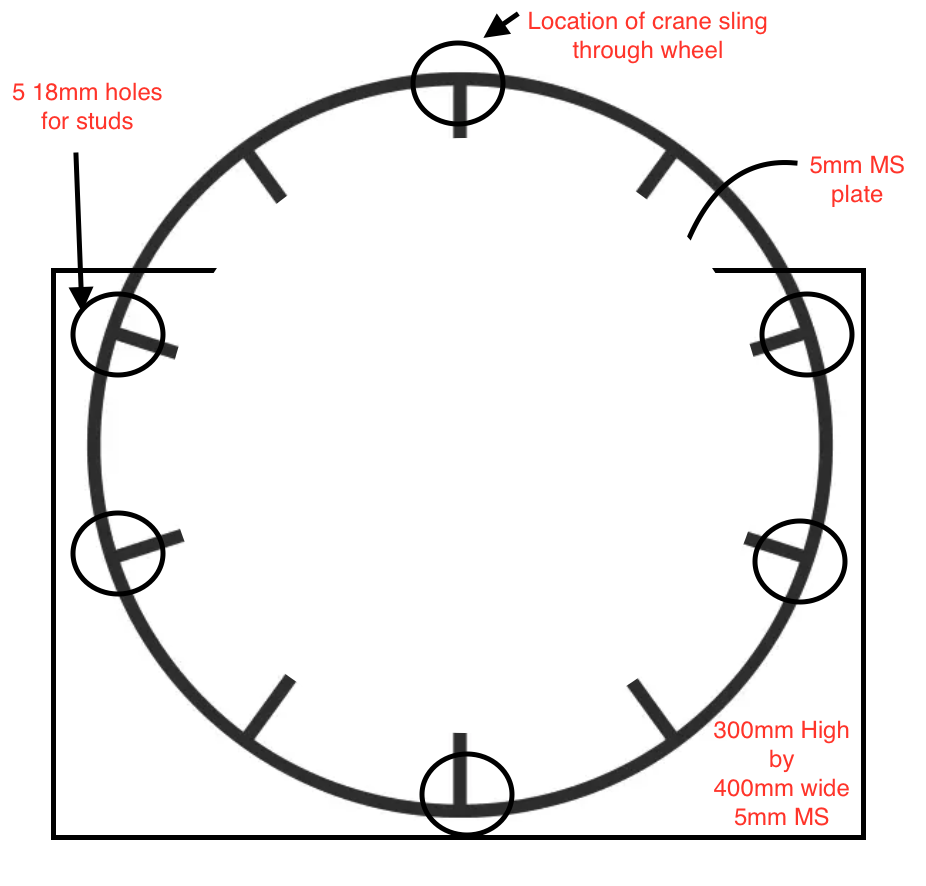
ChatGPT says that the 10 stud wheels follow the European heavy vehicle standard of having:
- Pitch Circle Diameter (PCD): 335 mm — that’s 10 studs equally spaced on a 335 mm bolt circle;
- Center pilot (hub-centric diameter): approx. 281 mm;
- Stud diameter: approximately 18 mm (⅞″), per measurements on ex‑mil rims
7.4 Water Storage and filtration
4x4 Australia recommend 8-12 litres per day for a couple traveling in Australia. For a week, the is clearly around 56-84 litres not counting showers or backup for breakdowns / road closures etc. How much water you carry, how you store it and whether you can gather more is a big issue regardless of whether are a camper or expedition vehicle.
7.4.1 Long Range Water Container
Regardless of whether you have an expedition back, or cargo, etc. if you are going to do any remote travel, then you want fuel and water. Unidan do a 165 Litre water tank that fits under the tray of the U1700L Unimog. Priced at $811.25 (20250831) This appears to be a rotomolded (i.e. very tough) plastic container that comes with water pump, fittings, tap, filters, etc.. This normally takes up some unused space under the Mog. However, check with them prior to purchase, as any modified Mog might have put something in that space already. In my case, there is an exhaust pipe and some electronics in the road. Nice solution, and nice sized though.
'Jerry Cans' are a relatively cheap method of carrying and storing water (and fuel). At 20 Litres, they hold roughly enough for 2 persons for 2 days, and they available for less than $40 each. From experience though, the plastic ones can crack over time, and the cheaper metal ones can buckle to the point that their lids don't close. I prefer either the expensive metal ones, or two plastic ones (allowing for one of the plastic ones to crack and leak).
Water bladders are popular for the backs of 4x4 cars. These collapse to be a large plastic bag, but can fill 60 litres or more. Their great advantage is that they don't take up much space when empty. FMestore have a range of bladders from 40 litres to 280 litres that are designed for the back seat or cargo area of a 4x4. Prices depend on pump and hose options, but the 280 ranges from $330 - $416 (20251006).
7.4.2 Water Filters
There are three main types of filters: particle filters, bacterial filters, and reverse osmosis (saltwater to fresh water). Setting aside salt water purification: Particle filters reduce the level of solids (i.e. mud, sediments) in the water, but do not purify the water (i.e. remove bugs). Bacterial filters tend to kill the bugs. Broadly speaking then, IF you are filling up in a remote country town or from a bore - you need a particle filter (only). However, if you are filling up from a stream or lake, then your need for purification ramps up quickly.
For particle filters, 5 microns are typical, but 1 and 2 micron filters clearly remove smaller particles (but also clog quicker). Note that some filters also reduce chlorine (used by most councils to kill bugs), heavy metals, acidity, etc. Some include items like silver to help kill bugs. Outback equipment sell the Thirsty Nomad Complete Caravan RV water treatment System for $289 (20251006). This does not use Ultra-violet to kill bugs though.
Filter Systems Australia also sell a range of filters designed to be installed in van / expedition vehicle. Their filters range from 0.5 micron to 5 micron and some are impregnated with silver to help kill bugs. Filter Systems also sell Ultraviolet (UV) water sterilization systems. These are the best for killing bugs, but range in cost from $295 - $3,750 (20251006). Puretec is another Australian company that supplies UV systems. Their prices seem similar.
Womo is another Australian company that sells water filtration / purification. In their case, (literally) they have the WOMO-Xplorer, which is a case that contains everything to filter water and "inactivating 99.999% of harmful bacteria and viruses". ($2,199 20251007) They also have the normal permanent installation stuff.
7.5 Davit (Crane)
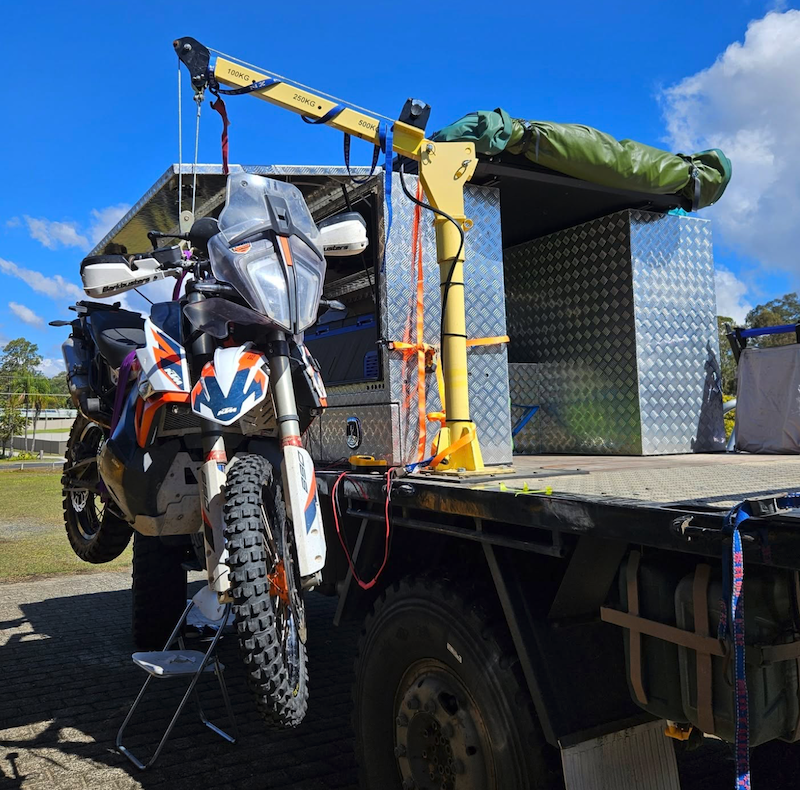
For those people, like me, that keep the rear tray, the tray can be used to carry quad bikes, bikes, boats, almost anything (up to about 6 Tonne). Loading that weight is the issue though. Ozmog Facebook user Chris Topher is one of the owners that have added a Davit to their tray. Chris used a Edisons T-Rex 800kg 12v powered davit as shown below. ($679 20250901) Clearly it can't both reach out a long way AND load 800kg, but the photo shows him loading a fair sized bike at a fair distance. The davit is strapped down for traveling, and it is bolted to two large plates - one on top of the tray, and its twin underneath the tray, to spread the load.
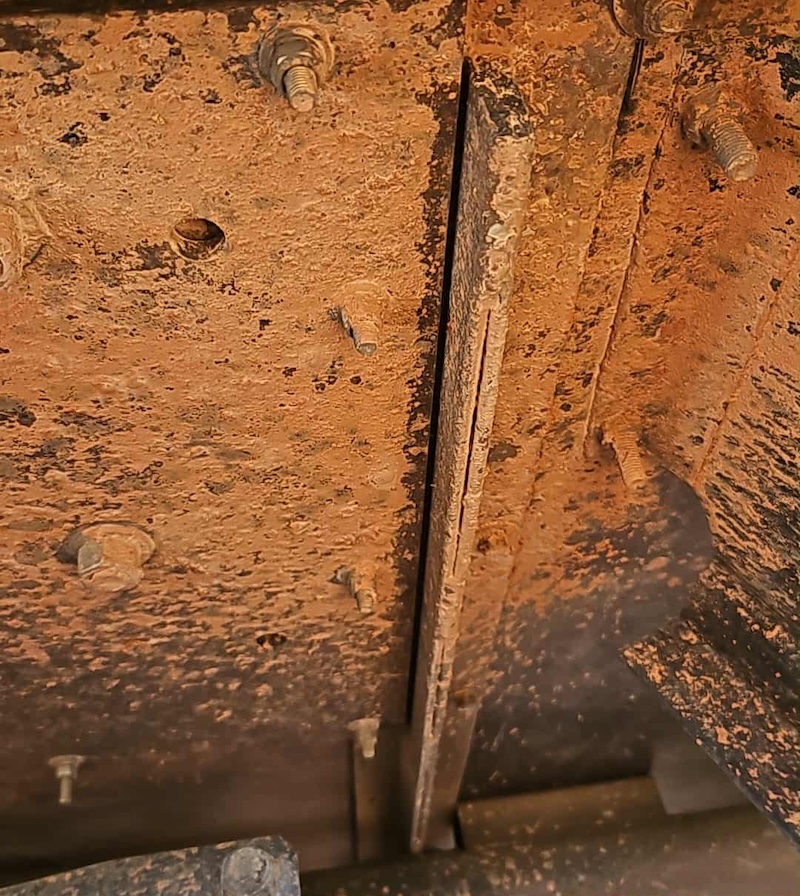
Chris points out that he had the plates laser cut and positioned with the holes on the right side of the plate to line up with the cross bracing underneath the tray ... lower 10mm plate slightly narrower to fit inside, upper wider and 12mm. If it was simply bolted to the floorboards he would question its side loading abilities. See second photo below.
7.6 Boat Loader
Taking a fishing boat away is something many of us want to do, whether in a expedition vehicle, or with a trailer / van. The boat can be mounted on the top of the Unimog, either right side up, or upside down. The MyLureBox Youtube Video provides a video of a Mozzi Boat Loader that keeps a small tinnie upright and ready to go on the roof of a 4WD / Unimog.