Photographing Dimboola Street Art
About Dimboola Street Art (aka Mallee Emu-Wren)
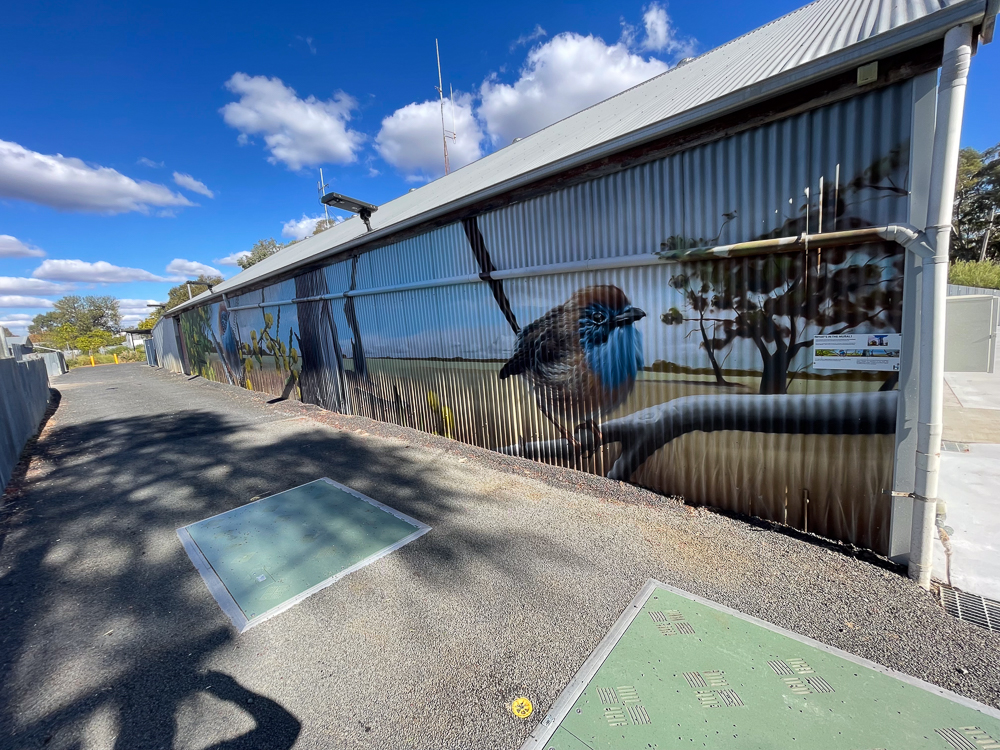
Otherwise known as the Mallee Emu-wren Mural, this lovely painting is in an unnamed alley just off Lochiel St and running behind the Lloyd St Shops.

This painting runs the length of an alley, and is painted on the side of a building. I am not aware of a lens that would be wide enought to allow this to be photographed in one photo. I photo-stitched this.
The painting is by Smug (Sam Bates), who is one of our favorite silo artists. He painted this while he was staying in Dimboola painting the Arkona Silo.
Dimboola is a historic Wimmera town in western Victoria, situated beside the Wimmera River and approximately 35 kilometres north-west of Horsham.
Although the town is best known for its river setting, historic buildings and proximity to Little Desert National Park, it also contains several worthwhile examples of contemporary street art.
The most photographically distinctive of these is the Mallee Emu-Wren mural by internationally renowned Australian street artist Sam Bates, better known as Smug.
Smug created the mural in 2022 while staying in Dimboola to paint the nearby Arkona Silo Art.
Rather than producing another monumental grain-silo portrait, he used a long corrugated-iron wall in a laneway near the Dimboola Library to create an intimate Wimmera Mallee landscape.
The mural features the tiny Mallee Emu-Wren together with native vegetation and other elements representing the flora and fauna of the surrounding region.
The artwork is particularly interesting photographically because the corrugated-metal wall becomes part of the image. The ribs of the iron alter the appearance of the painted bird as the photographer moves from side to side, creating subtle changes in texture, highlights and apparent depth.
Unlike many silo-art locations, the mural can also be photographed at close range. This allows photographers to make everything from a complete environmental record of the wall to extremely tight studies of the bird's eye, feathers, vegetation and paint texture.
Dimboola also contains another major mural by local artist Travis Price. His work reflects the importance of the Wimmera River, local history, wheat growing and the cultural history of the district. Together, the two murals make Dimboola a worthwhile street-art destination rather than simply a stopping point on the way to Arkona.
Viewpoints
-
Mallee Emu-Wren Mural - Main View
The mural is located along the laneway linking Lochiel Street with the rear of the Dimboola Library.
Begin by stepping far enough back to photograph the complete mural in its laneway environment.
This establishing photograph is useful because it shows the scale of the work, the corrugated-metal surface and the relationship between the artwork and its small-town setting.
Best for: complete mural views, street-art documentary photography and environmental compositions.
Recommended lens: approximately 24-70mm.
Address:
Dimboola Murals
6 Lochiel Street
Dimboola VIC 3414 -
Mallee Emu-Wren - Close Detail
After making the complete mural photograph, move closer and treat the Mallee Emu-Wren almost as though it were a wildlife portrait.
Smug's photorealistic technique produces extraordinary detail in the eye, beak, feathers and subtle blue plumage.
At close range, the underlying corrugated iron becomes more obvious and adds a second layer of texture to the image.
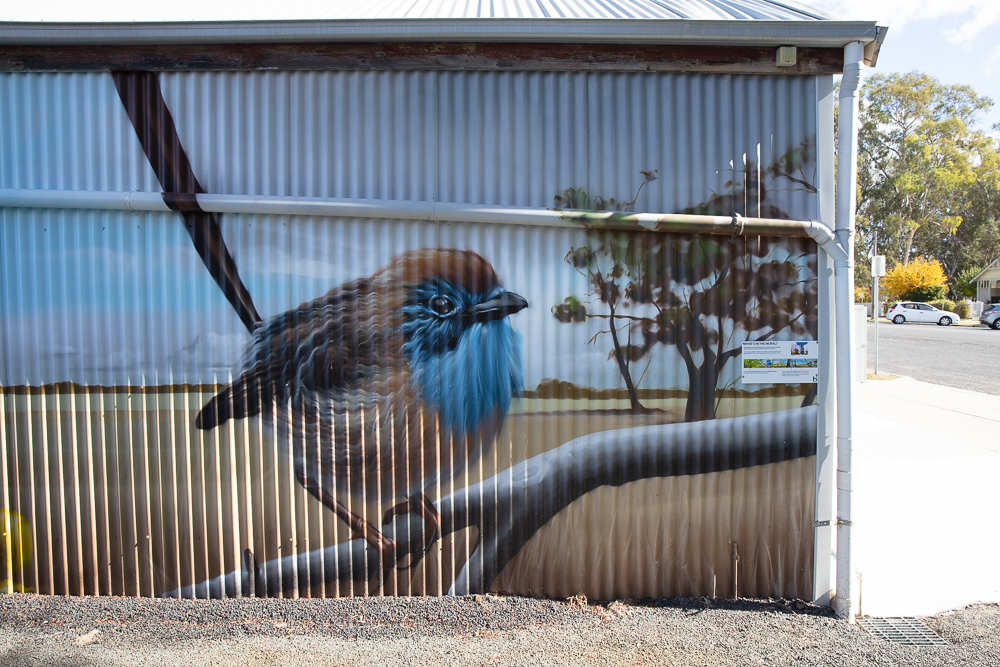
Dimboola Mallee Emu-Wren Best for: street-art detail, texture, wildlife-themed compositions and abstract photography.
Recommended lens: 70-200mm.
Try both a conventional bird portrait and extremely tight crops that show only the eye, head or breast.
-
Oblique View Along the Corrugated Wall
One of the most interesting ways to photograph the mural is from an angle rather than directly square-on.
The corrugations in the wall catch light differently as the viewpoint changes, and the painted image can appear to break into alternating strips of light and shadow.
This effect is particularly noticeable when the sun is striking the wall from the side.
Best for: texture, repeating patterns, abstracts and unconventional street-art compositions.
Photography tip: make several photographs while moving only a short distance between exposures. The appearance of the mural can change significantly from one position to the next.
-
Native Flora Details
The bird is the obvious subject, but the surrounding vegetation is equally useful for building a varied photographic series.
Look for isolated branches, flowers, leaves and colour combinations that can stand alone as graphic compositions.
These details also help explain that the mural represents the broader Wimmera Mallee environment, rather than simply depicting a single bird.
Recommended lenses: 50mm, 70-200mm or a short telephoto prime.
-
The Laneway Environment
Include some photographs that deliberately show the mural within the laneway.
Elements such as the pavement, wall edges, neighbouring buildings, light fittings and distant street can give the photograph a much stronger sense of place.
A photograph made entirely of artwork records the painting. A photograph that includes the laneway records Dimboola.
Best for: travel photography, documentary work and environmental street art.
-
Include a Person for Scale
A person walking through the lane can provide useful scale and turn the static mural into a more dynamic street photograph.
Rather than allowing the person to dominate the frame, position them as a relatively small element beside the bird.
This can work particularly well when the pedestrian is silhouetted or wearing colours that contrast with the mural.
Avoid obstructing the laneway and obtain permission where an identifiable person becomes the principal subject of the image.
-
Travis Price Mural
Dimboola's second major mural was created by street artist Travis Price, who grew up in the town.
His design draws upon memories of the Wimmera River as a focus for swimming, fishing, skiing, rowing and community life.
The focal image depicts a young woman submerged beneath the river, with the design flowing into wheat and wattle motifs.
The artwork also incorporates heritage-style signage and references to the traditional owners and historic names associated with the district.
Best for: street art, portraiture, typography, local history and environmental photography.
Address:
101 Lloyd Street
Dimboola VIC 3414 -
Blue Hour and After Dark
Because the Dimboola murals are located in town rather than at a remote grain site, they can also be worth revisiting around blue hour.
Street and building lighting can introduce a different atmosphere, particularly when there is still some colour remaining in the sky.
Best for: urban travel photography and night street art.
A tripod may be useful where it can be positioned safely without blocking pedestrians, traffic or accessways.
The only way I know to photograph this is to walk down the alley, taking photographs from the other side of the alley, and then stitching the result.
Other Things to Look Out For
How I photographed the Dimboola Street Art / Mallee Emu-Wren
What I took - what was in my kit
I took my LowePro Backpack loaded with Canon 5DSR body, Canon 24-70mm, Manfrotto 190 Tripod, and of course a range of lens wipes, spare batteries, sunscreen and bug repellant. I also took a DJI Mavic Air 2 drone. I shot wide (24mm), but still needed to stitch the final photo.
Techniques
Photo stitching.
As with many wide scenes (panoramas), you have a choice of a specialised panoramic camera like the Linhof, severely cropping a single image, or stitching several images together. I used multiple Canon 5SDR images stitched together.
Nearby Locations
-
Wimmera River
The Wimmera River provides the natural landscape counterpart to Dimboola's street art.
Mature River Red Gums, quiet water, reflections and birdlife make the river particularly attractive around sunrise and sunset.
Best for: reflections, River Red Gums, birds, sunrise, sunset and tranquil landscapes.
A 16-35mm or 24-70mm lens is useful for the broader river landscape, while a longer lens can isolate individual trees and wildlife.
-
Loch Iel - Pink Lake
Pink Lake lies only a short drive from Dimboola and is one of the district's strongest minimalist landscape locations.
The colour varies considerably according to water level, salt concentration, season and lighting, so the lake should not be expected to appear intensely pink on every visit.
Even when colour is subdued, the lake can produce strong photographs based on shoreline patterns, salt textures, reflections and open skies.
Best for: minimalist landscapes, colour, salt textures, reflections and birdlife.
-
Arkona Silo Art
Arkona Silo Art is approximately 10 kilometres north of Dimboola and is the obvious companion destination to the Smug mural.
Smug created both works during the same period, so photographing them together provides an interesting comparison between his intimate street-art technique and his monumental silo work.
Best for: silo art, rural landscapes, details and environmental photography.
-
Little Desert National Park
Dimboola is one of the principal gateways to Little Desert National Park.
The park contains heathland, woodland, sandy country, native wildflowers and excellent bird habitat.
Best for: wildlife, birds, wildflowers, native vegetation, close-up nature photography and stars.
Some tracks are sandy or remote, and road conditions can change following storms, fire or maintenance closures.
Check current conditions before entering more remote parts of the park.
-
Horseshoe Bend
Horseshoe Bend provides convenient access to the Wimmera River immediately south of Dimboola and is a useful location for combining river photography with Little Desert vegetation.
Best for: River Red Gums, sunset, birdlife, camping and night photography.
-
Dimboola Heritage Streetscape
Allow time to walk slowly through the centre of town rather than travelling directly between the murals.
Historic shopfronts, verandahs, signs, old brickwork and small architectural details can provide useful secondary subjects for an Auspano gallery.
A 35mm or 50mm lens is particularly effective for this type of documentary photography.
Nearby Auspano pages
- Little Desert National Park — approximately 5 km in a straight line; road distance may be considerably longer.
- Pink Lake — Loch Iel — approximately 8 km in a straight line; road distance may be considerably longer.
- Arkona Silo Art — approximately 10 km in a straight line; road distance may be considerably longer.
- Horsham Silo Art — approximately 32 km in a straight line; road distance may be considerably longer.
- Murtoa Stick Shed and Silo — approximately 45 km in a straight line; road distance may be considerably longer.
Location
Use this section to plan location for Dimboola Street Art.
Apple Map – Location and Nearby Photographic Locations
This Apple Map identifies Dimboola Street Art and 5 nearby Auspano locations. Select a numbered marker or linked page for more detail.
Photographic locations
How to Get There
Driving from Melbourne
Dimboola is in western Victoria on the Western Highway, beyond Horsham.
A typical route from Melbourne is:
Melbourne → Ballarat → Ararat → Stawell → Horsham → Dimboola
Allow approximately four hours from central Melbourne under normal driving conditions, excluding substantial stops.
Melbourne to Dimboola driving directions
From Horsham
Dimboola is approximately 35 kilometres north-west of Horsham.
The drive generally takes around half an hour, making Dimboola easy to include in a broader Wimmera photographic itinerary.
Getting around Dimboola
The town centre is compact and the Mallee Emu-Wren mural, Travis Price mural and several heritage subjects can be explored on foot.
A vehicle is strongly recommended for visiting Arkona, Pink Lake, Horseshoe Bend and Little Desert National Park.
Public Transport
Regional public transport serves Dimboola, but photographers planning to visit the surrounding landscape locations will find a private vehicle considerably more practical.
Check current services using:
Driving from the State Capital
The state capital is used as a consistent reference point. Apple Maps calculates the automobile route to this location; your actual route may vary with your starting point, traffic, roadworks and temporary closures.
State capital to destination
Calculating the driving route with Apple Maps…
Distance and travel time are Apple Maps estimates and may change with the route and current conditions.
Current Access / Conditions
There are no known issues with getting to this location.
Best Time to Visit
Victoria is a fairly temperate climate, without severe winters. Dimboola is in a fairly dry area of the state, so just about any time of the year you will find the area dry and temperate. The alley faces north-eat, so it gets the mid-morning sun directly on it. However, depending on the time of year, it is partly in shadow from the fence / buildings to its north-east.
Autumn - March to May
Autumn provides comfortable temperatures and warm tones in the surrounding agricultural landscape.
Street-art photography is particularly pleasant because the lower sun can create stronger modelling across the corrugated surface of the mural.
Good for: murals, heritage streetscapes, Wimmera River and rural landscapes.
Winter - June to August
Winter can produce soft light and dramatic skies, both of which are useful for photographing the murals.
Cloud cover reduces harsh highlights on the corrugated iron and can make the colours of the artwork easier to record evenly.
Good for: street art, architecture, monochrome photography and dramatic skies.
Spring - September to November
Spring is probably the best overall season for a photographic visit to Dimboola.
The surrounding agricultural landscape becomes greener, Little Desert can produce native wildflowers and bird activity generally increases.
The stronger natural colours also complement the flora and fauna depicted in Smug's mural.
Good for: street art, birds, wildflowers, landscape photography and Little Desert National Park.
Summer - December to February
Summer produces strong light, dry Wimmera landscapes and potentially spectacular sunsets.
Midday light can be harsh on the corrugated mural, however, so early morning or later afternoon is preferable.
Good for: street art, dry rural landscapes, sunsets and river photography.
Best light for the Mallee Emu-Wren mural
Unlike an open landscape, the quality of light on the mural depends heavily upon the orientation of the wall and surrounding buildings.
I would favour either:
- Soft overcast light, which provides even illumination and preserves colour detail across the entire mural.
- Low-angle side light, which exaggerates the texture of the corrugated iron and creates a more three-dimensional appearance.
Harsh midday sunlight can be useful for graphic shadow patterns, but it may also create very bright highlights and deep shadows across the corrugations.
Accessibility
Mallee Emu-Wren Mural
The Dimboola murals are located within the town centre and can be viewed without undertaking a long walk or negotiating remote terrain.
The Mallee Emu-Wren mural is positioned along a laneway between Lochiel Street and the rear of the Dimboola Library. As the alley is unnamed, and quite small, it is easy to miss. However, if you park in Lochiel St and simple walk around, you will soon find it. The roads are all paved, and their are footpaths to the alley.
Official visitor information lists the broader Dimboola murals precinct as having facilities including car parking, public toilets, lawns and gardens.
The laneway itself should still be treated as an outdoor urban surface. Small variations in pavement level, drainage, kerbs or access conditions may affect visitors using wheelchairs or walking aids.
From a photographic perspective, close access to the wall is not essential. Strong complete views of the mural can be made from farther back within the public laneway.
Travis Price Mural
The Travis Price mural is also situated within the developed town centre close to the library precinct.
It can therefore be combined with the Smug mural without travelling into remote or uneven terrain.
Wimmera River
Accessibility around the Wimmera River varies according to the particular park or riverbank location.
Developed areas in Dimboola provide the easiest access, while more natural riverbank sections can contain grass, loose soil, tree roots and uneven surfaces.
Pink Lake
Pink Lake is a particularly useful nearby photographic option for visitors with limited mobility because broad views can be obtained from the elevated parking area beside the Western Highway without requiring a long walk.
Little Desert National Park
Accessibility within Little Desert National Park is much more variable.
Sandy surfaces, unsealed tracks and uneven ground can make some areas unsuitable for conventional wheelchairs or visitors with restricted mobility.
Anyone with specific access requirements should check current Parks Victoria information before travelling into the park.
Where to Stay
Dimboola Riverside Holiday Park
For photographers, Dimboola Riverside Holiday Park is my preferred accommodation option in town.
The park is situated directly beside the Wimmera River, which means a sunrise or sunset landscape subject is available immediately outside the accommodation.
Current accommodation includes modern cabins together with powered, unpowered and ensuite caravan and camping sites.
Address:
2 Wimmera Street
Dimboola VIC 3414
Telephone: 03 5389 1416
Dimboola Riverside Holiday Park
Dimboola Motel
Dimboola Motel provides a straightforward motel alternative with convenient vehicle access.
It is a practical choice for photographers carrying substantial camera equipment and wanting to make early starts for Arkona, Pink Lake or the Wimmera River.
Address:
35-43 Horsham Road
Dimboola VIC 3414
Victoria Hotel Dimboola
The historic Victoria Hotel provides traditional accommodation in the centre of town and is within easy walking distance of Dimboola's heritage streetscape.
Address:
32 Wimmera Street
Dimboola VIC 3414
Camping in Little Desert National Park
Photographers wanting immediate access to nature, stars and sunrise can also consider camping at locations such as Horseshoe Bend or Ackle Bend.
These campgrounds are more basic than staying in town and visitors need to be appropriately self-sufficient.
Check current bookings, access conditions and closures before travelling.
Parks Victoria - Little Desert National Park
We stayed at the Horsham Riverside Caravan Park, and we can certainly recommend that.
Photography Recommendations
-
24-70mm standard zoom
The most useful overall lens for the Mallee Emu-Wren mural. It allows complete environmental photographs as well as medium close-ups.
-
70-200mm telephoto
Particularly useful for isolating the bird's head, eye, plumage and smaller areas of native vegetation.
-
Wide-angle lens
A 16-35mm can be useful if you want to include a large proportion of the laneway, but avoid moving so close that the architecture becomes unnecessarily distorted.
-
Watch the corrugations
The metal wall is not simply a flat canvas.
Move sideways while watching the mural through the viewfinder. Highlights and shadows on the corrugated surface can change dramatically with viewpoint.
-
Photograph both square-on and obliquely
A square-on photograph records the artwork accurately.
An oblique photograph emphasises the texture of the surface and can create a much more dynamic composition.
-
Include the laneway
Do not photograph only the mural.
One or two wider images showing the artwork in its urban environment are important for telling the story of the location.
-
Use shallow depth of field selectively
A relatively wide aperture can work well when isolating small mural details, but for the complete wall use sufficient depth of field to keep the painted surface sharp from edge to edge.
-
Look for abstract compositions
Individual feathers, leaves, branches and sections of corrugated metal can produce strong images that no longer read immediately as street art.
-
Consider polariser use carefully
A polarising filter can reduce glare on painted metal, but it can also change the relationship between highlights and shadows that makes the corrugated surface interesting.
Compare frames with and without polarisation rather than assuming the stronger effect is always better.
-
Combine art with nature
The strongest Dimboola photographic story combines the painted Mallee Emu-Wren with the real Wimmera environment nearby: River Red Gums, birds, native vegetation and open agricultural country.
Suggested photographic sequence
For a photographer spending a full day in Dimboola, I would organise the visit approximately as follows.
-
Sunrise - Wimmera River
Begin at the river while conditions are quiet and there is the greatest chance of still water and reflections around the River Red Gums.
-
Early morning - Dimboola heritage streets
Walk through the town centre while the light is low and traffic is relatively quiet.
Photograph shopfronts, verandahs, signs and architectural details.
-
Morning - Mallee Emu-Wren mural
Start with a complete square-on view of the artwork before moving progressively closer.
Make both horizontal and vertical compositions.
-
Mid-morning - mural details
Change to the 70-200mm and isolate the bird's eye, plumage, surrounding flowers and native vegetation.
-
Late morning - oblique mural views
Walk slowly along the laneway and deliberately exploit the corrugated surface.
Compare how the image changes as the light catches alternating ridges in the metal.
-
Midday - Travis Price mural
Photograph Dimboola's second major mural and compare its more graphic, narrative style with Smug's photorealism.
-
Early afternoon - Pink Lake
Drive to Loch Iel and assess current water and colour conditions.
Begin from the elevated viewpoint beside the Western Highway.
-
Mid-afternoon - Arkona Silo Art
Continue north to Arkona and photograph Smug's monumental work. This creates a particularly strong photographic pairing with his much smaller Dimboola mural.
-
Late afternoon - return to Dimboola
Revisit the Mallee Emu-Wren mural if low-angle light is now producing a more interesting texture across the corrugated wall.
-
Sunset - Wimmera River
Finish the daylight photography beside the river, using reflections, silhouetted Red Gums and sunset colour.
-
Blue hour - town centre
If conditions are suitable, make a final walk through the murals and heritage streets as artificial lights begin to appear.
How long should a photographer stay?
The Mallee Emu-Wren mural itself can be photographed thoroughly in around 30 to 60 minutes, but Dimboola deserves considerably longer.
I recommend at least one full day and one night if photography is the main purpose of the visit.
This allows the murals to be photographed under different light, provides access to the Wimmera River at both ends of the day and leaves enough time for Arkona and Pink Lake.
Two nights would be worthwhile if Little Desert National Park is also a major part of the photographic itinerary.
My priority photographs
If time is limited, I would regard these as the essential photographs:
- A complete square-on photograph of the Mallee Emu-Wren mural.
- A tighter portrait showing the bird's head and vivid blue throat.
- A close detail of the bird's eye and feather texture.
- An oblique photograph showing the texture of the corrugated wall.
- A composition concentrating on the painted native flowers and foliage.
- A wide environmental view showing the mural within the laneway.
- A photograph containing a pedestrian for scale and atmosphere.
- A complementary photograph of the Travis Price mural.
- A Wimmera River photograph featuring River Red Gums and reflections.
- A photograph of Smug's Arkona Silo Art to visually connect the two works created during the same visit to the district.
The Mallee Emu-Wren mural is a very different photographic experience from the huge silo artworks found throughout the Wimmera Mallee.
Its strength lies in its intimacy. The photographer can move close enough to study Smug's brush and spray work, then step only a few metres back to include the entire laneway and town environment.
I would therefore treat it not simply as another item on the Silo Art Trail, but as an opportunity to create a small photographic essay combining street art, wildlife imagery, texture, local history and the real Wimmera landscape that inspired the mural.
Suggested Photographic Sequence
Work through the location in an order that makes the best use of changing light and conditions.
How Long Should a Photographer Stay?
Allow enough time to photograph the location in more than one light or weather condition where practical.
My Priority Photographs
Use this section for the practical photographic shot list for the location.
Photo Subjects
Explore related Auspano photography guides by subject.
Photographer Comments & Updates
Have you photographed this location? Share your photographs, viewpoints, photography tips or recent access updates, or ask a question about visiting. When uploading your own photographs, please include your name and the date each photograph was taken. Date any access or track-condition observations; visitor reports may become outdated, so check official information before travelling.