Photographing Horhsam Silo Art
About the Artwork

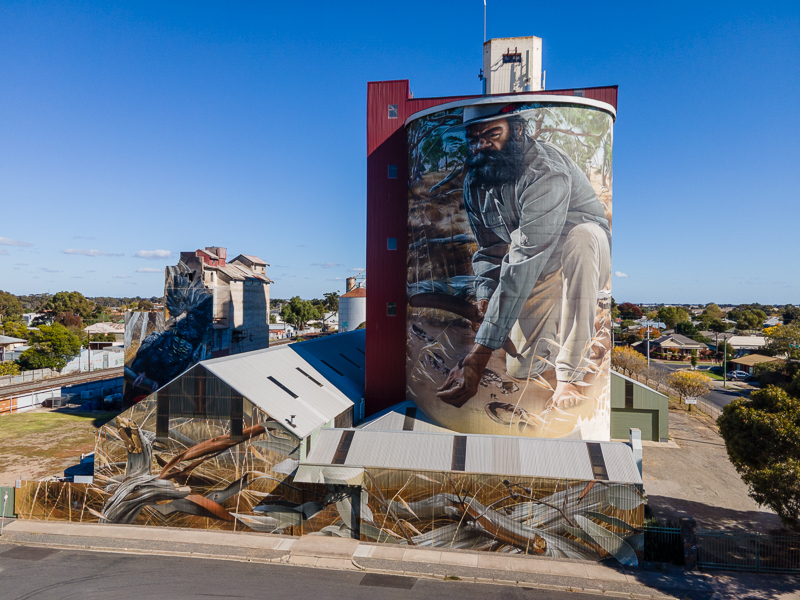
Yangga Dyata - Walking on Country is a large-scale public artwork at the former silo and flour mill complex in Horsham, western Victoria.
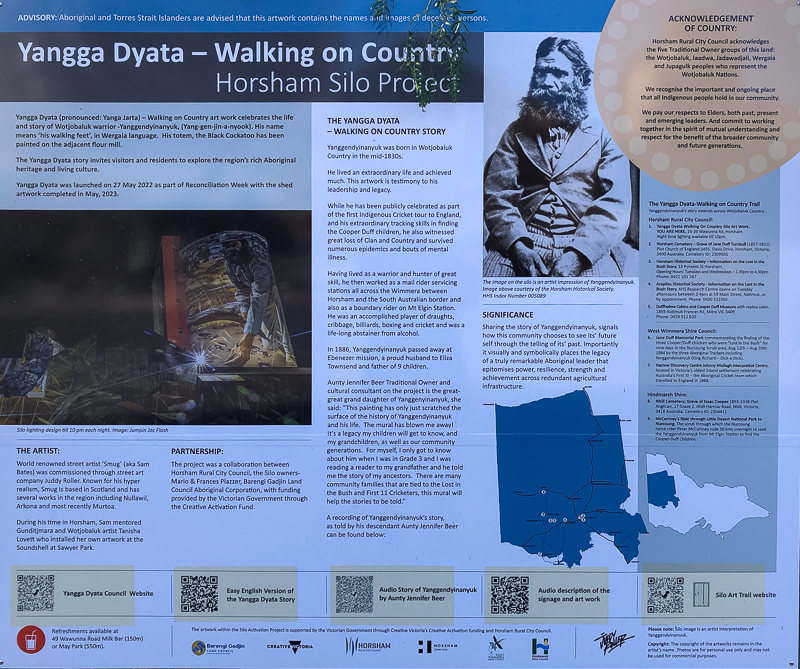
The artwork celebrates the life and legacy of Yanggendyinanyuk, a Wotjobaluk man whose life was associated with leadership, extraordinary tracking skills, cricket and the wider history of Wotjobaluk Country.
Yanggendyinanyuk's name means "His Walking Feet" in the Wergaia language.
The title Yangga Dyata translates as "Walking on Country".
Rather than being confined to a single grain silo, the artwork extends across several structures within the former agricultural complex.
The principal portrait of Yanggendyinanyuk occupies the tall silo, while an adjoining flour mill carries an enormous image of his Black Cockatoo totem.
A third artwork across the adjoining shed visually connects the two principal murals.
The result is therefore best considered as a single large art installation rather than simply one painted silo.
The original silo and flour-mill works were completed in May 2022.
Artist Smug returned in 2023 to extend and strengthen the overall composition.
The project was developed through a partnership involving Horsham Rural City Council, Barengi Gadjin Land Council Aboriginal Corporation, the owners of the silo complex and descendants of Yanggendyinanyuk.
Artwork / Subjects
Yanggendyinanyuk
The dominant subject is the monumental full-length portrait of Yanggendyinanyuk painted onto the tall silo.
The enormous human figure works particularly well on the narrow, vertical structure of the silo.
Unlike silo murals that use the entire structure as a landscape, the Horsham artwork is dominated by the human figure.
This makes facial expression, hands, clothing and posture important photographic subjects in their own right.
Tracker
Yanggendyinanyuk became particularly well known for his tracking ability.
In 1864, he assisted in the search for the Cooper-Duff children, who had become lost in the Wimmera scrub.
His knowledge of Country and exceptional tracking skills contributed to the successful search for the children.
Cricketer
Yanggendyinanyuk was also one of the Aboriginal cricketers from western Victoria who travelled to England in 1868.
The tour is recognised as an important event in Australian sporting and Aboriginal history.
His story therefore extends well beyond the single event for which he is sometimes remembered.
Black Cockatoo
The adjacent former flour mill carries a huge image of a Black Cockatoo, Yanggendyinanyuk's totem.
This is not simply a decorative wildlife mural.
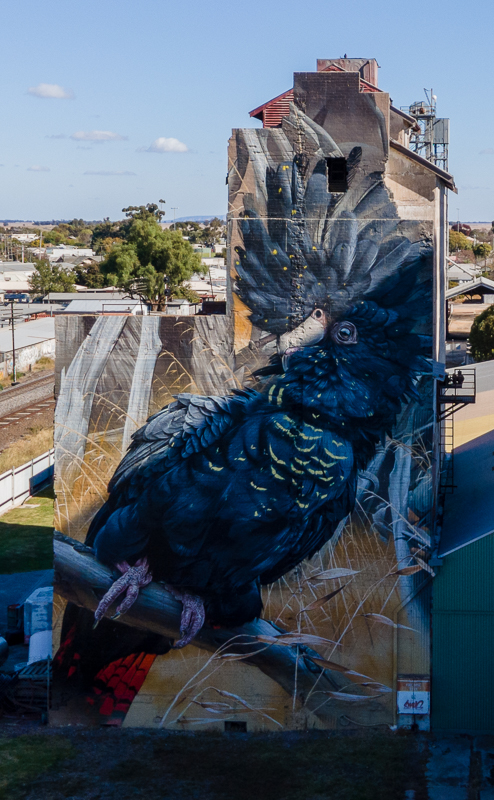
It forms an important part of the cultural story represented by the installation and establishes a visual connection between Yanggendyinanyuk and Country.
The bird is also an outstanding photographic subject.
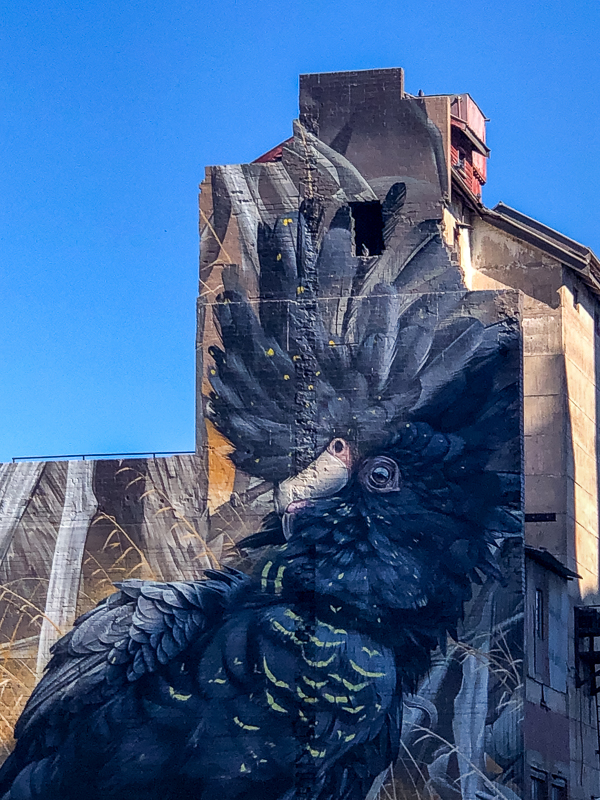
Its feathers, eye, beak and subtle tonal detail reward much closer examination than is possible from the initial wide view.
The Connecting Artwork
Smug returned to Horsham in 2023 to extend the installation onto the large shed between the principal artworks.
The purpose was to strengthen the relationship between the silo portrait and the Black Cockatoo and allow the different structures to read more successfully as one visual composition.
Photographers should therefore resist the temptation to photograph only the silo portrait.
The complete installation is the more important photographic story.
Artist
Sam Bates, better known as Smug, is an Australian-born artist internationally recognised for his large-scale photorealistic murals.
His work is characterised by highly detailed human and animal subjects rendered on an architectural scale.
The Horsham installation is particularly suited to this style.
Yanggendyinanyuk's face, clothing and figure contain considerable fine detail, while the enormous Black Cockatoo combines realistic feather structure with the scale of the former industrial building.
Smug initially completed the principal Horsham artworks in 2022 and returned in 2023 to extend the installation.
Photographing the Artwork
Horsham provides more photographic variety than might initially be apparent.
Do not simply arrive, photograph the front of the silo and leave.
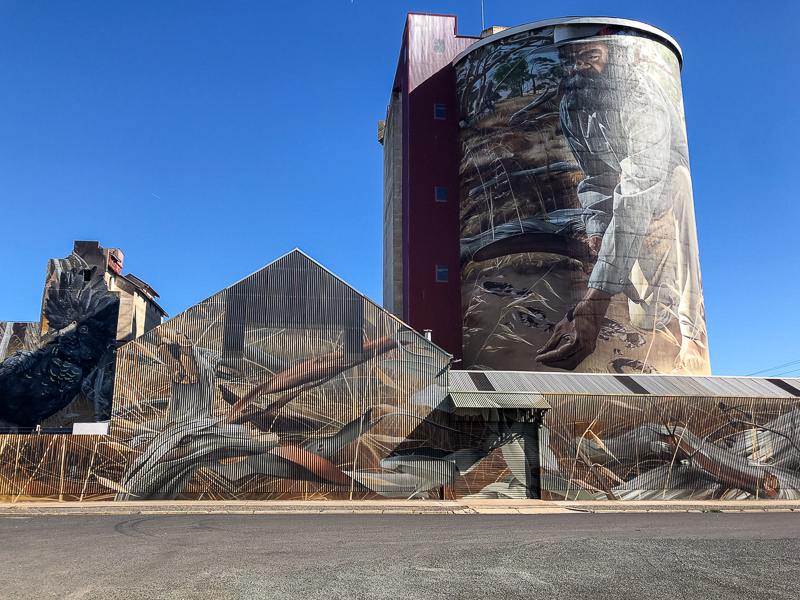
The installation should be approached at several different scales.
The Complete Installation
There is a car park / open space in front of the silo art at 35-39 Wawunna Rd, and the main view point is from this location, or an arial shot from just above it. Unfortunately, while this space is large, it has a fence behind it that precludes people from 'backing up' far enought to get the entire silo art into a normal 50mm lens shot. A wide angle lens or some photo stitching is required to shoot the silo.
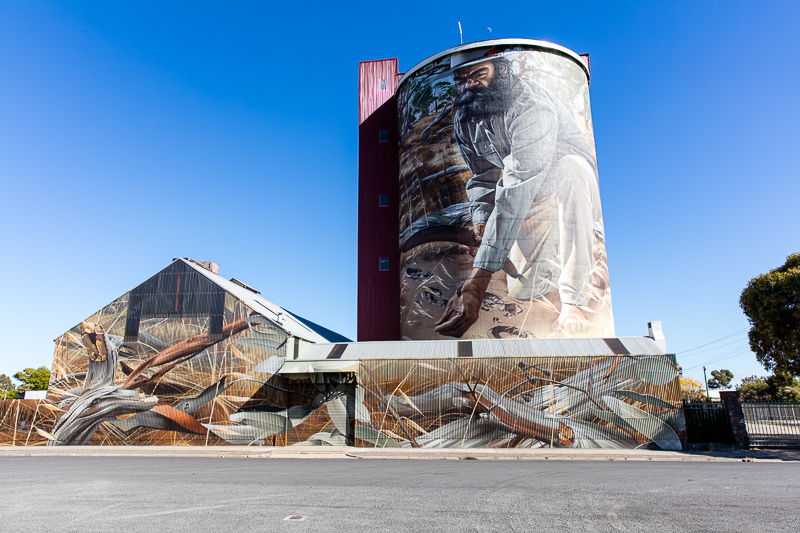
The Silo Art faces due east, and as the actual silo is rounded, it gets direct sunlight on it surface from first sun up until almost dusk.
Begin with a photograph showing the complete relationship between:
- Yanggendyinanyuk.
- The Black Cockatoo.
- The connecting shed artwork.
- The original industrial structures.
This is the photograph that best explains the physical installation.
Move around the public viewing area and examine how the individual structures overlap.
Relatively small changes in camera position can alter the apparent relationship between the silo, shed and flour mill.
Yanggendyinanyuk Portrait
After recording the complete installation, concentrate on Yanggendyinanyuk.
Make both a complete portrait and tighter photographs of:
- The face.
- Eyes and expression.
- Hands.
- Clothing.
- Individual areas of paint and surface texture.
A telephoto lens is particularly useful for these details.
Black Cockatoo
Treat the Black Cockatoo as a major artwork rather than as a secondary detail.
First photograph the complete bird within the architecture of the flour mill.
Then look for tighter compositions concentrating on:
- The eye.
- Beak.
- Individual feathers.
- Changes in colour.
- The relationship between paint and the building surface.
Connecting Artwork
The 2023 extension is particularly important when photographing the complete site.
Look for compositions in which it visually carries the viewer from Yanggendyinanyuk towards the Black Cockatoo.
It can also be photographed independently as a study of the way public art interacts with industrial architecture.
Industrial Context
Include several photographs showing that the artwork occupies a former agricultural-industrial complex.
The buildings, silos, corrugated surfaces, fences and surrounding infrastructure provide context and distinguish the work from a conventional painted wall.
Techniques
Photo stitching.
As with many wide scenes (panoramas), you have a choice of a specialised panoramic camera like the Linhof, severely cropping a single image, or stitching several images together. I used multiple Canon 5SDR images stitched together.
Drone photography
Drone cameras, at least on those drones that do not cost a fortune, are not that good. Like small format cameras, they suffer from having a small image chip. They do wonders in terms of electronics to try and improve the quality of the image, but they are still not up to a good camera. The key advantage of a drone though is that it can get perspective that is impossible from a land based camera without a crane or hoist of some sorts. You can basically shoot a shot from 50m above your head, or 200m over the right, above a river or something.
Apple Map – Artwork and Nearby Photographic Locations
This Apple Map identifies Horsham Silo Art and five nearby Auspano photographic locations.
Mapped locations
Location
See the other sections for location information.
Access & Parking
The artwork can be viewed from the public area adjacent to Wawunna Road.
Parking is available near the artwork.
Remain within public viewing and parking areas and do not enter operational, fenced or private parts of the silo and flour-mill complex.
The site is within an urban environment, so photographers should also be aware of traffic when moving between viewpoints.
Visitors travelling with caravans, motorhomes or other large recreational vehicles should assess the available parking and turning area before entering confined spaces.
Horsham has numerous alternative parking locations, so there is little reason to force a large rig into an unsuitable position simply to photograph the artwork.
Accessibility
The principal artwork can be seen from close to the public parking and viewing area without undertaking a long walk.
This makes Horsham one of the easier silo-art locations for photographers who cannot walk substantial distances.
Useful photographs of the complete installation can be made from relatively close to the vehicle.
Photographers using wheelchairs or mobility aids should nevertheless assess individual surfaces, kerbs and road crossings when moving between alternative viewpoints.
There is no need to enter the silo complex itself to obtain useful photographs.
Best Light
Horsham Silo Art rewards both directional sunlight and softer overcast conditions.
Early Morning
Early morning is worth considering for clean, relatively quiet views of the installation.
Lower-angle light can help reveal the cylindrical form of the silo and texture within the artwork.
Middle of the Day
Strong midday light is less subtle but can still work well because of the strong graphic character of the murals.
Watch carefully for deep shadows created by adjoining structures.
The different surfaces of the silo, shed and flour mill mean that one part of the installation may be well illuminated while another is in shadow.
Late Afternoon
Late-afternoon light can give the artwork greater warmth and can emphasise texture in both the mural and the industrial surfaces.
Check the complete composition rather than judging the light from the portrait alone.
Bright Overcast
Bright overcast conditions can be particularly useful.
Soft light reduces harsh shadows between the different structures and makes it easier to record detail throughout the complete installation.
It is also excellent for tighter photographs of Yanggendyinanyuk's face and the Black Cockatoo.
Nearby Locations
Horsham Public Art
Do not leave Horsham immediately after photographing the silo.
The city contains a collection of murals, sculptures and other public artworks that can extend the photographic story beyond the single silo installation.
A self-guided public-art walk through central Horsham is a useful companion to Yangga Dyata.
Horsham Regional Art Gallery
The Horsham Regional Art Gallery provides a very different interpretation of the region's visual culture and is worth combining with the outdoor public art when time permits.
Wimmera River
The Wimmera River provides one of Horsham's principal natural photographic subjects.
Look for:
- River Red Gums.
- Reflections.
- River bends.
- Birdlife.
- Sunrise and sunset colour.
- Walking paths and bridges.
Natimuk and Mount Arapiles
Natimuk and Mount Arapiles provide a major landscape-photography contrast to Horsham's urban and public-art subjects.
Mount Arapiles is particularly worthwhile around late afternoon and sunset.
Murtoa
Murtoa combines another large Smug mural with the extraordinary Murtoa Stick Shed.
The two locations make an excellent photographic pairing because they demonstrate very different uses of the Wimmera's grain-storage heritage.
Rupanyup
Rupanyup Silo Art provides another useful stop on a wider exploration of the Wimmera Mallee Silo Art Trail.
Sheep Hills
Sheep Hills contains one of the most colourful and visually complex works on the Silo Art Trail and provides a strong contrast with Smug's photorealistic treatment at Horsham.
Nearby Auspano pages
- Murtoa Stick Shed and Silo — approximately 26 km in a straight line; road distance may be considerably longer.
- Little Desert National Park — approximately 28 km in a straight line; road distance may be considerably longer.
- Dimboola Street Art — approximately 32 km in a straight line; road distance may be considerably longer.
- Pink Lake — Loch Iel — approximately 39 km in a straight line; road distance may be considerably longer.
- Arkona Silo Art — approximately 41 km in a straight line; road distance may be considerably longer.
How to Get There
From Melbourne
Horsham is approximately 300 kilometres north-west of Melbourne.
The principal road route is via the Western Highway through Ballarat and Ararat.
Once in Horsham, travel to Wawunna Road on the northern side of the city and follow signs or navigation to the silo-art site.
From Horsham City Centre
The silo is only a short drive from central Horsham.
This makes it easy to combine the artwork with the Wimmera River, central public art and Horsham Regional Art Gallery during the same photographic visit.
From Horsham Railway Station
The artwork is within Horsham's urban area and can be reached by local road or taxi from the railway station.
Caravans, Motorhomes and Large Rigs
Horsham is a major regional centre and is much easier to navigate with a large recreational vehicle than many small silo-art towns.
Nevertheless, assess the immediate viewing-area parking before entering with a long caravan or motorhome.
If the area is busy or turning space is limited, park elsewhere and return in a smaller vehicle where practical.
Driving from the State Capital
The state capital is used as a consistent reference point. The actual route varies with the traveller's starting point, traffic, roadworks and closures.
State capital to artwork
Calculating the driving route with Apple Maps…
Distance and time are estimates and may change with conditions.
Where to Stay
Horsham is the logical base for photographing Yangga Dyata.
As one of the principal regional centres of western Victoria, it provides a broad range of hotels, motels, apartments, caravan parks, restaurants, shops and fuel.
Staying in Horsham also makes it possible to combine the silo with sunrise or sunset photography along the Wimmera River and day trips towards Murtoa, Rupanyup, Sheep Hills, Natimuk and Mount Arapiles.
Photographers travelling with caravans, motorhomes or campers have several holiday-park options around Horsham.
When travelling with a particularly large rig, confirm site length, turning room, access width and drive-through availability directly with the chosen park before booking.
Photography Recommendations
Wide-Angle Lens - e.g. 16-35mm
A wide-angle lens is useful for showing the complete installation where space is limited.
However, avoid automatically moving very close and using the widest focal length.
Doing so can exaggerate the lower part of Yanggendyinanyuk's figure, stretch the silo vertically and alter the apparent proportions of the artwork.
Standard Zoom - e.g. 24-70mm
A standard zoom is likely to be the most useful general-purpose lens.
Where sufficient working distance is available, focal lengths around 35-70mm generally produce more natural proportions than an ultra-wide lens used close to the structures.
It is suitable for:
- The complete installation.
- Yanggendyinanyuk's full figure.
- The Black Cockatoo.
- Individual structures.
- Environmental compositions.
Telephoto Lens - e.g. 70-200mm
A telephoto lens is strongly recommended.
Use it for:
- Yanggendyinanyuk's face.
- Eyes and expression.
- Hands.
- Clothing detail.
- Black Cockatoo eye and beak.
- Feather detail.
- Paint texture.
- Compressed views across the different structures.
Tilt-Shift Lens
A tilt-shift lens is not essential, but this is a location where one can be genuinely useful.
The tall vertical silo encourages photographers to tilt the camera upwards, causing the sides of the structure to converge.
With a tilt-shift lens, keep the camera body level and use upward shift to include the top of the silo.
This preserves more natural architectural proportions and can produce an excellent technically controlled record of the complete portrait.
Tripod
A tripod is useful for:
- Carefully aligned architectural photographs.
- Tilt-shift photography.
- Multi-frame panoramas.
- Blue-hour photography.
- Precisely repeating compositions at different exposures.
Circular Polarising Filter
A polarising filter can sometimes reduce glare from painted or metal surfaces and increase colour saturation.
Rotate the filter while observing the effect rather than automatically using maximum polarisation.
Drone Photography
An aerial photograph could potentially show the relationship between the silo-art complex and the surrounding Horsham urban landscape.
However, this is an urban location containing roads, buildings, private property and other people.
Before flying, check current CASA airspace and operating requirements, confirm that take-off and landing are permitted and ensure the proposed flight can comply with separation requirements from people and property.
Do not assume that a drone flight is appropriate simply because the subject is a tall structure.
Controlling Perspective
Perspective control is particularly important at Horsham because the principal artwork is a human figure painted onto a tall vertical structure.
If the photographer stands close to the silo and points an ultra-wide lens sharply upwards, Yanggendyinanyuk's proportions can become significantly distorted.
The lower part of the figure may appear disproportionately large while the head and upper silo recede into the distance.
Wherever possible:
- Move farther away from the silo.
- Keep the camera as level as practical.
- Try a focal length around 35-70mm before resorting to an ultra-wide lens.
- Use a tilt-shift lens where technically corrected verticals are important.
- Check the apparent proportions of the human figure rather than concentrating only on whether the silo fits within the frame.
The same principle applies to the Black Cockatoo.
Moving farther back and using a longer focal length generally preserves the proportions of the bird and the building more successfully than moving close with an ultra-wide lens.
Perspective does not always need to be corrected completely.
Some upward convergence can communicate the enormous scale of the artwork.
The objective is to make that convergence a deliberate compositional decision rather than an accidental consequence of standing too close.
Suggested Photographic Sequence
-
Walk around the public viewing area before unpacking all the
equipment.
Examine how the silo, shed and flour mill overlap from different positions. -
Make a complete establishing photograph.
Show Yanggendyinanyuk, the connecting artwork and the Black Cockatoo together. -
Make a perspective-controlled version.
Move farther back and use a moderate focal length, or use a tilt-shift lens if available. - Photograph Yanggendyinanyuk's complete figure.
-
Switch to the telephoto lens.
Photograph the face, expression, hands, clothing and paint detail. - Photograph the Black Cockatoo as a complete artwork.
-
Make detailed Black Cockatoo photographs.
Concentrate on the eye, beak, feathers and surface texture. -
Photograph the connecting shed artwork.
Record both the artwork itself and its relationship with the two principal murals. -
Photograph the industrial context.
Include enough of the original structures to explain where the artwork has been created. -
Look for abstract details.
Paint, corrugated metal, concrete, edges and weathered surfaces can provide useful supporting photographs. -
Walk through central Horsham.
Photograph additional public art and streetscape subjects. -
Finish at the Wimmera River.
Late afternoon or sunset along the river provides a natural landscape conclusion to a Horsham photographic visit.
How Long Should a Photographer Stay?
A casual visitor could view the silo artwork in approximately 15-20 minutes.
A photographer should allow considerably longer.
Allow approximately 45-60 minutes for a conventional photographic record of the complete installation and its principal details.
Allow approximately 1.5-2 hours for a more comprehensive session using wide-angle, standard and telephoto lenses and working carefully with perspective.
For the complete Horsham photographic experience, including the silo, public art and Wimmera River, allow approximately half a day.
One night in Horsham is worthwhile if the visit is being combined with sunset or sunrise photography, Mount Arapiles, Murtoa or other Wimmera locations.
Two nights make Horsham an excellent base for exploring a much larger section of the Wimmera Mallee.
My Priority Photographs
- Complete Yangga Dyata installation showing the silo, connecting shed and flour mill.
- Perspective-controlled complete photograph of Yanggendyinanyuk.
- Full-length Yanggendyinanyuk portrait.
- Tight photograph of Yanggendyinanyuk's face and expression.
- Eyes and facial detail.
- Hands and clothing details.
- Complete Black Cockatoo mural.
- Black Cockatoo eye and head.
- Beak detail.
- Feather detail and colour.
- Connecting 2023 artwork.
- Composition showing how the connecting artwork links the portrait and cockatoo.
- Wide environmental photograph showing the artwork within the industrial complex.
- Concrete, corrugated metal and painted-surface details.
- Photograph showing the enormous scale of the artwork with a person included for comparison.
- Interpretive signage explaining Yanggendyinanyuk and Yangga Dyata.
- Additional Horsham public art.
- Wimmera River landscape to complete the broader Horsham story.
Artwork Information
| Location | Horsham, Victoria |
|---|---|
| Artwork | Yangga Dyata - Walking on Country |
| Artist | Sam Bates - Smug |
| Original artwork completed | May 2022 |
| Extension | 2023 |
| Principal subject | Yanggendyinanyuk |
| Other principal subject | Black Cockatoo - Yanggendyinanyuk's totem |
| Theme | Wotjobaluk history, Country, leadership, resilience, cultural heritage and legacy |
| Structures | Silo, former flour mill and adjoining shed |
| Address | 35-39 Wawunna Road, Horsham VIC 3400 |
| Parking | Public parking available near the artwork |
| Access | Artwork visible from the public viewing area |
| Recommended general lens | Standard zoom - approximately 24-70mm |
| Detail lens | Telephoto - approximately 70-200mm |
| Specialist equipment | Tilt-shift lens useful but not essential for perspective-controlled photographs |
| Suggested photographic time | 1.5-2 hours |
| Horsham photographic visit | Half day to one full day |
Photography Summary
Primary subjects: Horsham silo artwork and rural streetscapes
Best light: Soft or side light retains mural colour and texture.
Suggested kit: Wide and standard zoom; polariser
Photo Subjects
Explore related Auspano photography guides by subject.
Photographer Comments & Updates
Have you photographed this location? Share your photographs, viewpoints, photography tips or recent access updates, or ask a question about visiting. When uploading your own photographs, please include your name and the date each photograph was taken. Date any access or track-condition observations; visitor reports may become outdated, so check official information before travelling.