Photographing Pink Lake (Loch Iel) Dimboola
About Pink Lake
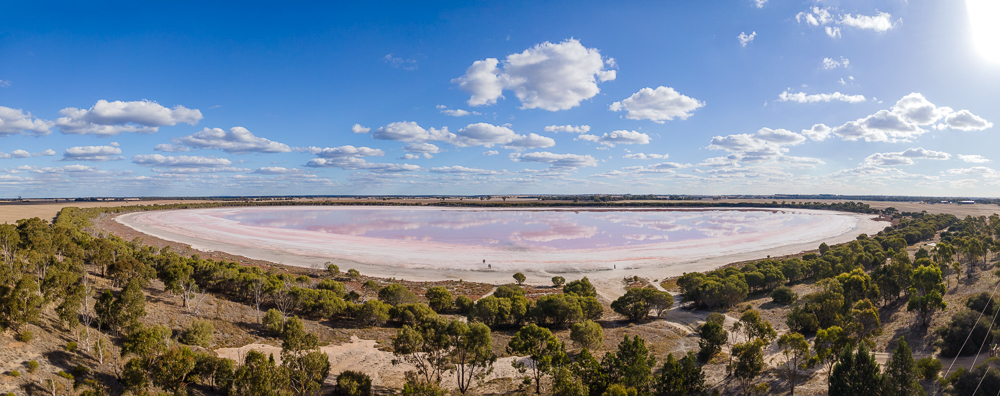
Pink Lake, historically known as Loch Iel, is a small salt lake beside the Western Highway approximately 6-7 kilometres west of Dimboola in Victoria's Wimmera region.
Despite its modest size, Pink Lake is one of western Victoria's most unusual and accessible landscape-photography locations.
The lake is famous for the pink colour that can develop in its highly saline environment. Microscopic salt-tolerant algae produce pigments that contribute to the lake's distinctive colour.
The intensity of the colour is highly variable.
Depending on rainfall, water level, temperature, cloud and seasonal conditions, the lake may appear:
- Bright pink.
- Salmon pink.
- Pale pink.
- Almost white.
- Or a mixture of pink, white and reflective water.
The strongest colour often develops after rain has replenished the lake and subsequent warmer conditions encourage biological activity.
During prolonged hot and dry conditions, the water can disappear and the lake may become predominantly white.
This variability is part of the photographic attraction.
A visit should therefore not be planned around the assumption that the lake will necessarily be vivid pink.
Even when the colour is subdued, the combination of salt, water, vegetation, Yellow Gums, Salt Paperbarks and the open Wimmera landscape provides worthwhile photographic subjects.
Pink Lake also has an interesting industrial history.
Salt was commercially harvested from the lake for many years, and remnants associated with the former salt-mining operation can still be seen around the lake.
The lake is now protected within Loch Iel (Pink Lake) Lake Reserve.
Viewpoints
Eastern Lookout / Highway Rest Area
The principal viewpoint is on the eastern side of Pink Lake, immediately beside the Western Highway.
The parking area occupies slightly higher ground and provides a broad view across the lake.
This should be the first photographic position on any visit.
Before walking down towards the lake, use the lookout to assess:
- Current water level.
- Strength and distribution of the pink colour.
- Reflections.
- Cloud conditions.
- Wind.
- Potential foregrounds.
Best subjects: wide establishing photographs, the complete lake, changing colour, reflections, vegetation around the lake and large Wimmera skies.
Suggested lenses: wide-angle and standard zoom.
Lake Foreshore
Steps descend from the rest area towards the lake foreshore.
Moving closer to the lake completely changes the photographic possibilities.
Instead of simply recording a pink lake from above, concentrate on the relationship between:
- Salt.
- Water.
- Vegetation.
- Reflections.
- The distant shoreline.
Lower camera positions can make relatively small salt formations and plants much more important within the composition.
Suggested lenses: wide-angle, standard zoom and short telephoto.
Salt and Water Boundary
One of the most productive photographic areas can be the irregular boundary between dry salt and shallow water.
Look for:
- Curves in the shoreline.
- Small pools.
- Pink and white colour transitions.
- Crystalline salt.
- Reflected clouds.
- Small areas of vegetation.
These compositions often work particularly well with a standard zoom or telephoto lens.
Vegetation and Lake
Yellow Gums, Salt Paperbarks and salt-tolerant plants around the lake provide useful foreground and framing opportunities.
Rather than photographing only uninterrupted pink water, try including vegetation to establish that the lake is part of a broader Wimmera environment.
A tree trunk or overhanging branch can also provide depth to an otherwise very flat landscape.
Telephoto Viewpoint
Pink Lake should not be regarded purely as a wide-angle location.
From the elevated eastern side, a telephoto lens can isolate small areas of the lake and remove distracting surroundings.
Look for:
- Pink colour gradients.
- Salt patterns.
- Birds.
- Reflections.
- Isolated trees.
- Water and salt layers.
Telephoto compression can produce more abstract images in which it is difficult to judge the scale of the landscape.
Former Salt-Harvesting Relics
Rusting remnants of the lake's former commercial salt-harvesting operations remain around the reserve.
Where these can be viewed from permitted visitor areas, they provide an interesting contrast between the natural salt lake and its industrial history.
They are particularly suitable for tighter compositions combining rust, salt, water and vegetation.
How I photographed the Pink Lakes
What I took - what was in my kit
I took my LowePro Backpack loaded with Canon 5DSR body, Canon 16-35mm zoom, Manfrotto 190 Tripod, polarising filter and of course a range of lens wipes, spare batteries, sunscreen and bug repellant. In this case I also took the DJI Mavic Pro 2.
Pink Lake does not require specialist photographic equipment, but carrying several focal lengths makes it possible to move beyond the obvious wide photograph of the lake.
Useful equipment includes:
- Wide-angle lens - e.g. 16-35mm for broad landscapes, foreground salt and dramatic skies.
- Standard zoom - e.g. 24-70mm for general landscape photography and more controlled compositions.
- Telephoto lens - e.g. 70-200mm for colour patterns, distant vegetation, birdlife and abstract landscapes.
- Tripod for low-light photography, panoramas, exposure bracketing and precise compositions.
- Circular polarising filter, used carefully because removing reflections may not always improve the photograph.
- Graduated neutral-density filter where the sky is considerably brighter than the lake.
- Macro lens if salt crystals and small salt-tolerant plants are important subjects.
- Long telephoto / wildlife lens if bird photography is a priority.
Techniques
Using Foreground, Middle Ground and Background
Pink Lake can appear very flat when photographed simply as a band of pink water beneath the sky.
Look for salt, vegetation or a shoreline feature close to the camera, use the lake as the middle ground and retain the distant shore and sky as the background.
This creates depth and gives the viewer a stronger sense of being at the lake rather than simply looking at a coloured surface.
Polarisation
A circular polarising filter can reduce glare from the water and may increase apparent colour saturation.
However, reflected sky and clouds can also be important parts of the composition.
Rotate the polariser while looking through the viewfinder and choose the amount of polarisation that best suits the particular photograph rather than automatically removing every reflection.
Exposure Bracketing
When the lake is relatively dark but the sky is bright, exposure bracketing can preserve detail in both.
Make several photographs at different exposures without moving the camera and combine them later if the brightness range exceeds what can comfortably be recorded in one frame.
Panoramas
The broad, relatively flat landscape is well suited to panoramic photography.
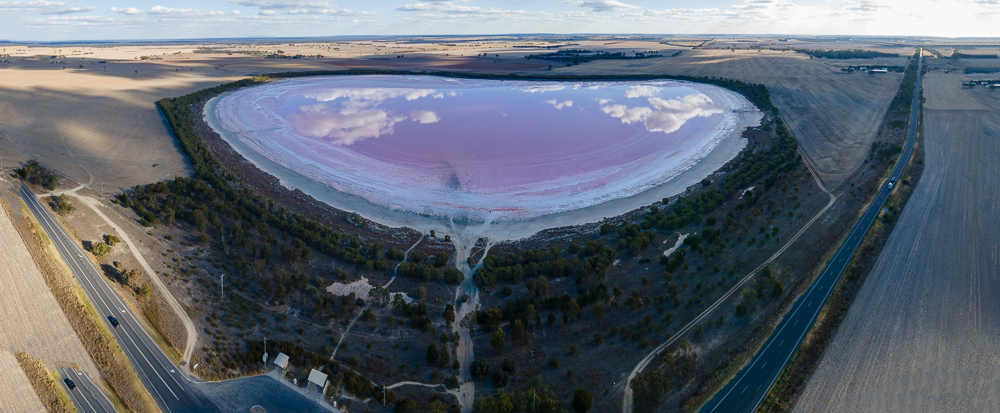
A panorama made with a standard or short telephoto lens can retain substantially more detail than simply cropping an ultra-wide photograph.
Level the tripod carefully and overlap adjacent frames sufficiently for reliable stitching.
Abstract Photography
One of the most effective ways to photograph Pink Lake is to deliberately remove the visual clues that identify it as a lake.
Use a longer lens to isolate areas containing:
- Pink water.
- White salt.
- Reflections.
- Vegetation.
- Ripples.
The resulting photograph can become an arrangement of colour, shape and texture rather than a conventional landscape.
Other things to look out for
Salt Crystals
Look closely at the salt surface rather than spending the entire visit photographing the overall lake.
Individual crystals and small formations can make excellent detail and macro subjects.
Salt-Tolerant Plants
Small specialised plants grow around this highly saline environment.
Their colour and texture can provide useful detail photographs and foreground elements.
Avoid trampling vegetation simply to obtain a better camera position.
Yellow Gums and Salt Paperbarks
The trees around the lake help place the unusual pink water within a recognisably Australian landscape.
Look for trunks, branches and foliage that can frame the lake or create layers within the composition.
Birdlife
Shallow water can attract wading birds, while Wedge-tailed Eagles have also been observed around the Yellow Gums.
Carrying a telephoto lens can turn an otherwise straightforward landscape visit into a useful wildlife-photography session.
Other Wildlife
Wildlife recorded around the reserve includes:
- Wedge-tailed Eagles.
- Kangaroos.
- Echidnas.
- Lace Monitors.
Reptiles, including snakes, may also be encountered, particularly during warmer weather.
Old Salt-Harvesting Equipment
Rusting remnants of the former salt industry provide very different subjects from the natural landscape.
Look for combinations of:
- Rust and white salt.
- Metal and pink water.
- Old machinery and vegetation.
- Industrial details.
Canola and Agricultural Landscapes
Depending on the season, surrounding agricultural country may provide additional photographic opportunities.
Bright yellow canola against the pink lake, blue sky and muted Wimmera landscape can create striking colour contrasts where suitable viewpoints are available from public roads.
Clouds
Do not assume that a cloudless blue sky will produce the strongest photograph.
Broken cloud can create softer light, reflections and variations in the apparent colour of the lake.
Nearby Locations
Pink Lake is particularly easy to incorporate into a larger photographic trip because it lies beside the Western Highway between Dimboola and Horsham.
The following locations can be combined with Pink Lake over a day, weekend or longer visit.
Dimboola
Only a few minutes east of Pink Lake, Dimboola is worth exploring rather than simply using it as the nearest service town.
Photographic subjects include the Wimmera River, historic streetscape, railway heritage, local art and the landscape around Horseshoe Bend.
Little Desert National Park
Dimboola is one of the principal gateways to Little Desert National Park.
The park provides a complete contrast to Pink Lake, with Mallee and heathland landscapes, wildflowers, wildlife, walking tracks and broad views from locations such as Pomponderoo Hill.
It is particularly worthwhile during the wildflower season.
Arkona Silo Art
Arkona Silo Art is north of Dimboola and features Smug's unusual portrait celebrating local tennis identity Roley Klinge.
The artwork provides an excellent public-art contrast to the natural landscape of Pink Lake.
Horsham
Horsham is the major regional centre east of Dimboola.
Photographic subjects include the Wimmera River, parks, urban public art and the city's large Yangga Dyata silo-art installation.
Mount Arapiles / Dyurrite
Mount Arapiles / Dyurrite rises dramatically above the otherwise flat Wimmera landscape near Natimuk.
It provides excellent opportunities for landscape photography, particularly during late-afternoon light and around sunset.
Murtoa
Murtoa combines the extraordinary Stick Shed, grain-growing history and large-scale public art.
It is particularly worthwhile for photographers interested in rural architecture and agricultural heritage.
Wimmera River
The Wimmera River can be photographed at both Dimboola and Horsham.
River Red Gums, reflections, birdlife and still water make it an excellent sunrise or late-afternoon subject.
Google Map - Pink Lake and Nearby Photographic Locations
Pink Lake can be combined easily with Dimboola, Little Desert National Park, Horsham, Arkona, Mount Arapiles and Murtoa as part of a broader Wimmera photographic trip.
Location
Pink Lake, 4669 Western Highway, Dimboola, Vic 3414 HXW6+R6 Dimboola, ///gurgling.bluff.physicists (-36.402936359364574, 141.9608143650658)
Pink Lake - officially Loch Iel (Pink Lake) Lake Reserve - is beside the Western Highway approximately 6-7 kilometres west of Dimboola in western Victoria.
Address:
Western Highway
Dimboola VIC 3414
The principal visitor area is immediately beside the highway and includes parking, a lookout/rest area, picnic facilities and toilets.
Google Maps: Pink Lake Dimboola
Techniques used
- Techniques
- Normal Style
- Long Exposures
- Nuetral Density Filters
- High Dynamic Range
- Focus Stacking
- Remove People
- Photo Stitching
- Movements
- Tombstoning
- ISO
- Shutter Speed
- Depth of Field
- Diffraction
- Moving the eye around the picture
- Golden and Blue Hour
- Infra-Red Photography
- Raw vs JPG (JPEG)
- Camera Modes
- Expose to the Right
- Sharpness
- Fore, Middle, Far
- Rule of Thirds
Kit used
How to get there
From Melbourne
Pink Lake is approximately 350 kilometres north-west of Melbourne.
Travel west via the Western Freeway and Western Highway through Ballarat, Ararat and Horsham towards Dimboola.
Continue west from Dimboola on the Western Highway for approximately 6-7 kilometres.
The Pink Lake rest area is beside the highway on the eastern side of the lake.
From Dimboola
Dimboola is the closest town and is only a few minutes from Pink Lake.
Travel west from Dimboola along the Western Highway towards Adelaide.
The lake and roadside visitor area are difficult to miss once approaching Loch Iel.
From Horsham
From Horsham, travel west along the Western Highway through Dimboola and continue for approximately 6-7 kilometres.
Horsham makes an excellent larger regional base when Pink Lake is being combined with Mount Arapiles, Murtoa, the Grampians and other Wimmera locations.
By Train
Dimboola has a railway station on the Melbourne-Adelaide rail corridor, but passenger services are limited compared with metropolitan and major regional Victorian rail routes.
Horsham also has interstate passenger rail connections.
Neither station provides convenient direct access to Pink Lake, so photographers travelling by rail will need onward road transport.
Caravans, Motorhomes and Large Rigs
Pink Lake is immediately beside the Western Highway and is considerably easier to reach with a caravan, motorhome or camper than many remote landscape locations.
The visitor area includes roadside parking, but drivers of particularly long combinations should assess the available turning and parking space before entering.
If the rest area is busy, avoid blocking circulation or attempting a difficult turn simply to park closer to the lookout.
Current Access / Conditions
Pink Lake is currently open as part of Loch Iel (Pink Lake) Lake Reserve.
The day visitor area provides parking and views of the lake, with steps providing access down towards the foreshore.
Dogs are not permitted within the reserve, and camping is not permitted at the Pink Lake day visitor area.
The colour and water level of the lake vary naturally and cannot be guaranteed.
Before travelling specifically to photograph strong pink colour, it is worth checking:
- Recent rainfall.
- Recent photographs or local reports.
- Current Parks Victoria conditions.
- Weather and cloud forecast.
Respect signs and barriers around the lake. They protect both visitors and the sensitive salt-lake environment.
Best time to visit
There is no guaranteed month in which Pink Lake will be bright pink.
The intensity of the colour varies with:
- Water level.
- Rainfall.
- Temperature.
- Cloud cover.
- Biological activity within the saline water.
Rain can replenish the lake and provide the conditions from which stronger colour subsequently develops.
During prolonged hot, dry periods the lake may fade substantially and can become almost white.
Winter into Spring
Winter rainfall can replenish the lake, while warming conditions afterwards may improve the intensity of its colour.
Spring also provides the possibility of flowering vegetation and colourful surrounding agricultural landscapes.
After Rain
Periods following substantial rain are particularly worth watching.
The lake may contain more water and biological activity may subsequently strengthen the pink colour.
Bright Overcast Conditions
Do not dismiss an overcast day.
Soft light can reduce glare, reveal subtle variations in colour and produce more even illumination across the lake.
Morning
Morning can provide relatively calm conditions, softer light and fewer visitors.
Calm water also improves reflections.
Late Afternoon
Lower-angle light can add warmth to the surrounding vegetation and emphasise texture along the salt margins.
The best light direction will depend on the season and the particular viewpoint being used.
Accessability
Pink Lake is one of the more accessible natural photographic locations in western Victoria.
The main parking and rest area is immediately beside the Western Highway and occupies elevated ground overlooking the lake.
An undercover concreted rest area provides views across Pink Lake, so useful photographs can be made without walking down to the foreshore.
This is particularly valuable for photographers with limited mobility.
Access from the visitor area down to the lake foreshore is by steps.
The foreshore itself is a natural salt-lake environment and should not be assumed to be suitable for wheelchairs or mobility aids.
Photographers unable to use the steps can still obtain broad landscape photographs from the elevated visitor area.
Where to stay
Dimboola is the closest accommodation base, while Horsham provides the widest range of accommodation and services.
Natimuk is another useful option for photographers combining Pink Lake with Mount Arapiles / Dyurrite.
Dimboola
Dimboola Riverside Caravan Park
Address: 2 Wimmera Street, Dimboola VIC 3414
Telephone: (03) 5389 1416
Website:
Dimboola Riverside Caravan Park
Riverside accommodation convenient for Pink Lake and Little Desert National Park, with caravan and motorhome facilities.
Dimboola Motel
Address: 35-43 Horsham Road, Dimboola VIC 3414
Telephone: (03) 5389 1177
Website:
Dimboola Motel
Motel accommodation close to town with useful vehicle parking.
Horsham
Horsham Riverside Caravan Park
Address: 190 Firebrace Street, Horsham VIC 3400
Telephone: (03) 5382 3476
Website:
Horsham Riverside Caravan Park
A useful base for photographers combining Pink Lake with Horsham, Mount Arapiles and other Wimmera locations.
Horsham Holiday Park
Address: 9161 Western Highway, Horsham VIC 3400
Telephone: (03) 5382 4481
Website:
Horsham Holiday Park
Provides cabins and powered and unpowered sites. The park advertises large sites and accommodation suitable for large motorhomes.
Horsham Motel
Address: 5 Dimboola Road, Horsham VIC 3400
Telephone: (03) 5382 5555
Website:
Horsham Motel
Natimuk
Natimuk Lake Caravan Park
Address: 357 Lake Road, Natimuk VIC 3409
Telephone: 0407 800 753
Website:
Natimuk Lake Caravan Park
Offers powered and unpowered sites and cabins and is particularly useful for photographers also visiting Mount Arapiles / Dyurrite.
Natimuk Hotel
Address: 65 Main Street, Natimuk VIC 3409
Telephone: (03) 5387 1300
Website:
Natimuk Hotel
Provides accommodation in Natimuk and is a convenient base for the surrounding Wimmera landscape and Mount Arapiles.
Photographic Recommendations
Wide-Angle Lens - e.g. 16-35mm
A wide-angle lens is useful for establishing photographs showing the lake within the broader Wimmera landscape.
It is particularly effective where salt, vegetation or another strong foreground can be placed close to the camera.
Avoid using an ultra-wide focal length simply because it is available. If the foreground is weak, the lake may become a narrow and insignificant band in the distance.
Standard Zoom - e.g. 24-70mm
A standard zoom is likely to be the most useful general-purpose lens at Pink Lake.
It provides sufficient width for broad landscapes while allowing the photographer to isolate areas of stronger colour without including unnecessary surroundings.
Telephoto Lens - e.g. 70-200mm
A telephoto lens is strongly recommended.
Use it to isolate:
- Strong areas of pink colour.
- Salt patterns.
- Birdlife.
- Reflections.
- Vegetation.
- Old salt-harvesting relics.
- Abstract layers of colour and texture.
Macro Lens
A macro lens can be worthwhile if conditions provide good salt crystals, small salt-tolerant plants or other fine details.
Macro photographs provide a useful change of scale from the broad lake landscapes.
Tripod
A tripod is useful rather than essential during normal daylight photography.
It becomes more valuable for:
- Panoramas.
- Exposure bracketing.
- Low-light photography.
- Long exposures.
- Carefully composed close landscapes.
Circular Polarising Filter
A circular polariser can reduce surface glare and may increase apparent colour saturation.
However, reflections can be attractive in their own right.
Rotate the filter and compare the effect before deciding how much polarisation to use.
Wildlife Lens
A longer lens can be worthwhile because the lake and surrounding Yellow Gums support a variety of bird and animal life.
Photograph wildlife from a respectful distance and avoid approaching nesting or feeding birds.
Drone Photography
Pink salt lakes can be exceptional aerial subjects because changes in salt, water and vegetation often form patterns that are difficult to appreciate from ground level.
Before flying, check current CASA airspace requirements and Parks Victoria rules applying to the reserve.
Do not assume that launching or landing a drone within the reserve is permitted.
Wildlife is another important consideration, particularly where birds are feeding or nesting.
Protecting Equipment from Salt
Salt is highly corrosive.
Avoid placing camera bags or equipment directly onto damp salt.
After photographing near the lake surface, clean salt residue from:
- Tripod feet and legs.
- Camera plates.
- Filters.
- Footwear.
- Bag bases.
Suggested Photographic Sequence
-
Begin at the elevated eastern lookout.
Assess the colour, water level, cloud, wind and strongest parts of the lake before carrying all the equipment down the steps. -
Make the establishing photograph.
Show Pink Lake within the broader Wimmera landscape. -
Use the standard zoom.
Isolate the areas showing the strongest colour. -
Switch to the telephoto lens.
Search for layers of pink water, white salt, vegetation and reflections. -
Walk down towards the foreshore.
Where access permits, look for strong foreground salt and vegetation. -
Photograph the salt-water boundary.
Search for curves, patterns and colour changes. -
Look for small subjects.
Photograph salt crystals and salt-tolerant vegetation. -
Photograph the former salt-harvesting relics.
Use them to tell the human history of the lake. -
Look for wildlife.
Check the shallows and surrounding trees for birds and other animals. -
Make a panorama.
Use a standard or short telephoto focal length to retain fine detail. -
Return to the elevated viewpoint.
Reassess the lake as the light changes. -
Finish with the strongest overall landscape.
By this stage the best colour, foreground and focal length should be apparent.
How Long Should a Photographer Stay?
A traveller stopping on the Western Highway can see Pink Lake in approximately 15-20 minutes.
A photographer should allow substantially longer.
Allow approximately 45-60 minutes for the lookout and a selection of conventional lake photographs.
Allow approximately 1.5-2 hours to work properly with several focal lengths, visit the foreshore, photograph details and look for wildlife.
Around 2-3 hours is appropriate if conditions are exceptional, particularly when the lake has strong colour, attractive reflections, interesting clouds or active birdlife.
Pink Lake does not normally justify an overnight stay by itself.
However, one or two nights in Dimboola or Horsham are easily justified when Pink Lake is combined with Little Desert National Park, the Wimmera River, Arkona Silo Art, Mount Arapiles and other regional photographic locations.
My Priority Photographs
- Wide establishing photograph showing the complete Pink Lake within the Wimmera landscape.
- Strongest available pink colour from the elevated eastern viewpoint.
- Pink water framed by Yellow Gums or Salt Paperbarks.
- Pink lake beneath an interesting cloud-filled sky.
- Reflection photograph if calm water is present.
- Salt foreground leading towards pink water.
- Pink-water and white-salt boundary.
- Telephoto compression of pink, white and vegetation layers.
- Abstract photograph containing only colour and texture.
- Salt crystals and surface detail.
- Salt-tolerant plants against the lake.
- Yellow Gum or Salt Paperbark as an environmental composition.
- Former salt-harvesting relics within the landscape.
- Tight industrial detail combining rust and salt.
- Wading bird within the coloured water if encountered.
- Wedge-tailed Eagle if encountered naturally.
- Kangaroo, echidna or other wildlife within its environment if encountered.
- High-resolution panorama of the lake.
- Seasonal agricultural landscape surrounding Pink Lake.
- Canola and Pink Lake colour contrast if seasonal conditions and a legal public viewpoint allow it.
- Visitor lookout and landscape context.