Murtoa Stick Shed and Silo
Murtoa Silo and Stick Shed, 47 Thomas Rd, Murtoa, Vic 3390
///museums.processor.slams (-36.61519850394899, 142.4732275466165)
About Murtoa Stick Shed and Silo
The small town of Murtoa has two attractions: Silo Art and its Stick Shed.
Murtoa is a small Wimmera town in western Victoria, approximately 30 kilometres east of Horsham. Established during the 1870s, the town developed as an important centre for the surrounding grain-growing district and today contains an unusually rich collection of agricultural, railway and architectural heritage.
For photographers, Murtoa has two outstanding attractions: the extraordinary Murtoa Stick Shed and the Murtoa Silo Art.
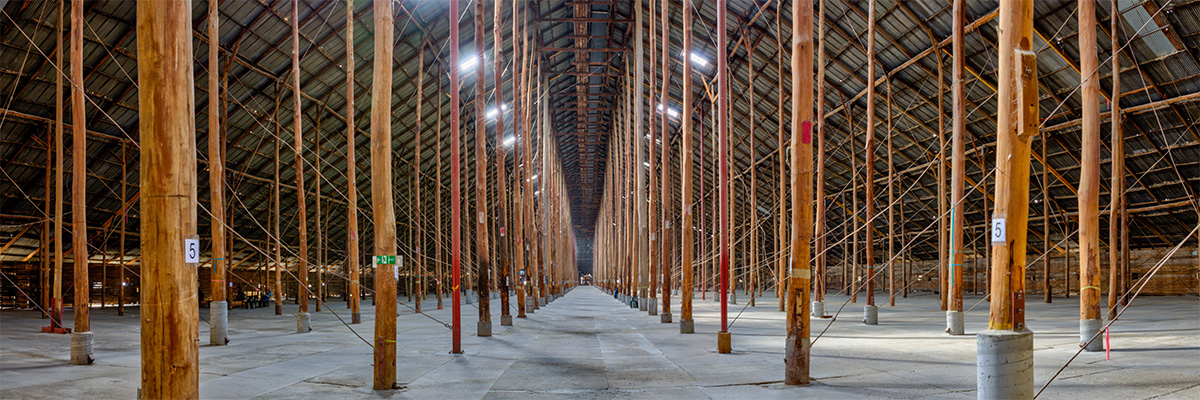
Of these, the Stick Shed is the photographic highlight. Sometimes called the "Cathedral of the Wimmera", this enormous former grain store contains seemingly endless rows of slender, unmilled timber poles supporting a vast corrugated-iron roof.
The repetition of the poles, strong perspective lines, enormous interior scale and shafts of daylight entering through the building create remarkable opportunities for architectural and abstract photography. It is one of those rare locations where the building itself provides dozens of quite different compositions without the photographer needing to move very far.
The Stick Shed was constructed during the Second World War as an emergency bulk wheat store. Built largely from materials that could be obtained despite wartime shortages, the vast structure demonstrates extraordinary Australian bush engineering and ingenuity.
It is approximately 270 metres long, 60 metres wide and almost 20 metres high, with more than 560 natural timber poles creating the forest-like interior.
The building is now nationally recognised for its heritage significance and is the only surviving example of the large emergency grain stores of this type constructed during the Second World War.
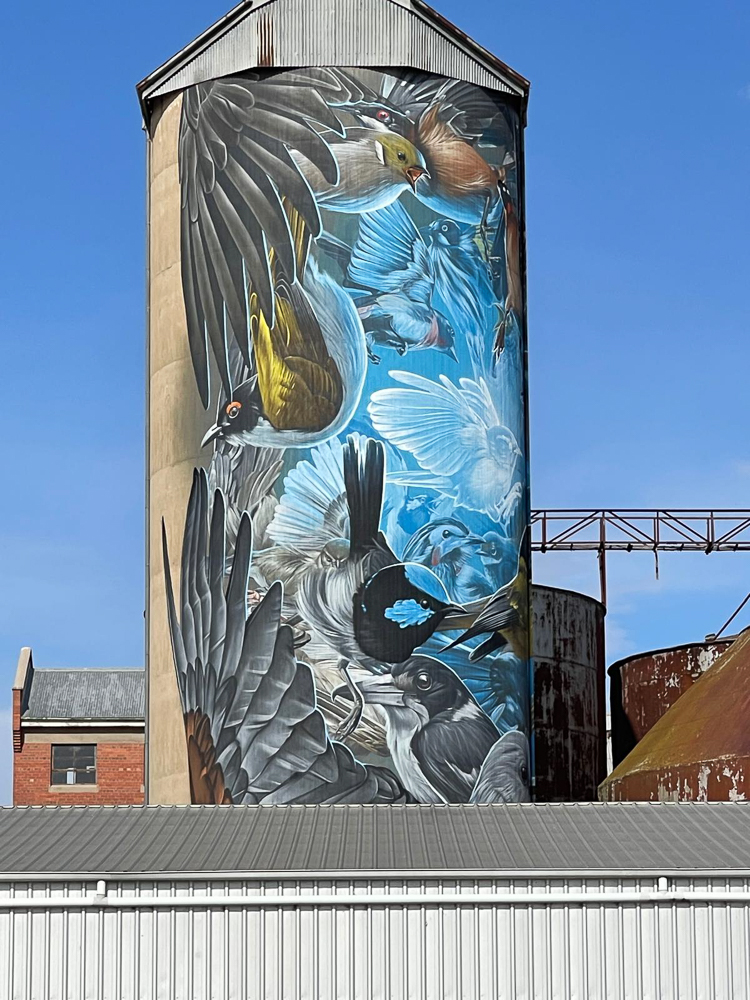
Murtoa's other major photographic attraction is its colourful silo mural. Completed in 2023 by internationally renowned Australian artist Sam Bates, known as SMUG, the artwork features a spectacular collection of native birds and incorporates important elements of Murtoa's history.
The town also offers the historic Railway Water Tower, railway station, Lake Marma, Rabl Park and a number of attractive heritage buildings, making Murtoa considerably more rewarding photographically than a simple roadside stop on the Silo Art Trail.
The Stick Shed - Official Website
The Stick Shed is an old grain storage shed. It was built during September 1941 - January 1942 from Gippsland Mountain Ash. It covers 16,000m2 and is 265m long by 60m wide. It can hold 400,000 tonnes of grain.
It is now open seven days a week, from 10am to 3pm. It costs $10 per adult enter.
The Murtoa Silo is another Smug (aka Simon Bates) painting. At night, there is a light show overlay on the silo.
How I photographed the Murtoa Stick Shed
What I took - what was in my kit
I took my LowePro Backpack loaded with Canon 5DSR body, Canon 24-70mm, Manfrotto 190 Tripod, and of course a range of lens wipes, spare batteries, sunscreen and bug repellent. I also took a DJI Mavic Air 2 drone.
The silo was photographed with the Canon 5DSR at various focal lengths, and also from the drone. In both cases, while the art is great, it has too many obstacles around it to enable it to be photographed properly. The silo yard has a large fence, which precludes taking photographs too close to the fence, and there is a large squat round building (silo?) in front of the silo art too. The drone was able to take the best photos - at ISO 100, 4.5mm, f2.8 and 1/400sec. The angle here was a trade off though. On the northern side, there was good lighting, but only one of the two silos was visible. Traveling south, more of the second silo became visible, but it was quickly covered by the third squat silo. The aspect of the two silos also means that while one has good lighting from mid-morning until dusk, the second is in shadow for almost all the day. We did not stay to see the night time show, or to see the lighting around dusk.
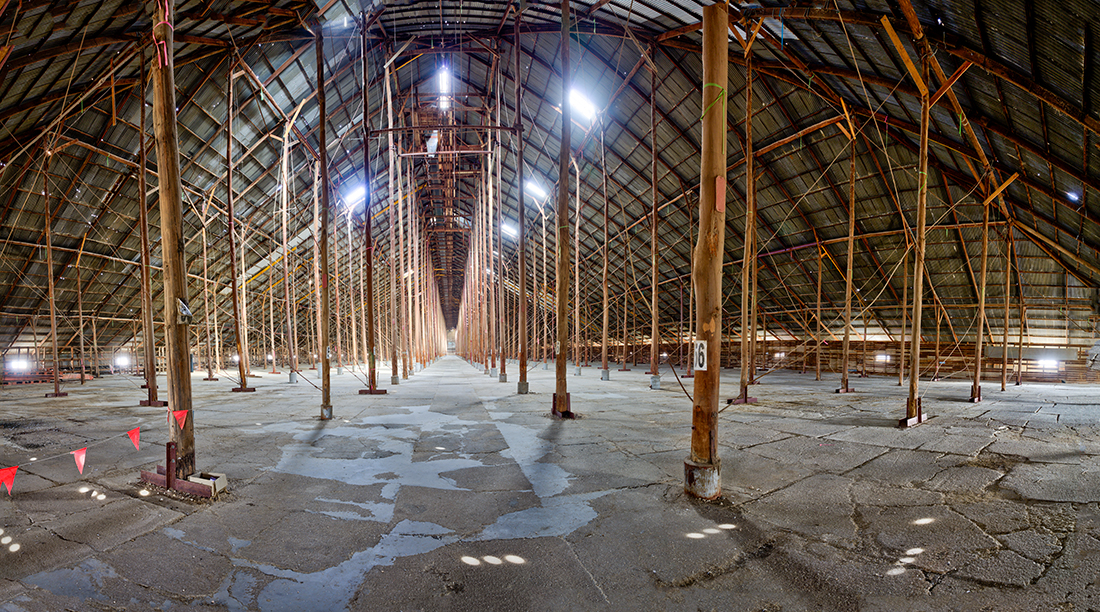
The stick shed presents a problem. It is too dark inside to photograph hand held (at least for me, and no In Body Image Stablisation (IBIS)). I shot purely on the tripod. I pumped up the ISO from my standard ISO 100 to ISO250 to make the camera a little more light sensitive, without going so far to as to increase noise. I chose f-8.0 as the aperture. This is slightly brighter than the f-10 diffraction limit to the lens on the 5DSR, while still keeping a fair bit of depth of field. I did not go with the Canon 16-35mm lens, but instead remained with the Canon 24mm-70mm. This was primarily because I was unsure of what I would encounter inside, and the 24-70 gives me more options. In hind sight I should have used the 16-35. I both photo stitched and used HDR. The photo stitching was to get the whole picture in - as it would need a lens of around 6-8mm to do it in one shot - but also to get the resolution I wanted for a 2m wide print. (which requires a minimum of 21,600pixels wide or 155MP in 1x3 panorama format). The stitching was a simple manual affair, with about a 30% overlap. Again, in hindsight, I should have used the Benro Polaris.
The HDR was an attempt to cope with the huge dynamic range inside. Basically the shed only has a dozen sky lights in its entire length. These produce extremely bright spots in what is otherwise a very dark interior. I did a three shot HDR, keeping the aperture the same, but varying the exposure by 1.5 f-stop equivalents. Some exposures were up to 5.0 seconds in duration, hence the need for a good tripod. Oh, and in case you think "I'll take a drone in there" - no drones are allowed. I did not find this out from first hand experience, but I did find it out when I tried taking a tripod in.
Techniques
Photo stitching.
As with many wide scenes (panoramas), you have a choice of a specialised panoramic camera like the Linhof, severely cropping a single image, or stitching several images together. I used multiple Canon 5SDR images stitched together.
Drone photography
Drone cameras, at least on those drones that do not cost a fortune, are not that good. Like small format cameras, they suffer from having a small image chip. They do wonders in terms of electronics to try and improve the quality of the image, but they are still not up to a good camera. The key advantage of a drone though is that it can get perspective that is impossible from a land based camera without a crane or hoist of some sorts. You can basically shoot a shot from 50m above your head, or 200m over the right, above a river or something.
Viewpoints
Stick Shed
From the outside, the Stick Shed is similar to the dozens of other large grain storage sheds that are spotted around Western Victoria. It is inside that is interesting. The shed's construction, and the fact that virtually no light gets inside, makes for an interesting spectacle and some great photographs. Jenny took some photos from the side, and both of us took photos from just off the middle of the shed. However, the money shot in this case is a view down the centre of the shed. This shows the vast length of the shed and creates a symetrical structure based around that centre line.
Murtoa Silo
The Murtoa Silo is in a private property on Thomas Rd, just to the north-east of town. However, you basically can't see anything from the road. To the north of the silo, there is a spot where you can pull off the road and drive to the railway line. From around the railway line there are several viewpoints, but none of them can be described as good. Over the railway line, the silo can be viewed from Soldiers Ave, but here the street is lined with trees, and they obstruct the view. I am told that the Silo Art is best viewed from the Water Tower Museum, but this was closed for renovation when we were there.
-
The Stick Shed
The Stick Shed should be regarded as Murtoa's premier photographic location.
Although its exterior resembles an enormous agricultural shed, walking through the entrance reveals one of the most extraordinary interior spaces in regional Australia.
Hundreds of tall, irregular timber poles disappear into the distance beneath the steeply pitched roof. The resulting perspective has often been compared with the nave of a huge cathedral.
Unlike the perfectly machined columns of a conventional building, each pole has its own shape, thickness, texture and lean. Photographing the structure therefore combines the order and symmetry of architecture with the irregularity of a natural forest.
Best for: architectural photography, symmetry, leading lines, abstracts, timber textures, light and shadow, monochrome photography and environmental portraits.
Address:
The Stick Shed
1471 Wimmera Highway
Murtoa VIC 3390GPS: approximately -36.6231, 142.4789
-
Stick Shed - Central Aisle
The classic Stick Shed composition is made looking directly along one of the long interior axes.
Positioning yourself carefully between the rows of poles creates extremely strong leading lines and one-point perspective, with the columns becoming progressively smaller until they appear to converge in the distance.
This is one of the occasions where precise camera positioning is important. Moving only a few centimetres left or right can change the relationship between dozens of poles.
Take time to position the camera so that the central aisle is genuinely centred rather than relying upon correcting the image later.
Recommended lens: approximately 16-35mm.
A focal length around 20-28mm often provides a particularly effective balance between capturing the scale of the interior and avoiding excessive ultra-wide-angle distortion.
Try both horizontal and vertical compositions. Vertical framing is especially effective at emphasising the extraordinary height of the poles and roof.
-
Stick Shed - Light and Shadow
One of the most interesting characteristics of the Stick Shed is the way daylight penetrates the otherwise dark interior.
Depending upon the weather and position of the sun, patches and shafts of bright light can illuminate individual poles and sections of the floor while the surrounding structure remains comparatively dark.
For photographers this means that a bright, sunny day is not necessarily undesirable. In fact, stronger sunlight can produce some of the building's most dramatic interior lighting.
Look for:
- Individual poles illuminated against a dark background.
- Diagonal shafts of light crossing rows of vertical poles.
- Repeated pools of light across the floor.
- Strong highlights against deep interior shadows.
- Silhouetted visitors providing a sense of scale.
Photography tip: expose carefully for the highlights. The brightest areas can be considerably lighter than the shadowed interior.
Shooting RAW and bracketing difficult exposures can be useful when the contrast range exceeds what can comfortably be captured in a single exposure.
-
Stick Shed - Timber Details and Abstracts
After making the obvious wide-angle photographs, change lenses and look for smaller compositions within the enormous structure.
The natural timber poles contain remarkable textures, knots, cracks, colours and shapes. Their irregularity contrasts with the repetitive geometry of the roof, steel bracing and concrete floor.
A 70-200mm lens is excellent here because it allows groups of poles to be visually compressed into dense patterns.
Longer focal lengths can transform the interior from an architectural photograph into an almost abstract image composed entirely of vertical lines, shapes and patches of light.
This is also an excellent location to experiment with black-and-white photography. Removing colour places greater emphasis on texture, repetition, tonal contrast and geometry.
-
Stick Shed - Including People for Scale
The Stick Shed is so large that photographs without a recognisable reference point can sometimes fail to communicate its true scale.
A single person walking down an aisle can transform the photograph. The tiny human figure immediately reveals the enormous height and length of the structure.
Rather than filling the frame with the person, allow them to become a very small element within the composition.
A figure silhouetted against a brighter doorway or illuminated section of floor can be particularly effective.
Be considerate of other visitors and obtain permission if an identifiable person becomes the principal subject of your photograph.
-
Stick Shed Exterior
Do not overlook the exterior of the building.
Its enormous length becomes apparent when photographed obliquely from one end, while the weathered corrugated iron provides useful texture and context.
Including surrounding grain infrastructure can help explain the original purpose of the building.
Best for: heritage architecture, agricultural history, documentary photography and details.
A 24-70mm lens is generally the most useful choice outside.
-
Murtoa Silo Art
Murtoa's silo mural provides a striking contrast to the restrained timber and corrugated-iron tones of the Stick Shed.
Completed by artist Sam Bates, better known as SMUG, in April 2023, the mural incorporates approximately 30 highly detailed birds.
The inspiration combines two important parts of Murtoa's history: the remarkable James Hill taxidermy collection, now housed in the nearby Water Tower Museum, and the work of Dr John Cade, who was born in Murtoa and became internationally significant for his work involving lithium in the treatment of bipolar disorder.
Best for: silo art, colour, details, architectural photography, rural heritage and night photography.
Location: Soldiers Avenue / railway precinct, Murtoa.
Photography tip: first make a relatively conventional record photograph of the complete mural and then look for tighter compositions concentrating upon individual birds, textures and relationships between the painted silo and the surrounding industrial structures.
A 24-70mm lens is ideal for the overall artwork, while a 70-200mm is useful for isolating the individual birds.
-
Murtoa Silo Art at Night
Murtoa offers something relatively unusual among Victoria's silo art locations because the artwork has also been developed as a night-time subject.
A permanent digital light treatment created by Dave Jones of Transience adds another dimension to the mural after dark.
This makes it worthwhile revisiting the silo after photographing Lake Marma around sunset.
Best for: blue-hour photography, illuminated architecture and night photography.
Use a tripod where it can be positioned safely and legally without obstructing pedestrians or traffic.
Bracket several exposures because the illuminated portions of the artwork may be substantially brighter than the surrounding night environment.
-
Murtoa Water Tower Museum
The historic 1886 Railway Water Tower is another distinctive architectural subject and forms part of the Murtoa Museum Precinct.
Inside is the extraordinary James Hill collection containing hundreds of specimens of birds and other fauna.
The museum also tells the story of Dr John Cade, providing useful context for understanding the symbolism incorporated into the silo mural.
The Water Tower contains a spiral staircase leading upwards through the structure and ultimately beneath the enormous former railway water tank.
The elevated position is also promoted locally as one of the best places from which to view the silo art.
Best for: heritage architecture, railway history, documentary photography, details and elevated views.
Current opening times should be checked before visiting because the museum is operated largely by volunteers.
-
Murtoa Railway Station and Railway Precinct
Murtoa's restored historic railway station and associated railway infrastructure provide another worthwhile collection of subjects.
Photograph details such as weathered surfaces, station architecture, railway lines, signs and the relationship between the railway precinct, water tower and nearby grain infrastructure.
Best for: railway photography, heritage architecture, details and documentary images.
Remain within areas legally open to the public and never enter or photograph from active railway tracks.
-
Lake Marma
Lake Marma provides Murtoa's principal landscape photography location and is particularly useful because it offers a very different photographic experience from the town's heritage attractions.
A walking track of approximately 2 kilometres follows the tree and reed-lined lake, with jetties, shoreline vegetation, birdlife and open views across the water.
Best for: sunrise, sunset, reflections, birds, reeds, silhouettes and tranquil landscapes.
The lake is particularly attractive when calm conditions allow colourful skies and shoreline trees to be reflected in the water.
Visit before sunrise as well as at sunset. The best position will depend upon the season and the location of the sun.
Recommended lenses: 16-35mm or 24-70mm for landscapes and a 100-500mm or similar telephoto for birdlife.
-
Rabl Park
Adjoining Lake Marma, Rabl Park contains mature trees, reeds, small bridges, jetties and landscaped areas.
The relocated historic 1896 Murtoa Railway Station footbridge spans part of the lake environment and can provide an interesting foreground or architectural element.
Best for: reflections, trees, birdlife, bridges, intimate landscapes and family/travel photography.
Early morning generally provides the quietest conditions and the greatest chance of smooth water.
Other Things to Look Out For
How I photographed the XXXX
What I took - what was in my kit
I took my LowePro Backpack loaded with Canon 5DMkII body, Canon 24-105mm zoom, Manfrotto 190 Tripod, and of course a range of lens wipes, spare batteries, sunscreen and bug repellant. I tended to shoot 28-55mm
Techniques
Nearby Locations
If a photographer has traveled 3.5 hours from Melbourne to the 'Western District', then it would be a shame not to check out: the Pink Lake, Horsham, Arkona Silo Art, the Little Desert National Park, and Murtoa 'Stick Shed'.
Murtoa is conveniently positioned for exploring several other photographic destinations in the Wimmera. These can readily be combined with Murtoa when travelling through the region.
-
Rupanyup Silo Art
Rupanyup is only a short drive east of Murtoa and forms one of the original locations on Victoria's Silo Art Trail.
The mural depicts young local sporting figures and provides a very different artistic style from the complex bird imagery at Murtoa.
Best for: public art, rural landscapes and documentary photography.
-
Minyip
Minyip is another attractive Wimmera town with a strong collection of period streetscapes and rural architecture.
It is particularly interesting for photographers attracted to historic shopfronts, railway infrastructure, old buildings and small-town details.
Best for: heritage architecture, street photography and rural documentary work.
-
Horsham
Horsham is approximately 30 kilometres west of Murtoa and is the major regional centre for this part of the Wimmera.
It provides additional accommodation, restaurants, shops and services and can readily be used as a base for photographing Murtoa.
Photographic possibilities include the Wimmera River, Botanic Gardens, historic architecture and rural landscapes surrounding the city.
-
Wimmera Farming Landscapes
The open agricultural country surrounding Murtoa should not simply be regarded as the space between recognised attractions.
Long straight roads, grain fields, isolated trees, old sheds, silos, farm machinery and enormous skies can provide some of the most characteristic photographs of the Wimmera.
Best light: early morning and the final hour before sunset.
A 70-200mm lens is especially useful for compressing distant farm buildings, trees and layers of agricultural land.
Always remain on public roads and road reserves unless permission has been obtained from the landowner.
-
Mount Arapiles
If travelling farther west, Mount Arapiles provides a dramatic contrast to the flat agricultural landscapes around Murtoa.
The prominent sandstone landform rises abruptly above the surrounding Wimmera plains and provides excellent opportunities for both elevated views and photographs of the mountain from the surrounding countryside.
Best for: sunrise, sunset, panoramic landscapes, geological details and telephoto landscapes.
Nearby Auspano pages
- Horsham Silo Art — approximately 26 km in a straight line; road distance may be considerably longer.
- Little Desert National Park — approximately 43 km in a straight line; road distance may be considerably longer.
- Dimboola Street Art — approximately 45 km in a straight line; road distance may be considerably longer.
- Arkona Silo Art — approximately 50 km in a straight line; road distance may be considerably longer.
- Pink Lake — Loch Iel — approximately 52 km in a straight line; road distance may be considerably longer.
Location
Use this section to plan location for Murtoa Stick Shed and Silo.
Apple Map – Location and Nearby Photographic Locations
This Apple Map identifies Murtoa Stick Shed and Silo and 5 nearby Auspano locations. Select a numbered marker or linked page for more detail.
Photographic locations
How to Get There
Driving from Melbourne
Murtoa is approximately 300 kilometres north-west of Melbourne. Allow approximately 3½ to 4 hours driving time depending upon the route, traffic and stops.
A convenient route is:
Melbourne → Ballarat → Ararat → Stawell → Murtoa
The final approach follows the Wimmera Highway, with the Stick Shed situated near the eastern entrance to Murtoa.
Melbourne to The Stick Shed driving directions
From Horsham
Murtoa is approximately 30 kilometres from Horsham and normally requires around 25 minutes by road.
This makes Horsham a practical alternative accommodation base for photographers who want a broader choice of hotels, restaurants and services.
Public Transport
Regional public transport services connect Murtoa with Horsham and other centres, although timetables should be checked carefully before travelling.
For photographers carrying equipment, a car remains considerably more convenient because it also provides access to the surrounding Wimmera landscapes and nearby towns.
Getting around Murtoa
Murtoa itself is compact, and several attractions around the town centre, railway precinct and Lake Marma can be explored on foot.
The Stick Shed is situated towards the eastern edge of town, so a vehicle is useful when carrying substantial photographic equipment.
Driving from the State Capital
The state capital is used as a consistent reference point. Apple Maps calculates the automobile route to this location; your actual route may vary with your starting point, traffic, roadworks and temporary closures.
State capital to destination
Calculating the driving route with Apple Maps…
Distance and travel time are Apple Maps estimates and may change with the route and current conditions.
Current Access / Conditions
There are no known issues with getting to this location.
Best Time to Visit
Autumn - March to May
Autumn provides comfortable temperatures and generally pleasant conditions for walking around Murtoa.
Agricultural landscapes around the town can contain warm straw, gold and ochre tones, which work particularly well during low-angle morning and evening light.
Good for: Stick Shed, silo art, Lake Marma, rural landscapes and architecture.
Winter - June to August
Winter can be particularly rewarding for photographers because changing weather systems often produce more interesting skies than the consistently clear conditions sometimes encountered in summer.
Softer daylight can also be helpful when photographing the exterior of the silo mural and heritage buildings.
Good for: dramatic skies, architectural photography, reflections and moody rural landscapes.
Spring - September to November
Spring is probably the best all-round period for photographing Murtoa and the surrounding Wimmera.
Agricultural country may be vividly green or developing golden grain crops, providing considerably more colour than after harvest.
Bird activity around Lake Marma can also add opportunities for wildlife photography.
Good for: Wimmera landscapes, Lake Marma, birds, silo art and general travel photography.
Summer - December to February
Summer provides long daylight hours and can produce spectacular Wimmera sunsets, but temperatures can become very hot.
The Stick Shed is particularly valuable during summer because much of the photographic experience takes place beneath its enormous roof.
Early morning and late afternoon are preferable for outdoor photography.
Good for: dramatic sunsets, harvested fields, silo art and architectural photography.
Best time of day for the Stick Shed
The Stick Shed presents an unusual situation for a landscape photographer: the middle of the day can actually be desirable.
Because the attraction is currently open from 10:00am until 3:00pm, conventional sunrise and sunset photography inside the building is generally not possible during normal admission.
Instead, concentrate on the way daylight enters the building through the roof and openings.
A sunny day can produce strong directional highlights and shafts of light, while an overcast day creates much softer and more evenly distributed illumination.
If photography is the principal purpose of the visit, I would allow at least 1½ to 2 hours inside the Stick Shed rather than treating it as a quick sightseeing stop.
Accessibility
The Stick Shed
The Stick Shed is one of Murtoa's more accessible major attractions. Current regional visitor information specifically identifies the attraction as catering for people who use wheelchairs and for visitors who use walking frames or other mobility aids.
The enormous interior is principally constructed over a concrete slab, allowing much of the experience to be enjoyed without negotiating the steep tracks, sand or rough terrain commonly encountered at landscape photography locations.
Visitors with particular mobility requirements should nevertheless contact the Stick Shed before travelling to confirm the most suitable parking, entrance and current internal access arrangements.
Telephone: 0434 227 921
The Stick Shed - Official Website
Murtoa Silo Art
The Murtoa Silo Art is an outdoor attraction that can be viewed from the surrounding public areas without requiring a substantial walk.
The most suitable viewing position will depend upon individual mobility, parking availability and the photograph required. Some surrounding surfaces and roadside areas may be uneven.
Lake Marma and Rabl Park
Lake Marma and Rabl Park contain formed paths, lawns, picnic areas and seating, but individual sections of the approximately 2 kilometre lake circuit may vary in surface and accessibility.
Photographers with reduced mobility do not need to complete the entire circuit to obtain worthwhile photographs. Several views of the lake, shoreline vegetation and sunset can be obtained from the developed park areas close to Lake Street.
Water Tower Museum
Visitors should be aware that the historic Water Tower includes a spiral staircase to its upper levels.
Anyone for whom stairs present difficulty should contact the Murtoa Museum before visiting to establish which parts of the precinct can be accessed comfortably.
Photography with Limited Mobility
From a photographer's perspective, Murtoa is particularly attractive because several of its best subjects can be photographed without long bushwalks.
The Stick Shed, silo art and developed sections of Lake Marma should therefore be considered the most suitable starting points for photographers with limited mobility.
Where to Stay
Murtoa has a small selection of accommodation, with further choices available in nearby Horsham.
Murtoa Cabins on Lake Marma
For photographers, the Murtoa Cabins on Lake Marma are particularly well positioned.
The self-contained cabins are located directly beside the lake, placing sunrise and sunset photography within walking distance of the accommodation.
This makes them my preferred Murtoa accommodation for photographers who want to make the most of the best light without having to drive before sunrise.
Address: 40 Lake Street, Murtoa VIC 3390
Murtoa Accommodation Information
Murtoa Caravan Park
Murtoa Caravan Park is also located on the foreshore of Lake Marma and is an excellent option for caravan, motorhome and camper travellers.
The park currently provides 18 powered and four unpowered sites, with drive-through arrangements possible subject to availability and approval.
Facilities include power, water, sullage, a dump point, toilets, showers, laundry and BBQ facilities.
Address: 47 Lake Street, Murtoa VIC 3390
Because the park is relatively small, contacting the operator before arriving is advisable, particularly for larger rigs.
Railway Hotel
The Railway Hotel is conveniently positioned near Murtoa's historic railway and museum precinct.
Refurbished rooms with private ensuites are available, together with the hotel's bar and dining facilities.
Address: 2 Comyn Street, Murtoa VIC 3390
Horsham
Photographers wanting a larger choice of motels, hotels, caravan parks, restaurants and other facilities can stay in Horsham, approximately 30 kilometres away.
We stayed at the Horsham Riverside Caravan Park, and we can certainly recommend that.
The short driving distance makes it quite practical to photograph Murtoa during the day and return to Horsham in the evening, although staying in Murtoa itself is preferable if Lake Marma sunrise or the illuminated silo is part of the photographic plan.
Photography Recommendations
Murtoa is unusual because its strongest photographic subject is an interior architectural space. I would therefore adjust the normal landscape photography kit slightly when visiting.
-
16-35mm wide-angle lens
Probably the most important lens for the Stick Shed. It allows the height of the poles, roof structure and long perspective lines to be incorporated into a single frame.
-
24-70mm standard zoom
Excellent for more natural-looking architectural compositions, the exterior of the Stick Shed, Murtoa Silo Art, railway precinct and general travel photography.
-
70-200mm telephoto
Do not leave the telephoto in the car. Inside the Stick Shed it can produce some of the most interesting photographs by compressing rows of timber poles into repeating patterns.
-
Longer wildlife lens
A 100-500mm, 200-600mm or similar lens is useful if photographing birds around Lake Marma is important.
-
Tripod
A tripod can be useful in the relatively dark Stick Shed and is valuable for Lake Marma at sunrise or sunset and the silo after dark.
Because visitor and event conditions can change, check with Stick Shed staff before setting up a tripod inside, particularly when the attraction is busy.
-
Image stabilisation and higher ISO
Be prepared to photograph handheld inside the Stick Shed. Modern image stabilisation and ISO 800-1600 can be very useful when a tripod is inconvenient.
-
Exposure bracketing
Bright openings in the roof combined with the dark interior can create a very large dynamic range. Bracketing can provide useful insurance even if the final photograph is processed from a single RAW exposure.
-
Watch the verticals
The Stick Shed contains hundreds of strong vertical lines, so even a slight camera tilt can be obvious.
Use the camera's electronic level if available and consider leaving a little extra room around the composition for subsequent perspective correction.
-
Use a person for scale
A small human figure can be one of the most effective compositional elements inside the Stick Shed because it immediately communicates the enormous size of the building.
-
Look for symmetry - then deliberately break it
Begin with the obvious perfectly centred views along the aisles. Once those photographs are secured, move off-centre and explore diagonal compositions, overlapping poles and compressed details.
-
Consider black and white
The Stick Shed is exceptionally well suited to monochrome processing because its strongest visual elements are line, repetition, texture and light rather than colour.
Suggested photographic sequence
If I were photographing Murtoa specifically for an Auspano gallery, I would structure the day approximately as follows:
- Sunrise - Lake Marma: reflections, reeds, trees and birdlife.
- Morning - town and railway precinct: photograph the station, Water Tower and heritage streets while the light is still relatively low.
- 10:00am - Stick Shed: enter close to opening time and initially photograph the wide, symmetrical compositions before visitor numbers increase.
- Late morning - Stick Shed details: change to the 70-200mm and concentrate on timber textures, repeating poles, light patches and abstract compositions.
- Afternoon - Murtoa Silo Art: photograph both the complete mural and individual bird details.
- Late afternoon - surrounding Wimmera: look for grain fields, isolated trees, farm buildings and large skies.
- Sunset - Lake Marma: return to the lake for reflections and colour.
- Blue hour / night - Murtoa Silo Art: finish with the illuminated silo artwork.
How long should a photographer stay?
Murtoa can certainly be visited as a day trip or as part of the Silo Art Trail, but photographers will get considerably more from the town by staying at least one night.
An overnight stay provides access to Lake Marma at both sunset and sunrise, the silo after dark and sufficient time to photograph the Stick Shed carefully rather than rushing through it.
For a dedicated photographic visit I would allow approximately one full day and one night. Two nights would be worthwhile if Murtoa is being used as a base for Rupanyup, Minyip, Horsham and the surrounding Wimmera landscape.
My priority photographs
If time is limited, I would regard these as the essential Murtoa photographs:
- A perfectly centred wide-angle view along the Stick Shed.
- A vertical Stick Shed composition emphasising the soaring timber poles.
- A telephoto abstract compressing dozens of poles together.
- A photograph incorporating shafts or patches of sunlight inside the shed.
- A photograph containing a small human figure to demonstrate scale.
- The complete Murtoa bird silo mural.
- A telephoto detail of several individual birds on the silo.
- The illuminated silo after dark.
- Lake Marma at either sunrise or sunset.
- A rural Wimmera landscape outside town during golden-hour light.
Murtoa deserves considerably more attention from photographers than its size might suggest. The silo art is impressive, Lake Marma provides useful landscape opportunities and the railway precinct is historically interesting, but the Stick Shed is the reason I would make a special photographic journey to Murtoa.
Its combination of monumental scale, rough natural timber, extraordinary repetition, strong perspective and constantly changing interior light makes it one of the most unusual architectural photography locations in Victoria.
Suggested Photographic Sequence
Work through the location in an order that makes the best use of changing light and conditions.
How Long Should a Photographer Stay?
Allow enough time to photograph the location in more than one light or weather condition where practical.
My Priority Photographs
Use this section for the practical photographic shot list for the location.
Photo Subjects
Explore related Auspano photography guides by subject.
Photographer Comments & Updates
Have you photographed this location? Share your photographs, viewpoints, photography tips or recent access updates, or ask a question about visiting. When uploading your own photographs, please include your name and the date each photograph was taken. Date any access or track-condition observations; visitor reports may become outdated, so check official information before travelling.